# cor
[](https://crates.io/crates/cor)
[](https://github.com/alexsavio/cor-cli/actions/workflows/ci.yml)
Colorize JSON-structured log lines from stdin.
`cor` reads newline-delimited JSON log entries from stdin and prints colorized,
human-readable output to stdout. Non-JSON lines pass through unchanged.
```text
2026-01-15T10:30:01.456 INFO: http.server request completed (server/router.go:118)
method: GET
status: 200
```
> **Why "cor"?** — *Cor* (pronounced /koɾ/) means "color" in Portuguese. Because naming a log colorizer "color" felt too obvious, we went with the version that sounds cooler and confuses spellcheckers.
## Demo
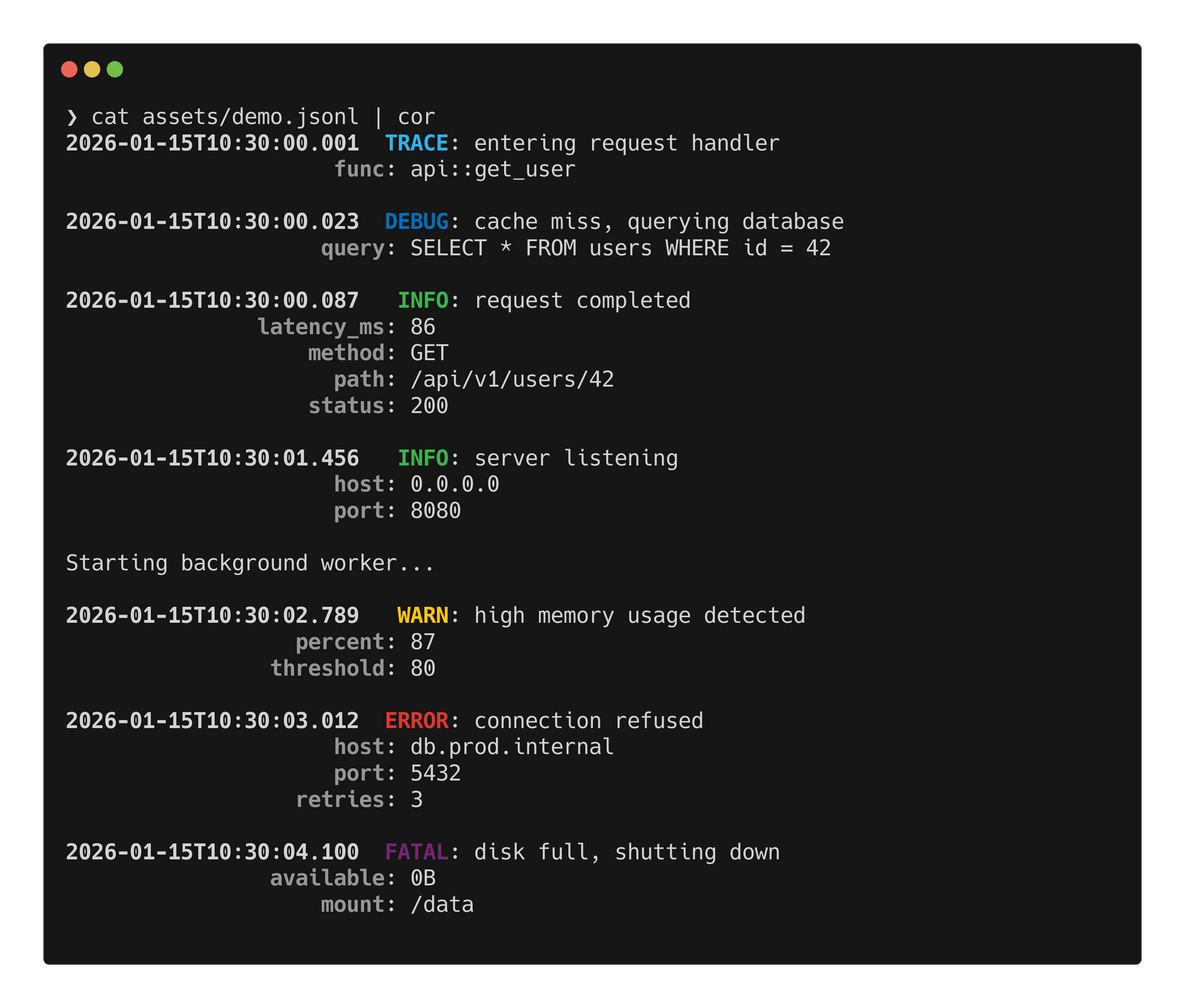
### Default output
`cat logs.jsonl | cor`
### Level filtering
`cat logs.jsonl | cor --level warn`

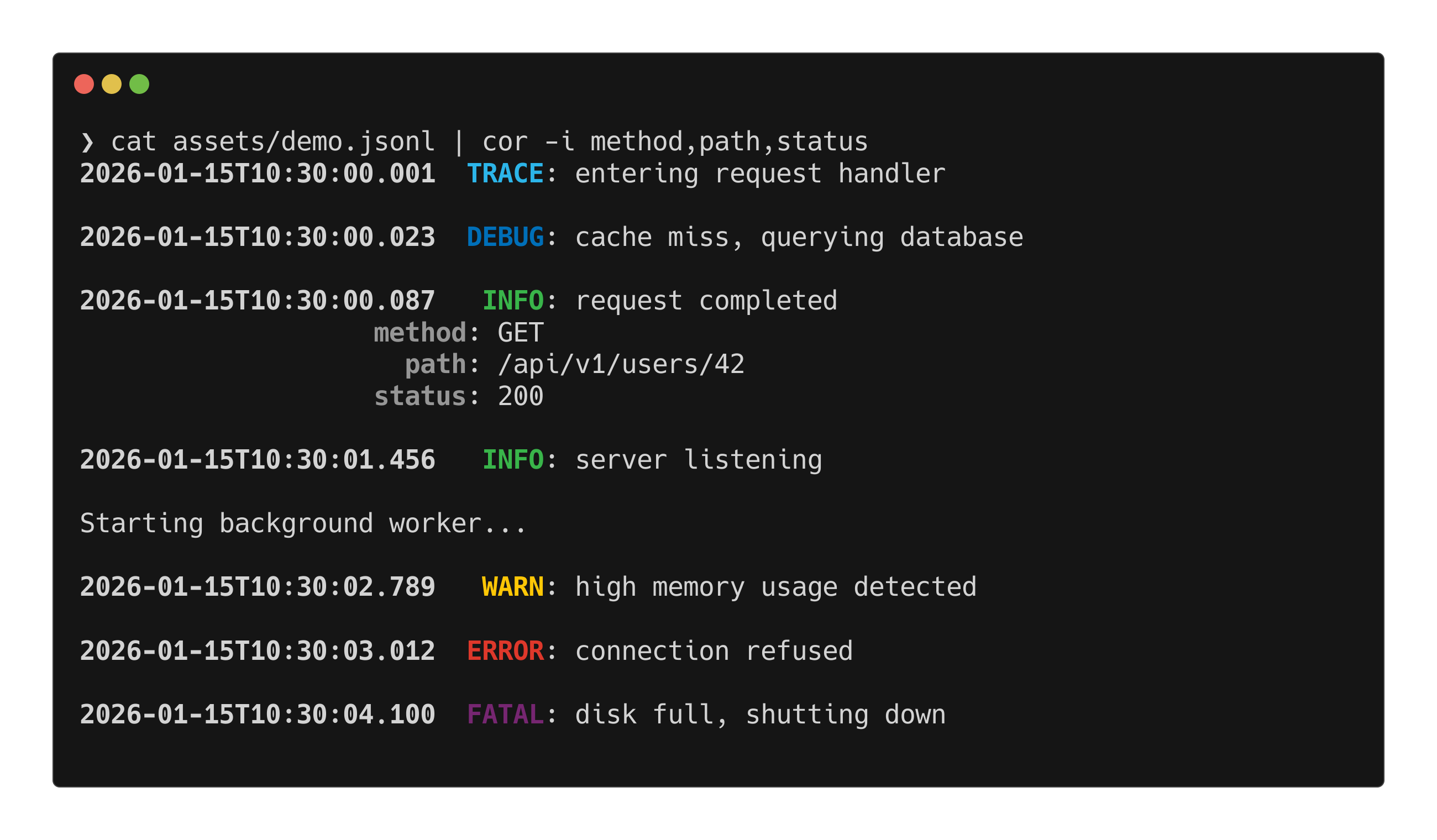
### Include specific fields
`cat logs.jsonl | cor -i method,path,status`
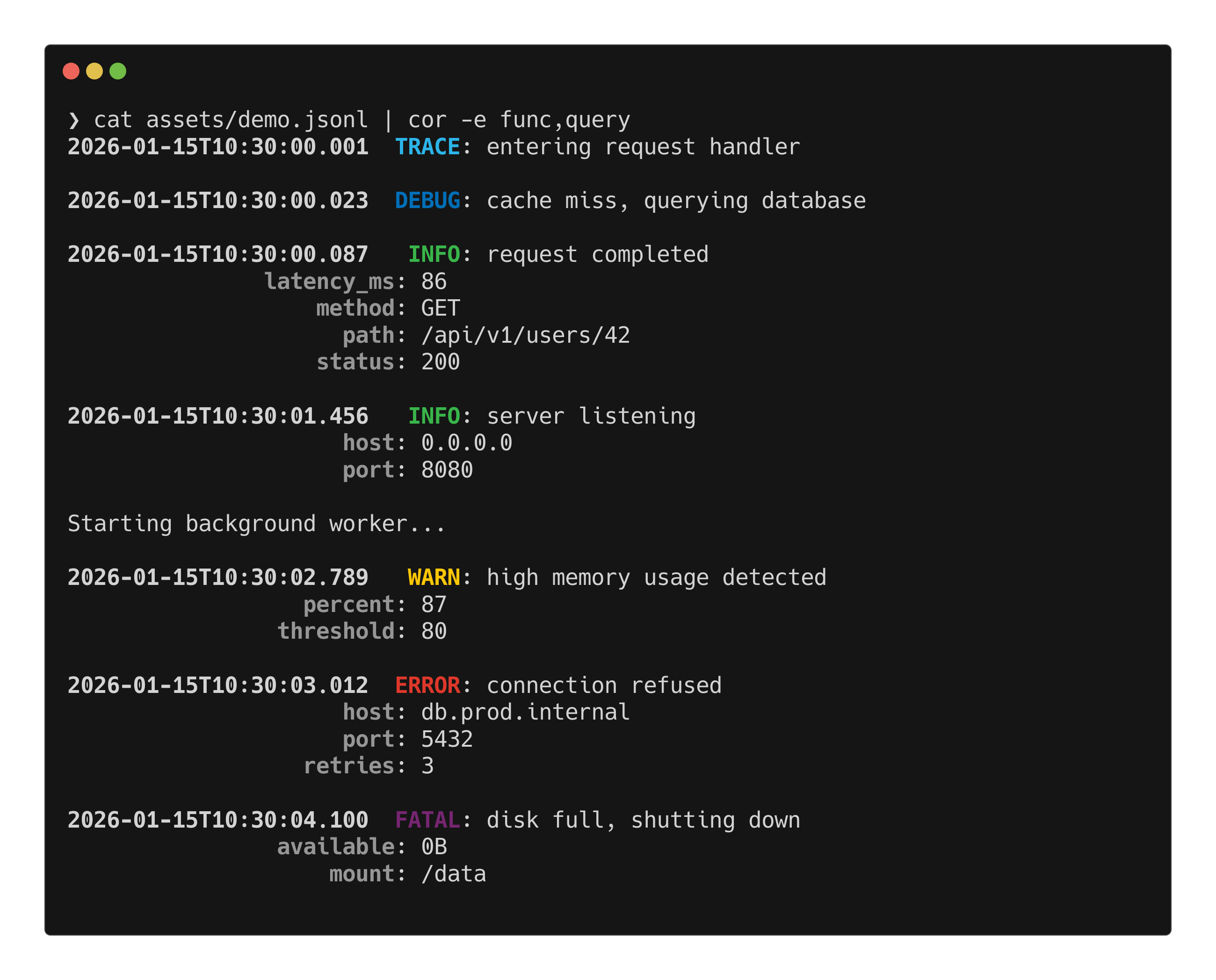
### Exclude fields
`cat logs.jsonl | cor -e func,query`
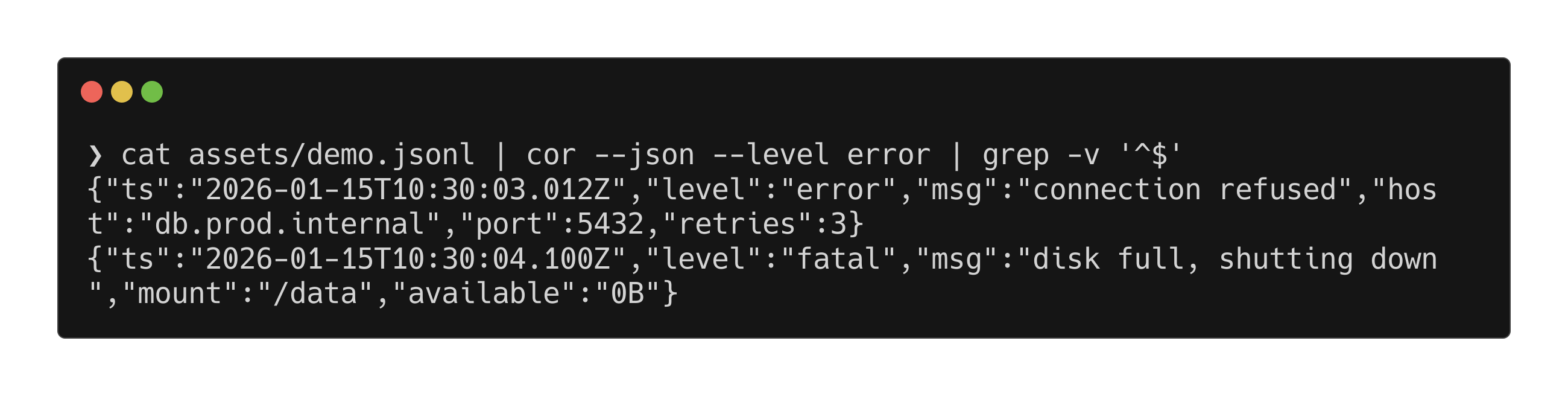
### JSON passthrough
`cat logs.jsonl | cor --json --level error`
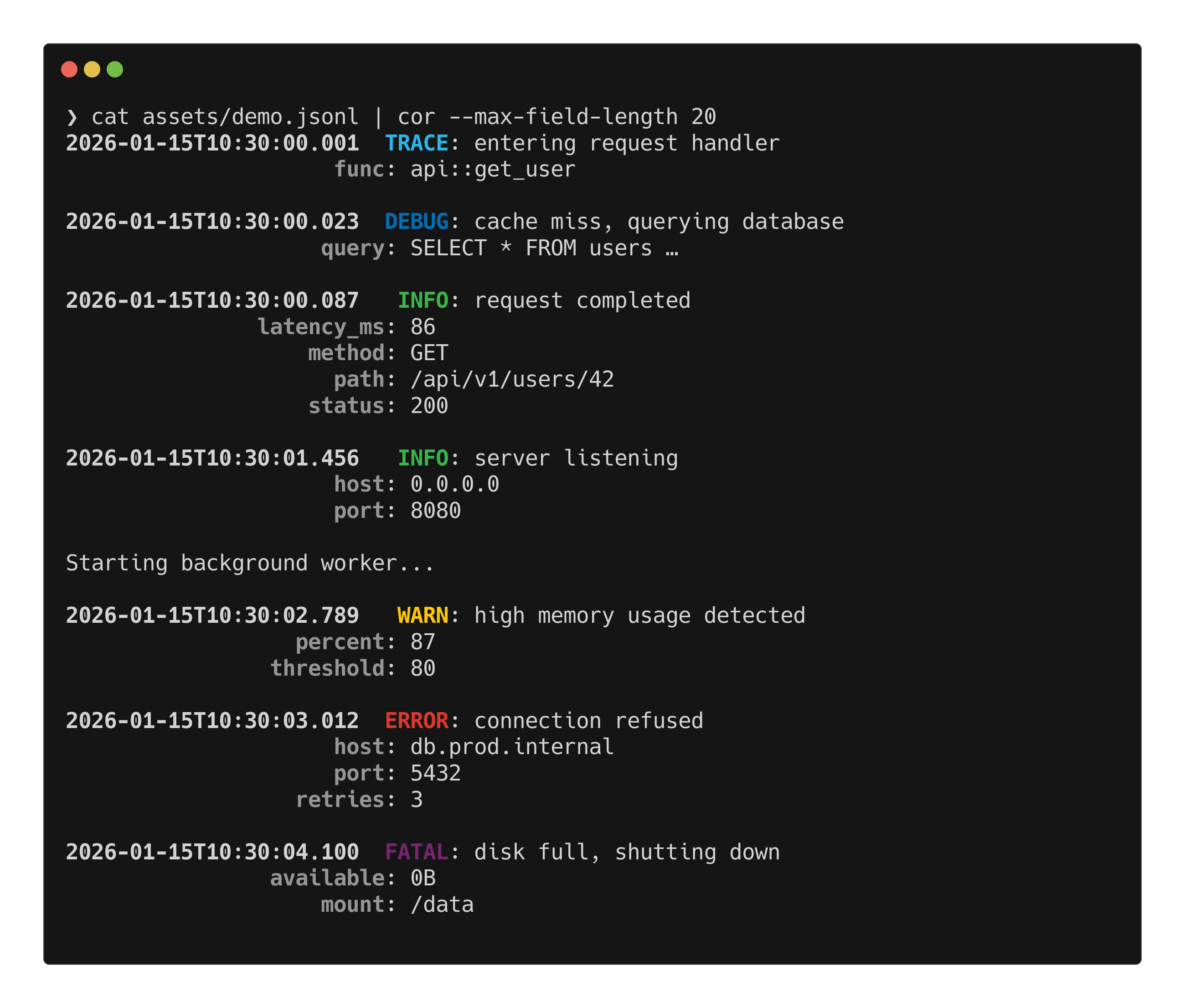
### Field truncation
`cat logs.jsonl | cor --max-field-length 20`
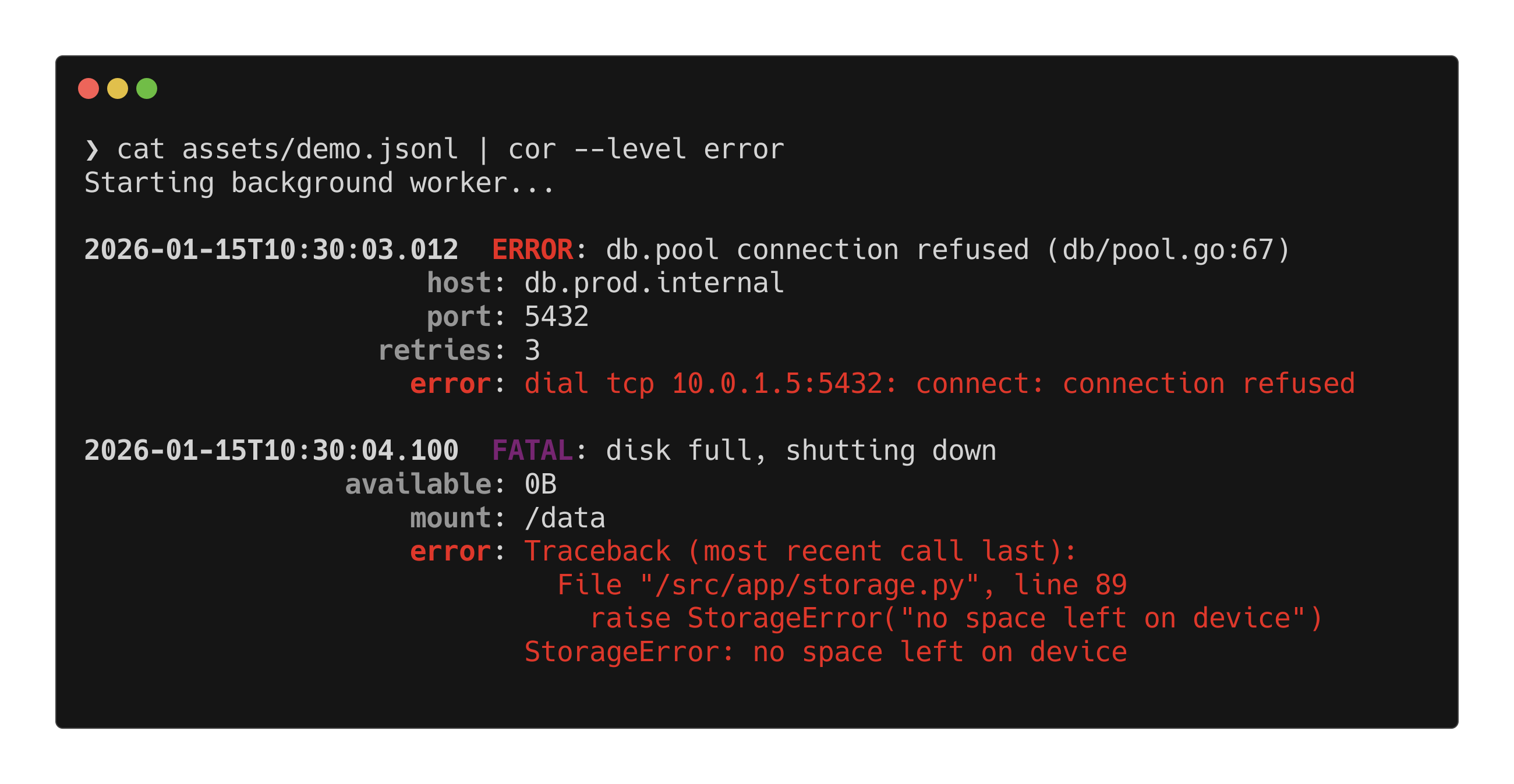
### Logger, caller, and error fields
`cat logs.jsonl | cor --level error`
## Features
- **Auto-detects fields** from logrus, zap, slog, pino, bunyan, structlog, and more
- **First-class structured fields** — logger name, caller location, and error/stacktrace get dedicated formatting
- **Embedded JSON** — handles lines like `2026-01-15 10:30:00 {"level":"info",...}`
- **Level filtering** — `--level warn` suppresses debug and info
- **Numeric levels** — bunyan/pino `30`→info, `40`→warn, etc.
- **Custom keys** — `--message-key`, `--level-key`, `--timestamp-key`, `--logger-key`, `--caller-key`, `--error-key`
- **Field filtering** — `--include-fields` or `--exclude-fields`
- **JSON passthrough** — `--json` outputs filtered JSON for piping
- **Truncation** — long values truncated at 120 chars (configurable)
- **Line gap** — configurable blank lines between entries (default: 1)
- **Config file** — `~/.config/cor/config.toml` for persistent settings
- **NO_COLOR** — respects [no-color.org](https://no-color.org) convention
- **Fast** — ~400K lines/sec, O(line-length) memory, streaming I/O
## Install
### From crates.io
```sh
cargo install cor
```
### From source
```sh
git clone https://github.com/alexsavio/cor-cli.git
cd cor-cli
cargo install --path .
```
### With SIMD acceleration (experimental)
Enable SIMD-accelerated JSON parsing via `simd-json` on supported architectures:
```sh
cargo install cor --features simd
```
**Note:** For typical small log lines (<1KB), the default `serde_json` parser is
often faster. The `simd` feature benefits large JSON payloads (request/response
bodies, stack traces) where SIMD's throughput advantage outweighs the copy overhead.
## Usage
```sh
# Pipe any JSON log stream
# Filter by level
# Custom keys
# Custom keys for logger, caller, error
# Only show specific fields
# Hide noisy fields
# Output filtered JSON (for piping)
# Disable truncation
# Compact output (no blank lines between entries)
# Extra spacing between entries
# Force colors in pipes
## Output format
```text
YYYY-MM-DDTHH:MM:SS.mmm LEVEL: logger message (caller)
key: value
other_key: other_value
error: error message or stacktrace
```
- **Timestamp** — bold `YYYY-MM-DDTHH:MM:SS.mmm` in UTC
- **Level** — colored and bold, right-justified in a 5-char field
- <span style="color:cyan">TRACE</span> · <span style="color:blue">DEBUG</span> · <span style="color:green"> INFO</span> · <span style="color:yellow"> WARN</span> · <span style="color:red">ERROR</span> · <span style="color:magenta">FATAL</span>
- **Logger** — dimmed, after level badge (e.g., `http.server`)
- **Message** — plain text
- **Caller** — dimmed, in parentheses after message (e.g., `(server/router.go:118)`)
- **Extra fields** — one per line, key right-justified to 25 chars, bold gray
- **Error** — red, after extra fields; multiline stacktraces are preserved and indented
## Log levels
These levels are recognized (case-insensitive, with aliases):
| TRACE | `trace`, `trc` | 10 |
| DEBUG | `debug`, `dbg` | 20 |
| INFO | `info`, `inf`, `information` | 30 |
| WARN | `warn`, `warning`, `wrn` | 40 |
| ERROR | `error`, `err`, `fatal_error` | 50 |
| FATAL | `fatal`, `critical`, `crit`, `panic`, `emerg` | 60 |
Custom level aliases can be defined in the config file.
## Auto-detected fields
`cor` scans for well-known field names used by popular logging frameworks:
| Timestamp | `time`, `ts`, `timestamp`, `@timestamp`, `datetime`, `date`, `t` |
| Level | `level`, `severity`, `loglevel`, `log_level`, `lvl`, `priority` |
| Message | `msg`, `message`, `text`, `log`, `body`, `event`, `short_message` |
| Logger | `logger`, `name`, `logger_name`, `component`, `module` |
| Caller | `caller`, `source`, `src`, `location`, `file`, `func`, `function` |
| Error | `error`, `err`, `exception`, `exc_info`, `stack_trace`, `stacktrace`, `stack` |
CLI flags (`--message-key`, `--level-key`, `--timestamp-key`, `--logger-key`, `--caller-key`, `--error-key`) override auto-detection.
## Embedded JSON
Lines with a text prefix before JSON are detected automatically:
```text
2026-01-15 10:30:00.123 {"level":"info","msg":"server started","port":8080}
[INFO] 2026-01-15T10:30:01Z {"level":"debug","msg":"config loaded"}
The prefix is preserved in the output after the level badge.
## Nested objects
Nested JSON objects are flattened using dot notation:
```json
{"level":"info","msg":"req","http":{"method":"GET","status":200}}
```
```text
INFO: req
http.method: GET
http.status: 200
```
## Config file
`cor` loads `~/.config/cor/config.toml` (or `$XDG_CONFIG_HOME/cor/config.toml`) if present. CLI flags always take precedence.
```toml
# Default minimum level
level = "info"
# Color mode: auto, always, never
color = "auto"
# Timestamp display format (strftime)
timestamp_format = "%Y-%m-%dT%H:%M:%S%.3f"
# Max field value length (0 = unlimited)
max_field_length = 120
# Blank lines between entries (0 = compact)
line_gap = 1
# Minimum width for field key alignment (default: 25)
key_min_width = 25
# Examples of custom timestamp formats:
# timestamp_format = "%H:%M:%S%.3f" # time only with milliseconds
# timestamp_format = "%H:%M:%S" # time only, no milliseconds
# Override field key names
[keys]
message = "msg"
level = "level"
timestamp = "ts"
logger = "logger"
caller = "caller"
error = "error"
# Map custom level names → standard levels
[levels]
"verbose" = "debug"
"critical" = "fatal"
"success" = "info"
# Custom colors for level badges
# Available colors: black, red, green, yellow, blue, magenta, purple, cyan, white
# Bright variants: bright_black, bright_red, bright_green, bright_yellow,
# bright_blue, bright_magenta, bright_cyan, bright_white
[colors]
trace = "cyan"
debug = "blue"
info = "green"
warn = "yellow"
error = "red"
fatal = "magenta"
```
## Environment variables
| `NO_COLOR` | Disables colors when set (any non-empty value) |
| `FORCE_COLOR` | Enables colors even when not a TTY |
| `TERM=dumb` | Disables colors in `auto` mode |
`--color=always` and `--color=never` override all environment variables.
## CLI reference
```text
cor [OPTIONS]
Options:
-c, --color <COLOR> Color mode [default: auto] [values: auto, always, never]
-l, --level <LEVEL> Minimum severity level [values: trace, debug, info, warn, error, fatal]
-m, --message-key <KEY> Override message field key
--level-key <KEY> Override level field key
-t, --timestamp-key <KEY> Override timestamp field key
--logger-key <KEY> Override logger name field key
--caller-key <KEY> Override caller/source field key
--error-key <KEY> Override error/stacktrace field key
-i, --include-fields <FIELDS> Only show these fields (comma-separated)
-e, --exclude-fields <FIELDS> Hide these fields (comma-separated)
-j, --json Output raw JSON instead of colorized text
-M, --max-field-length <N> Max field value length [default: 120]
-g, --line-gap <N> Blank lines between entries [default: 1]
--config <PATH> Path to config file
-v, --verbose Show parse errors for malformed JSON lines
-h, --help Print help
-V, --version Print version
```
## License
[MIT](LICENSE) — Alexandre Savio