
complex-bessel
Pure Rust implementation of complex Bessel functions based on Amos Algorithm 644 (ACM TOMS 644).




Features
- f32 & f64 — all functions accept
Complex<f64>orComplex<f32> - Complete function set — J, Y, I, K, H(1), H(2), Ai, Bi
- Consecutive orders —
_seqvariants return ν, ν+1, …, ν+n−1 in one call - Exponential scaling —
_scaledvariants prevent overflow/underflow - Negative orders — supports ν < 0 via DLMF reflection formulas (not in Amos)
no_stdsupport — 3-tier: bareno_std,alloc,std(default)
Quick start
[]
= "0.2"
use *;
use Complex;
let z = new;
let j = besselj.unwrap;
let k = besselk.unwrap;
let h = hankel1.unwrap;
// Scaled versions prevent overflow/underflow
let k_scaled = besselk_scaled.unwrap;
// Airy functions
let ai = airy.unwrap;
let ai_prime = airyprime.unwrap;
Functions
| Function | Description | Scaled variant returns |
|---|---|---|
besselj(ν, z)besselj_scaled(ν, z)besselj_seq(ν, z, n, scaling) |
Jν(z), Bessel first kind | exp(−|Im(z)|) · Jν(z) |
bessely(ν, z)bessely_scaled(ν, z)bessely_seq(ν, z, n, scaling) |
Yν(z), Bessel second kind | exp(−|Im(z)|) · Yν(z) |
besseli(ν, z)besseli_scaled(ν, z)besseli_seq(ν, z, n, scaling) |
Iν(z), modified first kind | exp(−|Re(z)|) · Iν(z) |
besselk(ν, z)besselk_scaled(ν, z)besselk_seq(ν, z, n, scaling) |
Kν(z), modified second kind | exp(z) · Kν(z) |
hankel1(ν, z)hankel1_scaled(ν, z)hankel1_seq(ν, z, n, scaling) |
Hν(1)(z), Hankel first kind | exp(−iz) · Hν(1)(z) |
hankel2(ν, z)hankel2_scaled(ν, z)hankel2_seq(ν, z, n, scaling) |
Hν(2)(z), Hankel second kind | exp(iz) · Hν(2)(z) |
airy(z)airy_scaled(z)airy_raw(z, scaling) |
Ai(z), Airy first kind | exp(ζ) · Ai(z) |
airyprime(z)airyprime_scaled(z)airyprime_raw(z, scaling) |
Ai′(z), derivative of Airy first kind | exp(ζ) · Ai′(z) |
biry(z)biry_scaled(z)biry_raw(z, scaling) |
Bi(z), Airy second kind | exp(−|Re(ζ)|) · Bi(z) |
biryprime(z)biryprime_scaled(z)biryprime_raw(z, scaling) |
Bi′(z), derivative of Airy second kind | exp(−|Re(ζ)|) · Bi′(z) |
where ζ = (2/3) z√z.
Function variants
The _seq variants (besselj_seq, besselk_seq, …) compute values at consecutive orders ν, ν+1, …, ν+n−1 in a single call and return a BesselResult that includes an Accuracy field.
The _raw Airy variants (airy_raw, biry_raw, …) similarly return an AiryResult with Accuracy.
All other functions return only the computed value without Accuracy.
Accuracy:
| Status | Meaning |
|---|---|
Normal |
Full machine precision |
Reduced |
More than half of significant digits may be lost |
Reduced is extremely rare in practice. SciPy's Bessel wrappers also silently discard the equivalent Amos IERR=3 flag by default.
To check accuracy status, use a _seq function (Bessel) or a _raw function (Airy):
use *;
use Complex;
let z = new;
let result = besselk_seq.unwrap;
assert!;
let result = airy_raw.unwrap;
assert!;
Error handling
All functions return Result<_, Error>. The four error variants are:
| Variant | Cause |
|---|---|
InvalidInput |
z = 0 for K/Y/H, n < 1 |
Overflow |
|z| or |ν| too large (or |z| too small) for finite result |
TotalPrecisionLoss |
|z| or |ν| too large for meaningful computation |
ConvergenceFailure |
Internal algorithm did not converge |
no_std support
| Cargo features | Available API |
|---|---|
default-features = false |
24 single-value functions |
features = ["alloc"] |
full API (+ 6 _seq variants) |
features = ["std"] (default) |
full API, with platform-native math |
The 24 single-value functions include 12 Bessel (J/Y/I/K/H(1)/H(2) × unscaled/scaled) and 12 Airy (Ai/Ai'/Bi/Bi' × unscaled/scaled/raw).
# Bare no_std — no allocator needed:
= { = "0.1", = false }
# no_std + alloc — full API:
= { = "0.1", = false, = ["alloc"] }
Accuracy & performance
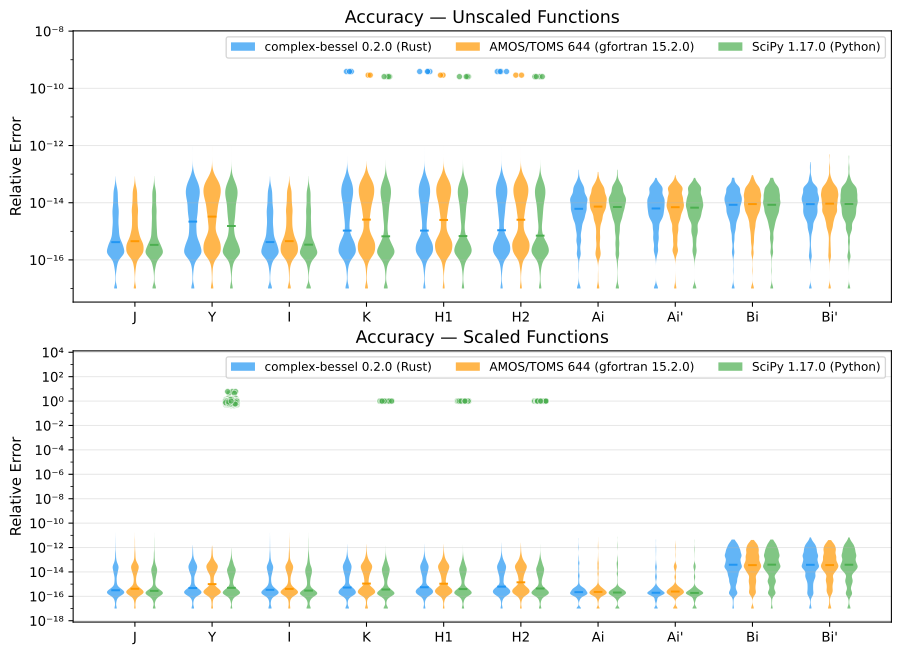
Precision of complex-bessel (Rust), AMOS/TOMS 644 (Fortran), and SciPy (Python) across all functions.
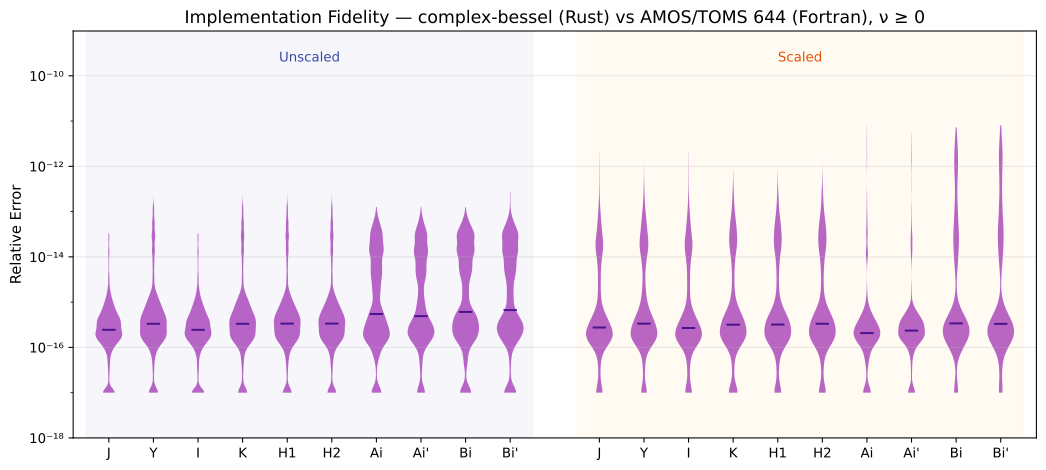
Since this library is a Rust translation of AMOS/TOMS 644, the two should produce nearly identical results.
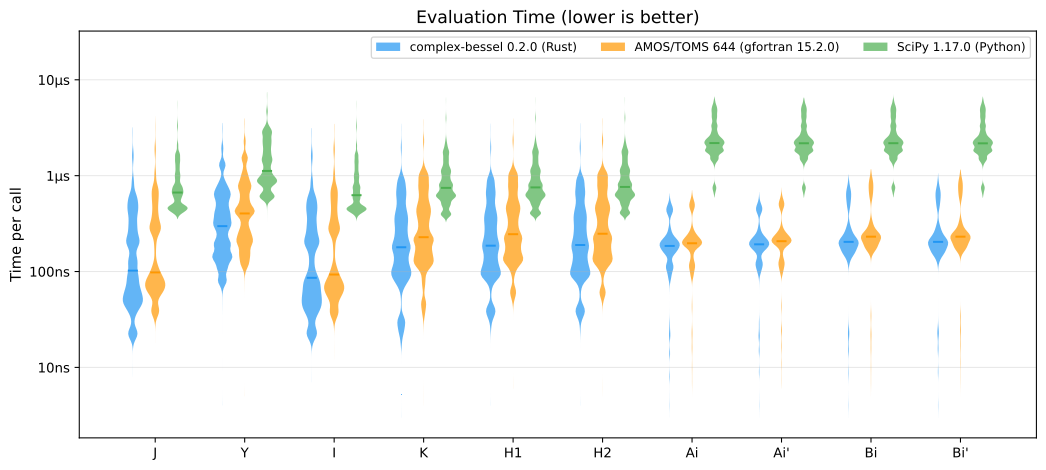
Median evaluation time per function call. On average, 19% faster than AMOS (Fortran) and 8× faster than SciPy (Python).
For methodology, datasets, and full benchmark results, see the test repository.
License
Licensed under either of
- Apache License, Version 2.0 (LICENSE-APACHE or http://www.apache.org/licenses/LICENSE-2.0)
- MIT License (LICENSE-MIT or http://opensource.org/licenses/MIT)
at your option.