
complex-bessel
Pure Rust implementation of complex Bessel functions based on Amos Algorithm 644 (ACM TOMS 644).


Features
- f32 & f64 — all functions accept
Complex<f64>orComplex<f32> - Complete function set — J, Y, I, K, H(1), H(2), Ai, Ai′, Bi, Bi′
- Consecutive orders —
_seqand_seq_intovariants evaluate at orders ν, ν+1, …, ν+n−1 in one call - Exponential scaling —
_scaledvariants prevent overflow/underflow - Negative orders — supports ν < 0 via DLMF reflection formulas (not in Amos)
no_std— no allocator needed; only theVec-returning_seqvariants requirestd
Accuracy & performance
Relative error against mpmath for complex-bessel (Rust), Amos TOMS 644 (Fortran), SciPy (Python), and SpecialFunctions.jl (Julia).

Evaluation time per call.

The charts are for f64. The test repository has the methodology, full results, and f32 accuracy.
Quick start
[]
= "0.5"
use *;
use Complex;
let z = new;
let j = besselj.unwrap;
let k = besselk.unwrap;
let h = hankel1.unwrap;
// Scaled versions prevent overflow/underflow
let k_scaled = besselk_scaled.unwrap;
// Airy functions
let ai = airy.unwrap;
let ai_prime = airyprime.unwrap;
Functions
| Function | Description | Scaled variant returns |
|---|---|---|
besselj(ν, z)besselj_scaled(ν, z)besselj_seq(ν, z, n, scaling)besselj_seq_into(ν, z, scaling, out) |
Jν(z), Bessel first kind | exp(−|Im(z)|) · Jν(z) |
bessely(ν, z)bessely_scaled(ν, z)bessely_seq(ν, z, n, scaling)bessely_seq_into(ν, z, scaling, out) |
Yν(z), Bessel second kind | exp(−|Im(z)|) · Yν(z) |
besseli(ν, z)besseli_scaled(ν, z)besseli_seq(ν, z, n, scaling)besseli_seq_into(ν, z, scaling, out) |
Iν(z), modified first kind | exp(−|Re(z)|) · Iν(z) |
besselk(ν, z)besselk_scaled(ν, z)besselk_seq(ν, z, n, scaling)besselk_seq_into(ν, z, scaling, out) |
Kν(z), modified second kind | exp(z) · Kν(z) |
hankel1(ν, z)hankel1_scaled(ν, z)hankel1_seq(ν, z, n, scaling)hankel1_seq_into(ν, z, scaling, out) |
Hν(1)(z), Hankel first kind | exp(−iz) · Hν(1)(z) |
hankel2(ν, z)hankel2_scaled(ν, z)hankel2_seq(ν, z, n, scaling)hankel2_seq_into(ν, z, scaling, out) |
Hν(2)(z), Hankel second kind | exp(iz) · Hν(2)(z) |
airy(z)airy_scaled(z)airy_raw(z, scaling) |
Ai(z), Airy first kind | exp(ζ) · Ai(z) |
airyprime(z)airyprime_scaled(z)airyprime_raw(z, scaling) |
Ai′(z), derivative of Airy first kind | exp(ζ) · Ai′(z) |
biry(z)biry_scaled(z)biry_raw(z, scaling) |
Bi(z), Airy second kind | exp(−|Re(ζ)|) · Bi(z) |
biryprime(z)biryprime_scaled(z)biryprime_raw(z, scaling) |
Bi′(z), derivative of Airy second kind | exp(−|Re(ζ)|) · Bi′(z) |
where ζ = (2/3) z√z.
Function variants
The _seq variants (besselj_seq, besselk_seq, …) compute values at consecutive orders ν, ν+1, …, ν+n−1 in a single call and return a BesselResult that includes an Accuracy field.
The _seq_into variants (besselj_seq_into, besselk_seq_into, …) write the sequence into a caller-provided slice and return a SeqInfo with Accuracy; they never allocate.
The _raw Airy variants (airy_raw, biry_raw, …) similarly return an AiryResult with Accuracy.
All other functions return only the computed value without Accuracy.
Accuracy:
| Status | Meaning |
|---|---|
Normal |
Full machine precision |
Reduced |
More than half of significant digits may be lost |
Reduced is extremely rare in practice. SciPy's Bessel wrappers also silently discard the equivalent Amos IERR=3 flag by default.
To check the accuracy status, use a _seq/_seq_into function (Bessel) or a _raw function (Airy):
use *;
use Complex;
let z = new;
let mut out = ;
let info = besselk_seq_into.unwrap;
assert!;
let result = airy_raw.unwrap;
assert!;
Error handling
All functions return Result<_, Error>. The four error variants are:
| Variant | Cause |
|---|---|
InvalidInput |
non-finite z or ν; z = 0 for K, H, Y (except at negative half-integer orders) and for J, I of negative non-integer order; n < 1 (empty out) |
Overflow |
|z| or |ν| too large (or |z| too small) for a finite result |
TotalPrecisionLoss |
|z| or |ν| too large for meaningful computation |
ConvergenceFailure |
internal algorithm did not converge |
Using without std
Turn off the default std feature:
= { = "0.5", = false }
All functions except the six _seq variants (which return a Vec) remain
available, and none of them allocate. Math functions then come from libm
instead of the platform library.
Improvements over Amos
- Scaled Y at large |Im z| — Amos's ZBESY drops a dominant term as an underflow (large ν, |Im z| > ~350); complex-bessel keeps it.
- No spurious overflow in K and H — double-precision ZUOIK reports
Overflowfor representable values near 1e300; complex-bessel follows the single-precision CUOIK test. - Complex division — Smith's algorithm instead of ZDIV, for better f32 accuracy.
- Airy limit in uniform expansions — at |z| ≈ 7e8–1e9 and large ν, ZUNI2/ZUNK2 use an undefined result when the Airy argument exceeds its range limit; complex-bessel evaluates the Airy function there anyway.
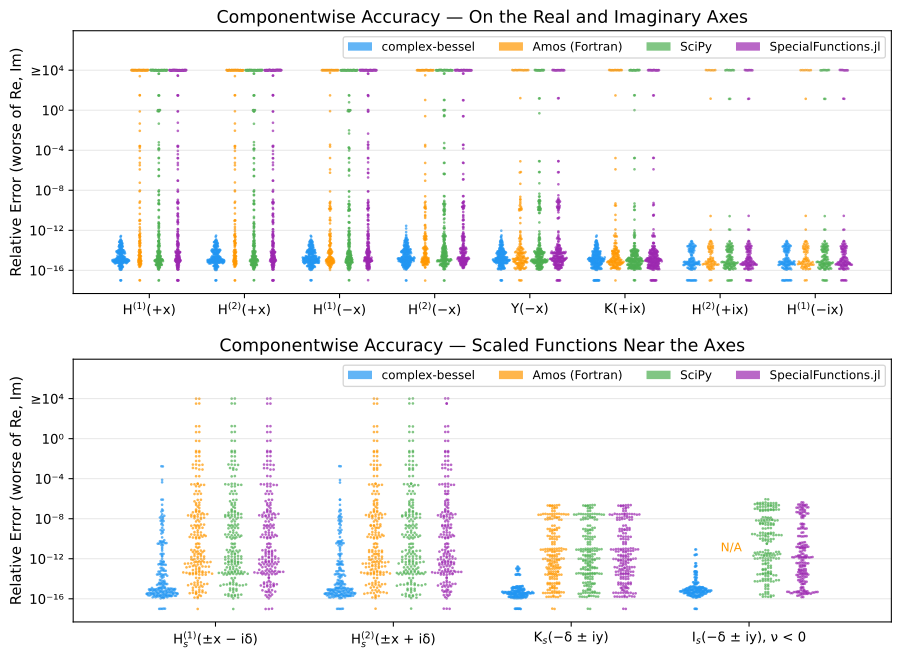
- Small components on the axes — where a value combines two real functions of very different size (e.g. H = J + iY on the real axis), Amos's small component can lose all its digits; complex-bessel recomputes it from the real functions.
- Phase of scaled K and H — in the analytic continuation, Amos's ZS1S2 rounds the phase of exp(−2i Im z), a relative error up to ε·|z|; complex-bessel applies this factor separately, keeping the phase exact.
The last two show up in the componentwise relative error (of the real and imaginary parts separately):
License
Licensed under either of
- Apache License, Version 2.0 (LICENSE-APACHE or http://www.apache.org/licenses/LICENSE-2.0)
- MIT License (LICENSE-MIT or http://opensource.org/licenses/MIT)
at your option.