
compio_dns : Supercharged DNS Resolution for the compio Ecosystem
For financial high-frequency trading, every millisecond matters. compio_dns was born from the pursuit of extreme performance.
It seamlessly integrates into the compio ecosystem, non-intrusive, allowing you to gain near-free performance acceleration without modifying any calling code.
The default compio DNS resolution relies on spawn_blocking to call the synchronous getaddrinfo system call (similar to tokio).
This occupies thread pool resources.
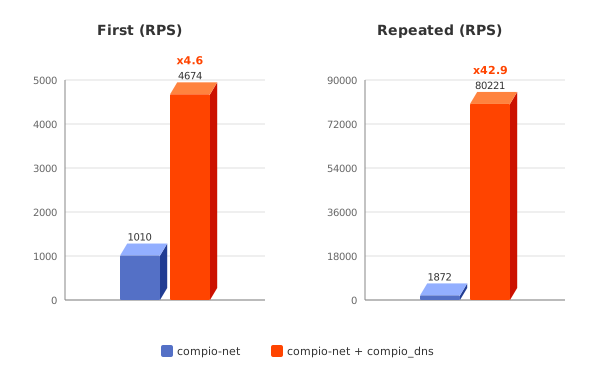
compio_dns replaces the default thread-pool-based implementation, providing true fully asynchronous resolution capabilities. Coupled with domain resolution caching, it achieves crushing performance improvements!
Usage
First, install the dependency:
Add the following to your lib.rs or main.rs:
extern crate compio_dns;
This ensures that compio_dns is compiled and registered during linking.
Finally, clean the compilation cache and rebuild with the cfg set to take effect (you must set RUSTFLAGS during compilation):
RUSTFLAGS="--cfg compio_dns "
For convenience, it is recommended to use mise to automatically set RUSTFLAGS.
For example, my mise.toml configuration is as follows:
[]
= "--cfg compio_dns {{ env.RUSTFLAGS }}"
Key Features
- Zero-Cost Abstraction: Replaces the resolver implementation at compile time via
compio-net'sresolve_set!macro, eliminating dynamic dispatch overhead. - Native Async: Built on the
compioruntime, utilizingJoinHandleand async tasks for non-blocking resolution. - Smart Cache: Built-in
scc::HashCache(32k capacity) with TTL clamping (min 60s, max 24h) and lazy eviction, significantly accelerating hot domain resolution. - System Integration: Fully supports
/etc/hostsand/etc/resolv.conf, includingsearch domainandndotspolicies, ensuring consistent system behavior. - High Availability: Queries all Nameservers concurrently (Happy Eyeballs) and handles UDP truncation via TCP Fallback mechanism.
- Custom Protocol Stack: Pure Rust implementation of DNS protocol parsing, supporting zero-copy operations.
Design Philosophy
The diagram below illustrates how compio_dns interacts with compio-net and its internal processing flow:
graph TD
    UserCode[User Code] -->|Connect| CompioNet[compio-net]
    CompioNet -->|Resolve| ExternResolve(ExternResolve Trait)
    ExternResolve -->|Static Registration| CompioResolve[compio_dns]

    subgraph compio_dns
        Cache["scc::HashCache 32k"]
        Hosts["Local hosts"]
        SystemConfig["System DNS Config"]
        UDPSocket[Async UDP Socket]
        TCPSocket[Async TCP Socket]

        CompioResolve -->|Check| Hosts
        CompioResolve -->|Check| Cache
        Cache -->|Hit| Return[Return IP]
        Cache -->|Miss| Query[Async Query]
        Query -->|Read Config| SystemConfig
        Query -->|Concurrent Send| UDPSocket
        UDPSocket -->|Truncated/Retry| TCPSocket
        UDPSocket -->|Parse Response| UpdateCache[Update Cache]
        TCPSocket -->|Parse Response| UpdateCache
        UpdateCache --> Return
    end
Tech Stack
- Runtime:
compio-runtime - IO & Buffer:
compio-io,compio-buf - Network:
compio-net - Concurrency & Cache:
scc(Scalable Concurrent Containers) - Static Initialization:
static_init - Hash Algorithm:
rapidhash - Binary Parsing:
zerocopy - Error Handling:
thiserror
File Structure
.
├── bench/                  # Benchmark data and results
├── compio_dns_test/        # Performance testing project
├── readme/                 # Documentation resources and bilingual docs
├── src/
│   ├── cache.rs            # LRU cache implementation
│   ├── error.rs            # Error definitions
│   ├── extern.rs           # compio-net integration interface
│   ├── lib.rs              # Library entry and API exports
│   ├── os/                 # System config reading (hosts, resolv.conf)
│   ├── protocol/           # DNS protocol parsing and construction
│   └── resolve.rs          # Core resolution logic
├── svg.js                  # Benchmark chart generation script
└── ...
API Reference
compio_dns is primarily invoked automatically by compio-net via extern crate, but it also exposes a few APIs for advanced usage.
use compio_dns::Resolve;
The core resolver struct.
-
Resolve::new() -> io::Result<Self>Creates a new resolver instance. Automatically loads system configuration. -
resolve.lookup(name: &str) -> io::Result<IntoIter<SocketAddr>>Performs domain resolution. Automatically handles hosts, caching, and recursive queries.
compio_dns::resolve_sock_addrs
pub async Convenience function to resolve a domain and attach a port, returning an iterator of SocketAddr.
compio_dns::DnsError
Enumerates various DNS resolution errors, such as ResolutionFailed, InvalidData, etc.
A Bit of History
In the early days of the Internet, the HOSTS.TXT file was maintained by the NIC at Stanford Research Institute (SRI). Every host on the network had to periodically download this single text file for name resolution. As the number of ARPANET hosts surged, this centralized management became unsustainable. In 1983, Paul Mockapetris invented DNS (Domain Name System), transforming domain management into a distributed hierarchical structure, solving the scalability problem once and for all. Today, compio_dns stands on the shoulders of giants, reinterpreting this ancient protocol with the asynchronous power of Rust for efficiency and elegance.
About
This project is an open-source component of js0.site ⋅ Refactoring the Internet Plan.
We are redefining the development paradigm of the Internet in a componentized way. Welcome to follow us:
compio_dns : compio 生态域名解析的超级加速
对应金融高频交易而言,每一毫秒都很重要,compio_dns 诞生于对极致性能的追求。
它能无缝集成到 compio 生态中, 非侵入式,无需修改调用代码就可以获得近乎免费的性能加速
compio DNS 解析默认依赖 spawn_blocking ,调用同步的 getaddrinfo 系统调用(类似 tokio)。
这占用了线程池资源。
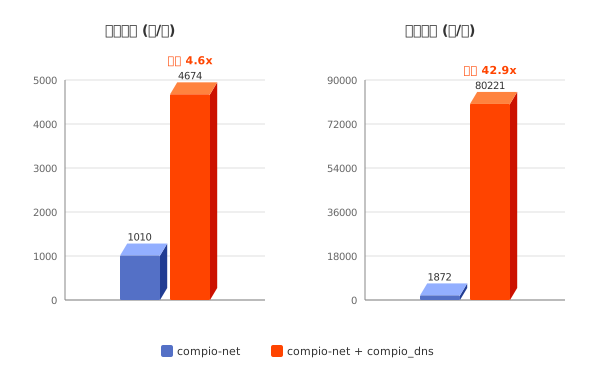
compio_dns 替换默认的基于线程池的实现,提供真正的全异步解析能力。配合域名解析缓存,实现了碾压级的性能提升!
使用
先安装依赖:
lib.rs 或 main.rs 加上:
extern crate compio_dns;
这是用来确保 compio_dns 会被编译并在链接时注册。
最后,清理编译缓存并设置 cfg 重新编译即可生效(编译时要设置 RUSTFLAGS)。
RUSTFLAGS="--cfg compio_dns "
为了方便,建议配合 mise 实现自动设置RUSTFLAGS。
比如,我的 mise.toml 配置如下:
[]
= "--cfg compio_dns {{ env.RUSTFLAGS }}"
特性介绍
- 零开销抽象:借由
compio-net的resolve_set!宏,直接在编译期替换解析器实现,无动态分发开销。 - 原生异步:基于
compio运行时构建,利用JoinHandle和异步任务实现非阻塞解析。 - 智能缓存:内置
scc::HashCache(容量 32k),支持 TTL 钳制 (最小 60s,最大 24h) 和惰性淘汰,显著加速热点域名解析。 - 系统集成:完整支持
/etc/hosts、/etc/resolv.conf,包括search domain和ndots策略,行为与系统一致。 - 高可用设计:并发查询所有 Nameserver (Happy Eyeballs),并通过 TCP 回退 机制处理 UDP 截断响应。
- 自研协议栈:纯 Rust 实现的 DNS 协议解析,支持零拷贝操作。
设计思路
下图展示了 compio_dns 如何与 compio-net 交互以及内部处理流程:
graph TD
    UserCode[用户代码] -->|连接| CompioNet[compio-net]
    CompioNet -->|解析| ExternResolve(ExternResolve Trait)
    ExternResolve -->|静态注册| CompioResolve[compio_dns]

    subgraph compio_dns
        Cache["scc::HashCache 32k"]
        Hosts["本地 hosts"]
        SystemConfig["系统 DNS 配置"]
        UDPSocket[异步 UDP Socket]
        TCPSocket[异步 TCP Socket]

        CompioResolve -->|检查| Hosts
        CompioResolve -->|检查| Cache
        Cache -->|命中| Return[返回 IP]
        Cache -->|未命中| Query[异步查询]
        Query -->|读取配置| SystemConfig
        Query -->|并发发送| UDPSocket
        UDPSocket -->|截断/重试| TCPSocket
        UDPSocket -->|解析响应| UpdateCache[更新缓存]
        TCPSocket -->|解析响应| UpdateCache
        UpdateCache --> Return
    end
技术堆栈
- 运行时:
compio-runtime - IO & Buffer:
compio-io,compio-buf - 网络:
compio-net - 并发锁与缓存:
scc(Scalable Concurrent Containers) - 静态初始化:
static_init - 哈希算法:
rapidhash - 二进制解析:
zerocopy - 错误处理:
thiserror
目录结构
.
├── bench/                  # 基准测试数据与结果
├── compio_dns_test/        # 性能测试专用项目
├── readme/                 # 文档资源与双语文档
├── src/
│   ├── cache.rs            # LRU 缓存实现
│   ├── error.rs            # 错误定义
│   ├── extern.rs           # compio-net 集成接口
│   ├── lib.rs              # 库入口与 API 导出
│   ├── os/                 # 系统配置读取 (hosts, resolv.conf)
│   ├── protocol/           # DNS 协议解析与构建
│   └── resolve.rs          # 核心解析逻辑
├── svg.js                  # Benchmark 图表生成脚本
└── ...
API 说明
compio_dns 主要通过 extern crate 方式被 compio-net 自动调用,但也暴露了少量 API 供高级使用。
use compio_dns::Resolve;
核心解析器结构体。
-
Resolve::new() -> io::Result<Self>创建新的解析器实例。会自动加载系统配置。 -
resolve.lookup(name: &str) -> io::Result<IntoIter<SocketAddr>>执行域名解析。会自动处理 hosts、缓存、递归查询。
compio_dns::resolve_sock_addrs
pub async 便捷函数,解析域名并附加端口,返回 SocketAddr 迭代器。
compio_dns::DnsError
枚举了各类 DNS 解析错误,如 ResolutionFailed, InvalidData 等。
历史小故事
在早期的互联网时代,HOSTS.TXT 文件由斯坦福研究院 (SRI) 的 NIC 维护,网络中的每台主机都需要定期下载更新这个单一的文本文件以进行名称解析。随着 ARPANET 主机数量的激增,这种集中式管理变得不可持续。1983 年,Paul Mockapetris 发明了 DNS (Domain Name System),将域名管理变成了分布式的层级结构,彻底解决了扩展性问题。今天,compio_dns 站在巨人的肩膀上,用 Rust 的异步力量重新诠释了这一古老协议的高效与优雅。
关于
本项目为 js0.site ⋅ 重构互联网计划 的开源组件。
我们正在以组件化的方式重新定义互联网的开发范式,欢迎关注: