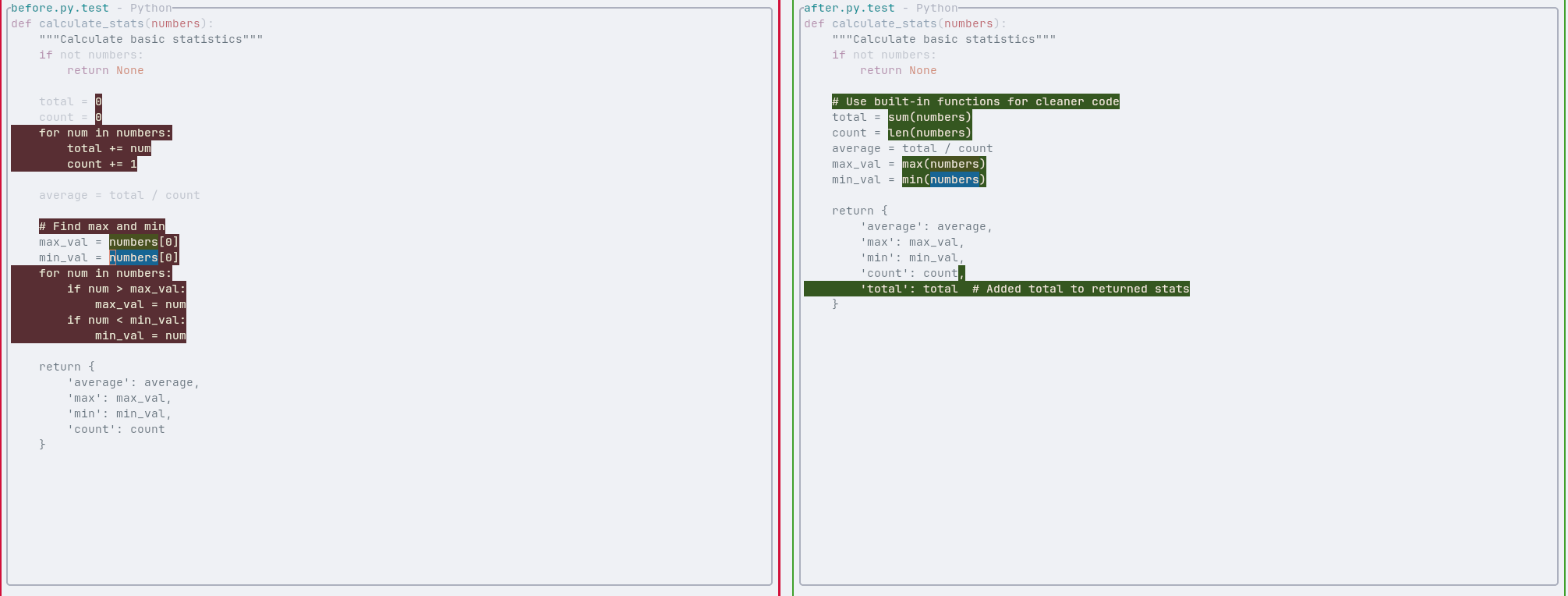
# CodeDiff
[](https://github.com/ivankovic/codediff/actions/workflows/ci.yml)
[](https://github.com/ivankovic/codediff/releases/latest)
[](https://docs.rs/codediff)
[](CONTRIBUTING.md#coverage)
[](LICENSE)
Fast, robust, syntax-aware code diffing.

# Installation
```
cargo install codediff
```
This command builds CodeDiff from source. You need a C compiler on `PATH` and a Rust toolchain,
edition 2024 or later (rustc 1.88 or later). The build compiles every tree-sitter grammar from C.
The first `cargo install` takes a few minutes, because of this and the `lto = "fat"` release
profile.
Pre-built binaries for Linux, macOS (Intel and Apple Silicon), and Windows are attached to every
[GitHub release](https://github.com/ivankovic/codediff/releases/latest), along with an unofficial
`.deb` for Debian and Ubuntu, a `codediff-completions-and-man.tar.gz` holding the man page and
shell completions, and a `SHA256SUMS.txt` covering all of them.
On NixOS, or anywhere with Nix installed, no installation step is needed at all:
```
nix run github:ivankovic/codediff
```
Recipes for Arch (AUR), Gentoo, Debian and Nix live in [`packaging/`](packaging/), together with
what a VS Code extension would take. None of them are submitted to their respective repositories
yet.
## Shell completions and the man page
```
codediff util completions bash # also: zsh, fish, powershell, elvish
codediff util man
```
Both print to stdout, generated from the same definition as `--help`, so they cannot drift from the
real flag list. Every package under `packaging/` installs them for you; if you installed a
pre-built binary by hand, redirect them wherever your shell expects — or `source <(codediff util
completions bash)` for the current session.
The git-history analysis tools in `src/bin/` sit behind an off-by-default `stats` feature.
`cargo install` does not install these tools. They matter only if you build from a checkout. The
`stats` feature exists because these tools need git2 and its own OpenSSL/libssh2 build
dependencies. The diffing tool itself does not need these dependencies. Build these tools with
`cargo build --features stats`.
## Editor integration
For Neovim, see [codediff.nvim](https://github.com/ivankovic/codediff.nvim).
Editors integrate through `codediff --mode json BEFORE AFTER`, which prints one JSON object
describing each side's changed ranges, their operation (insert/delete/update/move), a move's real
counterpart range in the other file, and the nearest enclosing declaration - enough to place
highlights on buffers the editor already has open, with no ANSI parsing. The schema is documented
at the top of `src/tui/json_output.rs`. **Its columns are byte offsets**, which is what tree-sitter
reports and what Neovim consumes directly; an editor using UTF-16 (VS Code) or character offsets
must convert per line.
There is no VS Code extension yet. [`packaging/vscode.md`](packaging/vscode.md) writes up what one
would need.
# Using CodeDiff
## The interactive TUI
`codediff` with no arguments opens a terminal UI with two panels, "Before" and "After". Terminals
220 columns or wider show both panels side by side. Narrower terminals show one panel at a time.
`codediff BEFORE AFTER`, with two file paths, opens directly into their diff, not an empty viewer.
If you build from a checkout instead of `cargo install`, use `cargo run --` in place of `codediff`
in every example below.
* `Tab` — switch the active panel. `v` cycles the layout between auto, forced dual, and forced
single, and codediff remembers the choice across runs.
* `o` — open a file selector for the active panel. Type to filter the listing; `Backspace` widens
the filter, and only with nothing left to widen does it go to the parent directory. `Ctrl-h`
toggles dotfiles. Once both panels have a file, codediff computes and draws the diff between
them automatically, color-coded by change type (inserted, deleted, updated, moved) using the
current overlay theme - see `c` below. On the empty start screen, the digit keys `1`-`9` reopen
a recently diffed pair.
* `r` — reload both files from disk and re-diff, keeping the cursor where it is. `e` opens the
focused panel's file in `$VISUAL`/`$EDITOR` at the cursor line and re-diffs on return - together
they close the read-diff/fix-code loop without leaving the session. While a diff is computing,
`Esc` cancels it and keeps the previous result.
* `c` — open the color theme picker. Built-in themes: Dark (default), Solarized Dark, Solarized
Light, Dracula, Nord, Gruvbox Dark, Monokai, One Dark. Moving the selection previews the theme
live; `Enter` keeps it, and codediff remembers your choice across runs.
* `?` — show every keybinding plus a color legend rendered in the active theme's actual colors,
and copyright/license/repository info. `j`/`k` scrolls it. `?` or `Esc` closes it.
* Arrow keys or `h`/`j`/`k`/`l` — move the cursor, one line or column at a time, same as a text
editor. The range under the cursor, and the matching range on the other panel, highlight
whenever it's part of a real change; unchanged (identical) content is never highlighted. The
other panel's cursor always follows the matched node. `Enter` jumps to the matched counterpart
on the other panel (and back). Both panels carry a line-number gutter, long lines scroll
horizontally with the cursor (`…` marks a cut edge), and a one-column strip at each panel's
right edge maps where the changes are in the whole file.
* `n`/`p` — jump straight to the next or previous change. This skips unchanged lines entirely. It
wraps around at the start or end of the file. `g` jumps to a line number.
* `/` — search the focused panel for text (smart-case: all-lowercase matches insensitively, any
capital matches exactly). The match count updates live while typing, and matches highlight in
the theme's search color. `Enter` jumps to the nearest match; a bare `Enter` repeats the last
search. `Esc` cancels; an empty query clears the current search's highlights. `>`/`<` step to
the next/previous match once a search is active.
* `Ctrl-d`/`Ctrl-u` — move the cursor half a page. `Ctrl-e`/`Ctrl-y` — scroll the view one line
without moving the cursor. `Page Up`/`Page Down`/`Home`/`End` — scroll.
* `S` — toggle syntax highlighting.
* Mouse — the wheel scrolls the panel under the pointer; a left click focuses that panel and
places the cursor on the clicked character. Terminal-native text selection stays available via
your terminal's usual modifier (typically Shift-drag).
* `q` or `Esc` — quit. If a dialog is open, `Esc` cancels the dialog instead; while a diff is
computing, `Esc` cancels the computation.
## The web UI
`codediff-web` is the same viewer served to a browser tab. It is a second binary behind the
off-by-default `web` feature:
```
cargo install codediff --features web
codediff-web BEFORE AFTER
```
It starts a local server, prints the URL, and opens your browser (`--no-open` to skip that,
`--port` and `--host` to pick where it listens - the default is a random port on 127.0.0.1). With
no arguments it starts empty, like the TUI, and it accepts git's `GIT_EXTERNAL_DIFF` argument list
too. Every key from the list above works in the page, `?` included, and the two front ends share
one config file: a theme, layout or render option chosen in one is what the other starts with.
Three things differ because a browser is not a terminal. `e` opens `$VISUAL`/`$EDITOR` in the
terminal `codediff-web` was started from (a GUI editor opens wherever it opens), and the page
re-diffs when it exits. `q` stops the server, the way it quits the TUI; closing the tab does not,
so a reload does not end the session. `Ctrl-Z` has no counterpart. Only the machine running
`codediff-web` can use the page: it binds a loopback address, and every request has to carry a
token the page got when it loaded, so no other site open in the same browser can read a diff or
drive the session. Listening on anything but a loopback address exposes your files to whoever can
reach it.
## Headless / batch mode
`codediff --headless BEFORE AFTER`, or its synonym `--batch`, prints the diff as plain text, with
optional color, instead of opening the TUI. Use this for scripts, CI, or any case where stdout is
not a real terminal. Headless mode also starts automatically whenever stdout is not a terminal, for
example when piped into `less` or redirected to a file. Because of this, `codediff BEFORE AFTER |
less` works without the flag.
Every printed line is prefixed with its line number, so the moved-chunk headers' "Moved to lines
40-60" cross-references can actually be followed. codediff collapses long runs of unchanged
lines. It keeps 3 lines of context on each side of a change (override with `--context N`), the
same convention as `diff -u`. codediff also prefixes each hunk with the nearest enclosing
function, class, or struct line, when that line is not otherwise visible. This shows the location
of a change deep inside a large file. The reader does not need to see the whole file around it.
Colors are on by default (git's pager renders them); pass `--color never`, or set `NO_COLOR=1`
(see <https://no-color.org>), to disable ANSI colors, for example when you redirect output to a
file - `--color always` forces them even under `NO_COLOR`.
codediff exits `0` on success and `2` on error. For scripting, pass `--exit-code` to additionally
get `1` when the files differ, the `diff(1)` convention. That is opt-in rather than the default
for the same reason `git diff` exits `0` even when files differ: codediff's usual non-interactive
callers are version control systems driving it as a display tool, and they read a non-zero exit as
"the tool failed" - `jj` warns on every file, and `git difftool` with `difftool.trustExitCode=true`
aborts the whole diff. (The 7-argument `GIT_EXTERNAL_DIFF` form stays at `0` even with
`--exit-code`, since git treats a non-zero exit there as fatal.)
## Git integration
`codediff` doubles as a `git difftool` backend. Run the interactive setup wizard, which asks
whether to configure it globally or for the current repository only:
```
codediff git configure
```
Or configure it by hand:
```
git config difftool.codediff.cmd 'codediff "$LOCAL" "$REMOTE"'
git difftool --tool=codediff
```
Run `git config diff.tool codediff` to make plain `git difftool` use codediff by default, without
needing `--tool`. If you do not want git to ask "view diff ... [Y/n]?" before every file, run `git
config difftool.prompt false`.
**`git difftool` opens the interactive TUI. `git diff` and `git log -p` never do.** `git diff`
pipes its output through git's pager, and a full-screen TUI cannot draw onto a pipe, so codediff
always falls back to plain text there regardless of terminal or `GIT_EXTERNAL_DIFF` config (see
"Headless / batch mode" above). If you want the interactive viewer from git, use `git difftool`,
not `git diff`. If `git difftool` still doesn't open interactively over SSH, reconnect with
`ssh -t` — the session needs an allocated pseudo-terminal; tmux panes always have one, so tmux
itself is never the cause.
codediff also works directly with `git diff` and `git log -p`, through `GIT_EXTERNAL_DIFF`. This
path needs no `difftool` config:
```
GIT_EXTERNAL_DIFF=codediff git diff
```
Files with no tree-sitter grammar (an unrecognized extension, or none at all - `Makefile`,
`Dockerfile`, ...) fall back to a plain line-level diff instead of the syntax-aware one, so a
change touching one of them never blocks `git diff` from showing the rest.
Binary files - anything codediff cannot read as text, a PDF or an image - get a one-line
`Binary file <path> differs` notice instead of a diff, the same stand-in git and `diff(1)` print
for them. They likewise never block the rest of a `git diff`: an external diff that exits non-zero
makes git abandon the *entire* run, so codediff reports an unshowable file as a successful diff of
nothing rather than as a failure.
## Jujutsu (jj) integration
jj does not read git's `difftool`/`diff.external` settings, even in a colocated repo, so it needs
its own configuration. Run the setup wizard:
```
codediff jj configure
```
Or configure it by hand:
```
jj config set --user merge-tools.codediff.program codediff
jj config set --user merge-tools.codediff.diff-args '["$left","$right"]'
jj config set --user merge-tools.codediff.diff-invocation-mode file-by-file
```
That registers `jj diff --tool codediff`. To make it the default for plain `jj diff` as well:
```
jj config set --user ui.diff-formatter codediff
```
Use `--repo` in place of `--user` to configure the current repository only.
**`diff-invocation-mode = "file-by-file"` is required.** jj's default hands a diff tool two
*directory* trees; codediff diffs two files, so without this setting every invocation fails. With
it, jj passes one changed file pair at a time, keeping each file's real path and extension, so
language detection works exactly as it does under git.
`jj diff` runs its formatter under a pager, so codediff renders in its non-interactive text mode
there - the same output `git diff` gets. jj has no equivalent of `git difftool`'s interactive
per-file viewer (its terminal-attached hook, `ui.diff-editor`, is for `jj diffedit`/`jj split`,
which edit the right-hand side and read it back - not something a read-only viewer should claim to
do), so for the full-screen TUI on a jj repo, run `codediff BEFORE AFTER` directly.
# Guiding principles
## Robust
CodeDiff must process 100% of all commits in the full test dataset.
The full test dataset holds the git commit history of about 7,400 open-source git repositories,
as available on the main branch. This list of repositories comes from the Gentoo Linux
distribution. Find it in `list_of_repositories.csv`.
A smaller list of 100 repositories, the "small" dataset, is available in the same directory. Use
it for faster iteration when you debug.
## Fast
CodeDiff must produce a diff in under 400ms for 99.99% of all commits in the full test dataset.
In code, I accept less readable, more complex code, if that code is faster.
Benchmarks make sure that performance does not regress.
## Accurate
CodeDiff must match a human's own reading of a change, measured against the hand-authored
ground-truth mappings in `src/test/data/diffs/`:
* **90% of test cases with zero mismatched visible nodes.**
* **99% of test cases with at most 1% of visible nodes mismatched.**
*Visible* is the load-bearing word. Most AST nodes are structure the reader never sees on their
own - a `block`, an `argument_list`, a `declaration_list`, whose every readable byte belongs to
some descendant. Getting one of those wrong does not put anything wrong in front of the reader, so
counting it alongside a wrongly-matched identifier overstates how wrong the diff is.
A node is visible when it carries text of its own: a leaf, or an interior node with non-whitespace
content its children don't cover (a comment whose `//` marker is a separate child, say). This is a
property of the syntax tree and the source bytes **and of nothing else** -
`codediff::diff::nodes::is_structurally_visible` is the definition. In particular it does not
depend on the diff: a measurement whose own denominator moves when the algorithm changes cannot
be used to judge the algorithm. Corpus-wide about 68% of nodes are visible.
`make benchmark-quality` reports both the raw and the visible mismatch count per fixture.
# License
Copyright (C) 2026 Marko Ivankovic
This program is free software: you can redistribute it and/or modify
it under the terms of the GNU Affero General Public License as published
by the Free Software Foundation.
See the LICENSE file for the full text of the License.
## Cannot use AGPL software?
Contact me for options.
# AI policy
This project uses substantial AI assistance, currently Claude Code. Most commits disclose this
with a `Co-Authored-By` trailer and a link to the session that produced them. This project does not
hide that fact. This project does not treat AI assistance as a lesser way to write software.
AI-assisted contributions are welcome. Use whatever tools help you do good work. Disclose your use
of these tools the same way. You are still responsible for understanding and standing behind
whatever you submit.
# For Developers, human or otherwise
See [CONTRIBUTING.md](CONTRIBUTING.md) for the technology overview, code-quality and testing
expectations, project structure, and what CI checks on every push and PR. `AGENTS.md` has
additional AI-agent-specific conventions.