
Code Atlas




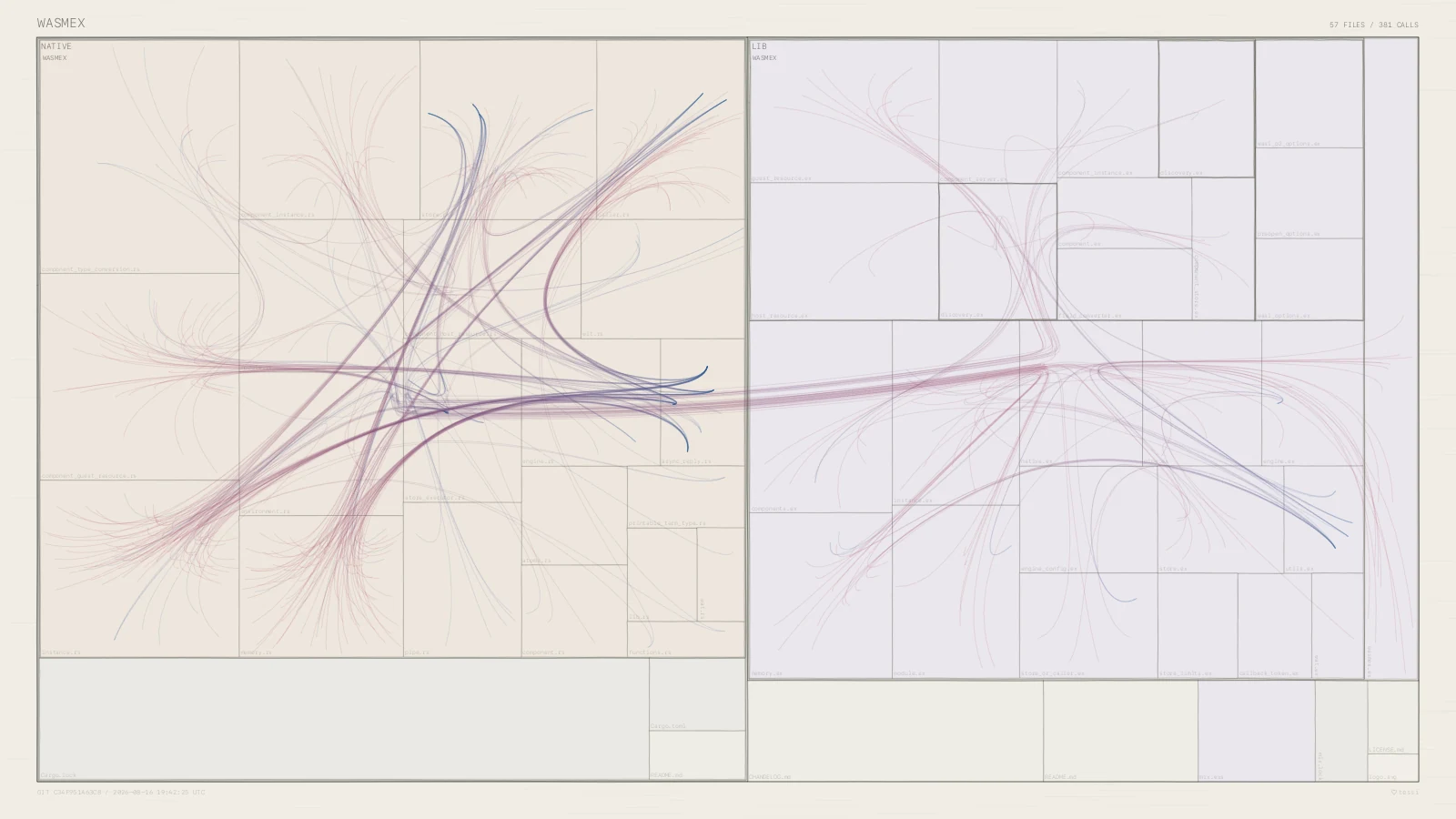
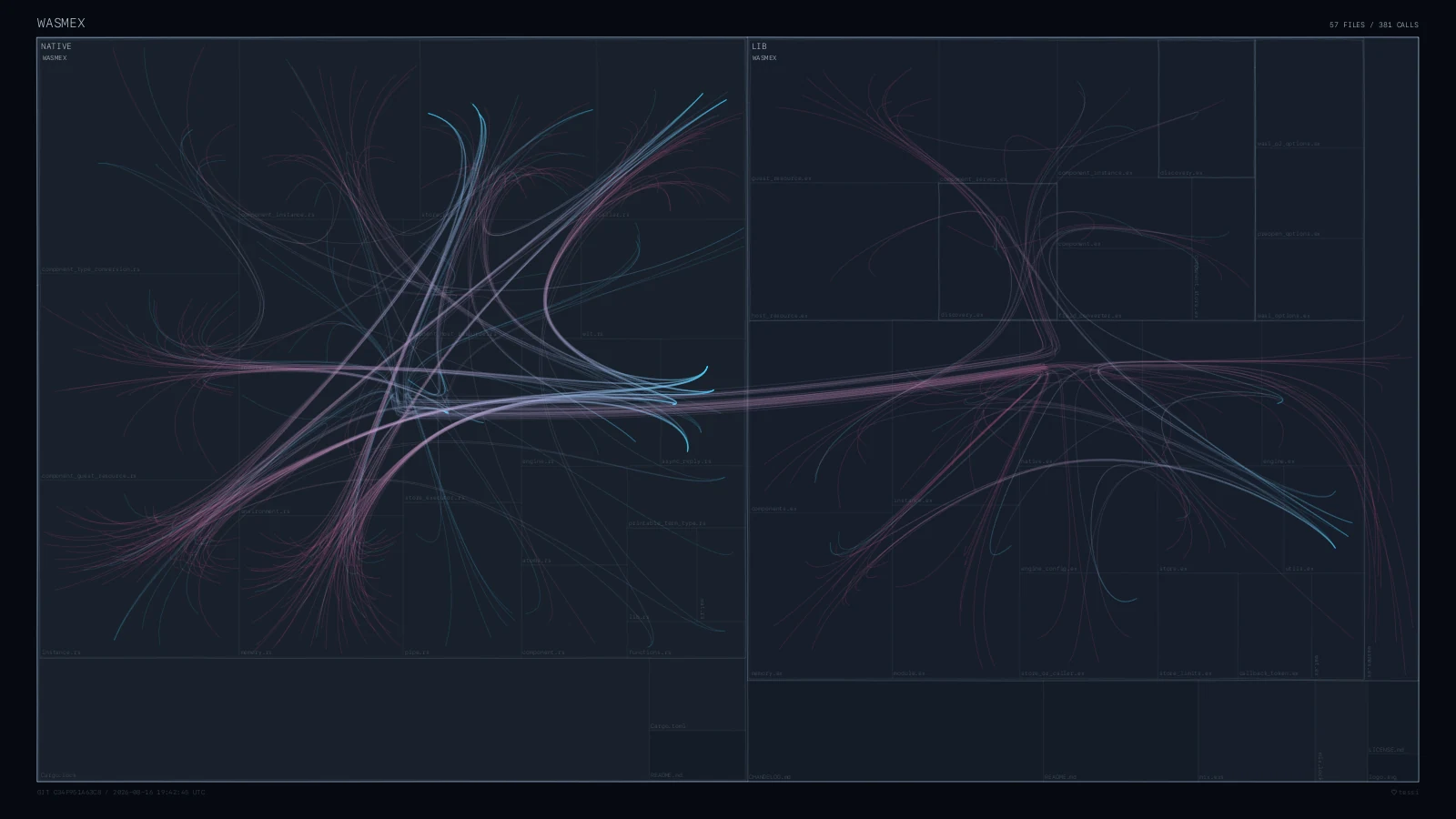
Renders an architectural map for a code repo. Files and directories are renderes on a treemap, overlayed by (method/function) calls between them as a hierarchical edge bundled callgraph.
| light | dark |
|---|---|
 |
 |
Reading the map
- Treemap parcel area represents lines of code, byte size, or commit count.
- Every visible route is one callsite. A route begins at the source line's position inside its file, follows the directory hierarchy, and ends at the target line.
- Color shows direction: red at the source, blue at the target. Call routes get more intense in color when they overlap. This allows to see main communication routes in a project.
Install
Code Atlas supports Linux and macOS and requires Git at runtime. Installing from source requires Rust 1.87 or newer.
Checksummed native archives are also attached to tagged GitHub releases.
Try it
Create a self-contained interactive viewer from any local checkout:
Open atlas.html directly or put that single file on any static host. It embeds
the map, calls, light and dark themes, filters, and viewer code; it makes no
runtime network requests.
Create an A2 landscape poster with a higher-resolution call layer:
The output extension selects PNG, SVG, PDF, or HTML. SVG and PDF keep parcels,
boundaries, and labels as vectors. PDF calls are rendered in bounded tiles;
--resume verifies and reuses completed tiles after interruption.
Useful controls:
| Option | Meaning |
|---|---|
--metric loc|bytes|commits |
Choose the file-area metric. |
--theme architect|night|ink|solarized-dark|solarized-light |
Choose the static-output appearance. HTML always embeds light and dark. |
--backend software|wgpu |
Choose the call renderer. Unsupported GPUs fall back to software. |
--exclude PATH |
Exclude a repository-relative prefix; repeat as needed. |
--include-tests |
Include conventional test paths, excluded by default. |
--include-hidden |
Include dotfiles and dot-directories, excluded by default. |
Run code-atlas render --help for every layout, pigment, and print option.
Explore calls in the browser
Pan and zoom like a map, select a file or individual spline, and filter calls without collapsing them. The query language is case-insensitive:
in:*delivery*
out:*attempts* in:*delivery*
path:*clickhouse* -in:*deprecated*
in:*delivery* | in:*authoring*
in:/to: match target paths, out:/from: source paths, and path: either
endpoint. callee: and analyzer: match call metadata. Spaces mean AND, |
means OR, and a leading - excludes a term. The viewer includes examples and
specific syntax-error help.
Selection, query, and camera position are stored in the URL hash for sharing. Appearance follows the system by default and can be saved as Light or Dark. WebGPU is used when available, with a Canvas2D fallback; pigment automatically strengthens when filters leave only a few visible calls.
Source and target lines can link back to a hosted repository:
Analyzer coverage
| Language | Preferred analysis | Fallback |
|---|---|---|
| Elixir | mix xref trace |
conservative parsing for scripts |
| Rust | rust-analyzer SCIP | uniquely resolved syntax calls |
| TypeScript / JavaScript | scip-typescript | relative-import calls |
| Gleam | explicit-import resolution | - |
Use CODE_ATLAS_RUST_ANALYZER or CODE_ATLAS_SCIP_TYPESCRIPT to override the
semantic indexer binaries. Code Atlas never downloads analyzer tools while
rendering. Inspect coverage and warnings without producing an image:
"Every call" means every cross-file callsite resolved by the active analyzers. Dynamic dispatch, macros, reflection, and generated code prevent any static tool from seeing every runtime call. Same-file calls are intentionally excluded. The JSON report records analyzer coverage, unresolved calls, exclusions, the Git revision, dirty-worktree state, renderer, and timing information.
Security and privacy
Only analyze repositories and language toolchains you trust: semantic analysis
may run project-local tools such as mix compile. HTML exports contain no source
text, but they do contain paths, revision identifiers, metrics, call metadata,
and geometry. Treat private-repository exports as sensitive project metadata.
See SECURITY.md for the full boundary and reporting process.
Development
The CLI is the supported interface. The Rust library remains experimental during
the 0.x series. See CONTRIBUTING.md for local checks and
RELEASING.md for the release procedure.
This project was built through LLMs.
License
Code Atlas is released under the MIT License.