
clipper2


A safe, idiomatic Rust API for 2D polygon clipping and offsetting, built on top of Clipper2, Angus Johnson's C++ library.
The focus of this crate is to provide an easy to use API, staying as
close to the core Vec and fn types as possible. The unsafe FFI
layer lives in the separate
clipper2c-sys crate; reach
for that one only if you need direct access to the raw C ABI.
Example
The example below uses macroquad to visualize the result of the
operations and some helpers from the examples/ directory. See the
examples directory for more.
use *;
use ;
use *;
async
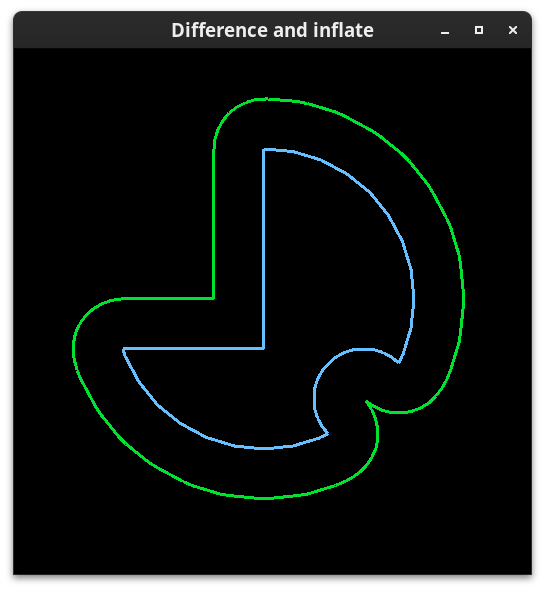
This is how the resulting shapes look:
Minkowski sum and difference
The Minkowski operations grow a polygon by an arbitrary polygonal
kernel rather than the radius-only kernel of inflate, which makes
them the right primitive for square cutters, drag-knives, asymmetric
tool footprints, and configuration-space obstacles in robot motion
planning. The kernel may be concave; concave kernels can carve holes
into the swept region.
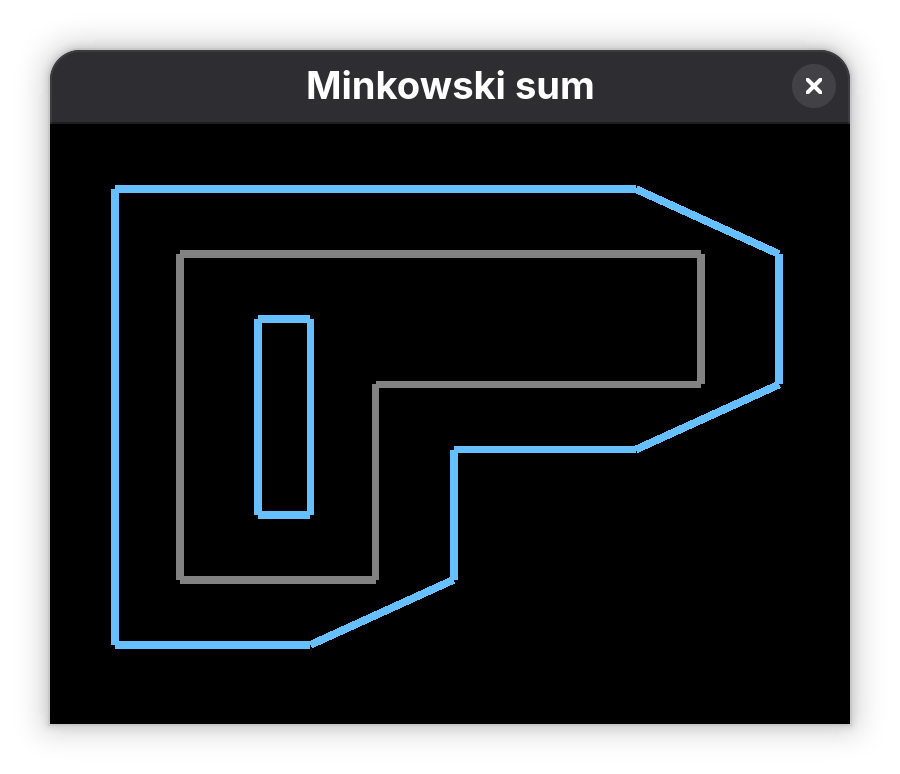
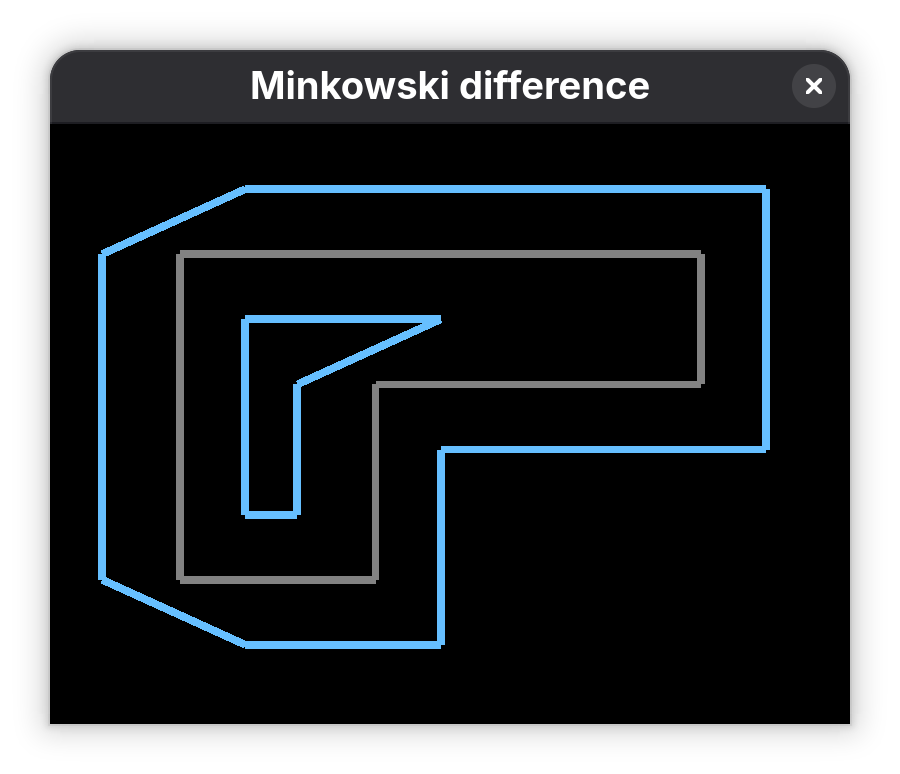
minkowski_sum translates the kernel by +p at every vertex of the
input path; minkowski_diff translates by -p. For a pattern that
is symmetric about the origin (a centred disc or square) the two
agree, but for an asymmetric pattern the difference is the sum
reflected through the origin of the pattern. The screenshots below
use the same concave arrowhead kernel against the same L-shaped
outline:
use *;
// A concave arrowhead pointing right (asymmetric, non-convex).
let pattern: Path = vec!.into;
// A closed L-shaped contour.
let outline: Path = vec!.into;
let sum = outline.minkowski_sum ;
let diff = outline.minkowski_diff;
minkowski_sum |
minkowski_diff |
|---|---|
 |
 |
The arrowhead extends the swept boundary rightward (its tip is at +0.6 x); the concave notch carves an inner ring on the right half of the L. |
The same arrowhead, applied via difference, extends the swept boundary leftward; the concave notch now carves the inner ring on the left half of the L. |
What's exposed
- Polygon boolean operations — intersection, union, difference, XOR — through a fluent
Clipperbuilder or as standalone functions - Polygon offsetting (inflate / deflate) with configurable corner styles (
JoinType: square / bevel / round / miter) and endpoint styles (EndType: polygon / joined / butt / square / round) - Minkowski sum and difference for sweeping an arbitrary polygonal kernel along a path or polygon (square / drag-knife / asymmetric tool footprints, configuration-space obstacles)
- Path simplification
- Point-in-polygon test
- Polygon area (signed and unsigned)
- Geometric transforms on
Path/Paths—translate,rotate,scale(uniform or anisotropic, optionally around a point),flip_x/flip_y - Path utilities —
append,closest_point,shift_start_to,surrounds_path,rectangle, axis-alignedBounds - Optional
serdesupport forPoint,Path,Paths
Typical use cases
- CAD / CNC / 3D-printing slicers — toolpath offsetting, pocketing, infill generation, contour boolean operations
- GIS / mapping — polygon overlay, buffer zones, vector tile clipping
- Vector graphics & rendering — path stroking via offset, SVG-style clipping, tessellation pre-pass
- Game development — visibility polygons, navigation mesh boolean operations, collision-region merging
- Robotics / motion planning — swept-area computation, configuration-space approximations
- Computational geometry research — robust boolean operations on polygons
API uses f64, but i64 under the hood
The Clipper2 library
uses i64 values
internally to guarantee the robustness of all calculations. This crate
takes f64 coordinates at the API surface and rescales them to i64
for the C++ engine.
The types Point, Path, and Paths accept a PointScaler generic
parameter that controls the conversion factor. By default this is the
Centi scaler, which multiplies values by 100 — pick a larger
scaler if you need sub-centi precision, or a smaller one if your input
range is so wide that 100× would overflow.
Building
The crate compiles the vendored Clipper2 C++ source through the
clipper2c-sys build, and therefore requires a working C++17
toolchain on the build host. CI exercises the default toolchains
shipped with each GitHub-hosted runner:
| Runner | Default C++ toolchain |
|---|---|
| ubuntu-latest | system g++ / clang++ |
| macos-latest | Xcode-shipped clang++ |
| windows-latest | MSVC (Visual Studio Build Tools) |
Optional features:
serde— derivesSerialize/DeserializeonPoint,Path, andPaths(also enables the matching feature onclipper2c-sys).doc-images— embeds illustrative images in the rustdoc output (enabled by default).
WebAssembly: wasm32-unknown-unknown builds via the WASI SDK
toolchain — see scripts/wasm-check.sh.
Status
This crate is pre-1.0; expect breaking changes between minor versions as the API is refined. Suggestions on how the API can be simplified, or direct code contributions, are welcome — see CONTRIBUTING.md for more details.
License
Licensed under either of Apache License, Version 2.0 or MIT license at your option.
Unless you explicitly state otherwise, any contribution intentionally submitted for inclusion in clipper2 by you, as defined in the Apache-2.0 license, shall be dual licensed as above, without any additional terms or conditions.