# claude-code-transcripts-ingest
[](https://crates.io/crates/claude-code-transcripts-ingest)
[](#license)
CLI that ingests every Claude Code transcript under `~/.claude/projects` into a
DuckDB database, with a normalised schema suited for usage / cost analysis across
sessions, subagents, tool calls, and cache tokens. Ships with an embedded viewer
served over HTTP.
Installs the `cct` binary.
## Install
```sh
cargo install claude-code-transcripts-ingest
```
The `duckdb` dependency is bundled (built from C++ sources), so the install is
self-contained but takes a minute or two the first time.
## Quick start
```sh
cct ingest # scans ~/.claude/projects → ~/.local/share/cct/transcripts.duckdb
cct serve # viewer at http://localhost:8766
```
## Commands
### `cct ingest`
```
cct ingest [-i <dir>] [-o <file>] [-j <jobs>] [--pricing <toml>] [--no-progress]
```
| `-i, --input-dir` | `~/.claude/projects` | Directory scanned recursively for `.jsonl` |
| `-o, --output` | `~/.local/share/cct/transcripts.duckdb` (`$XDG_DATA_HOME/cct/transcripts.duckdb`) | Output DuckDB file (overwritten each run) |
| `-j, --jobs` | `0` (logical CPUs) | Parallel worker threads |
| `--pricing` | — | TOML overriding the seeded `model_pricing` table |
| `--no-progress` | — | Silence per-second progress on stderr |
### `cct serve`
```
cct serve [--db <file>] [--port <n>]
```
| `--db` | `~/.local/share/cct/transcripts.duckdb` (`$XDG_DATA_HOME/cct/transcripts.duckdb`) | DB file to serve |
| `--port` | `8766` | Listen port |
#### Transcripts
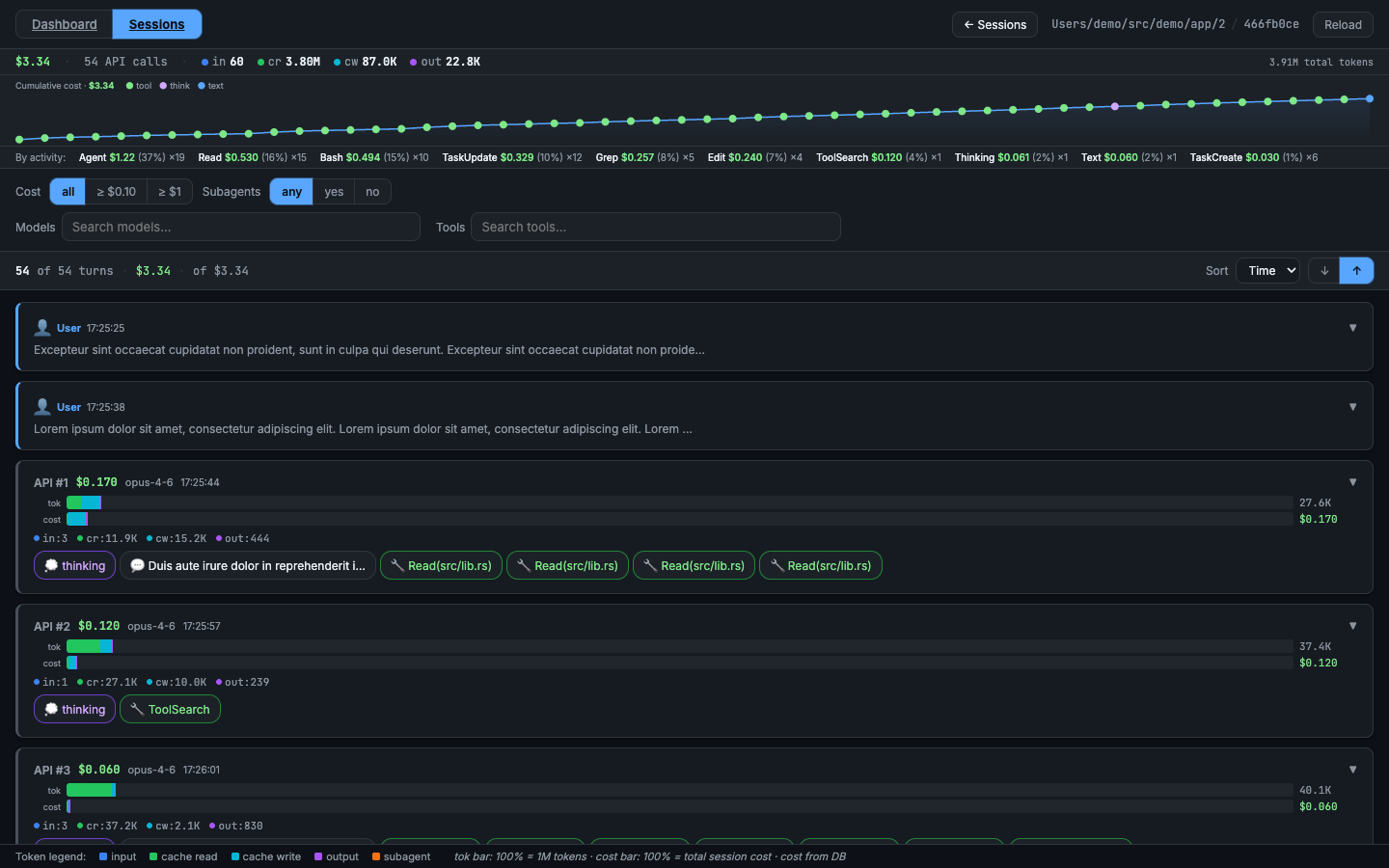
Browse by project → session → turn-by-turn timeline. Every assistant turn shows its exact cost: input, output, cache-read, and cache-creation tokens with the resulting dollar amount. Subagent calls expand inline so you can trace the full cost of any delegated task back to the turn that triggered it.
#### Dashboard
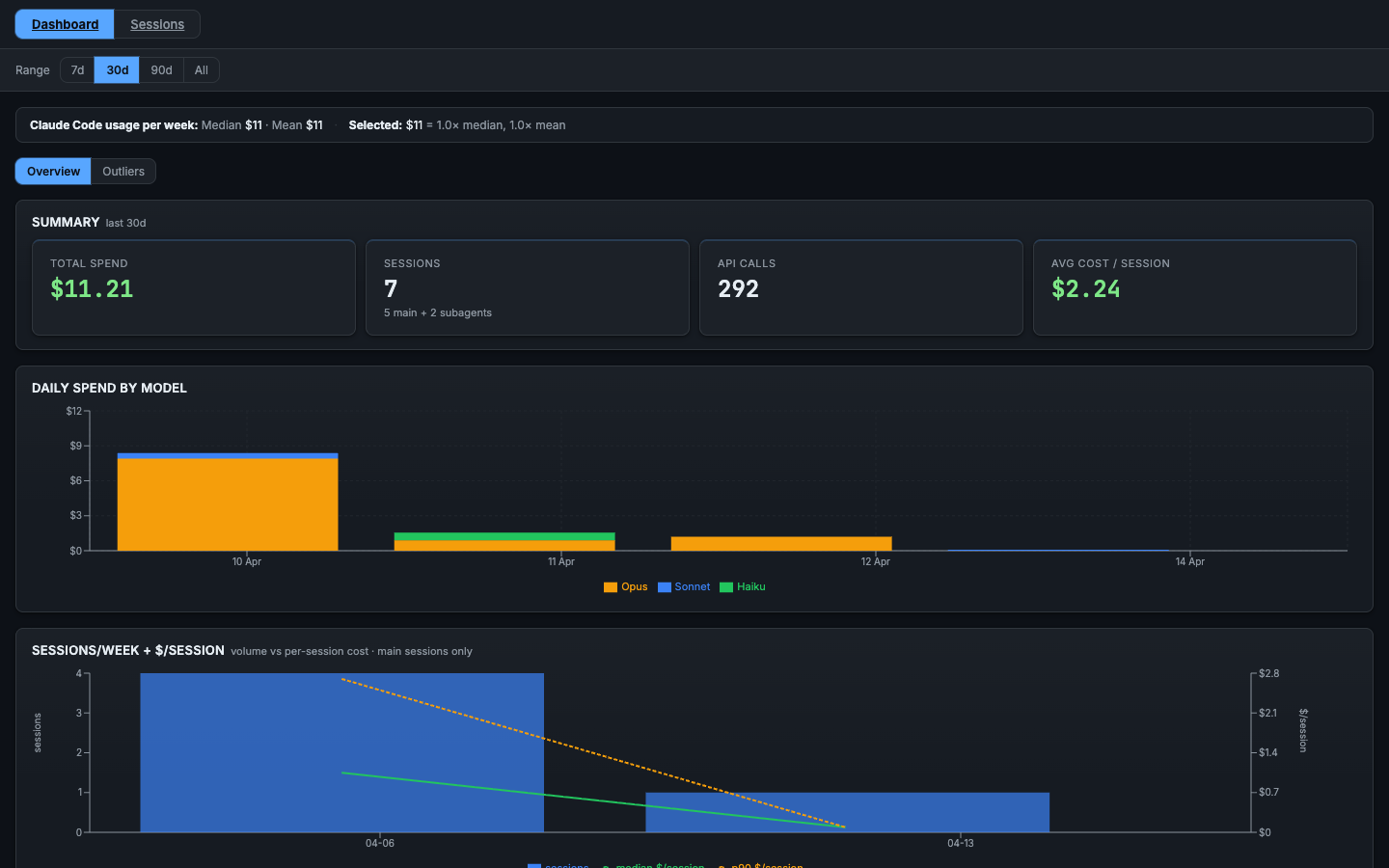
A multi-panel cost dashboard split into two sub-tabs. Switch between them with the **Overview** and **Outliers** buttons; the active tab is preserved in the URL (`?sub=outliers`) so you can bookmark or share a specific view.
**Overview** — general spend picture:
- Summary (total cost, token breakdown)
- Daily Spend by Model
- Sessions/Week + $/Session (volume vs per-session cost)
- Token-type Cost Split (main-chain vs sidechain)
- First-turn Cache-Creation Distribution (system-prompt size proxy)
- Model Breakdown
- Errors
**Outliers** — actionable panels for reducing spend:
- Top 1% Most-Expensive Turns (top 30 by cost, click to open session)
- Top Sessions (by cost, click to open in Transcripts)
- Context Size Distribution (peak tokens per session)
- Cache Invalidation Events
- Compaction Events
- Hour-of-Day Cost
- Artifact Leaderboards: Large Writes / Agent Prompts / Tool Results
- Top Reads by Size
- File Hotspots (files re-read across the most sessions)
- Bash Leaderboards
- MCP Tool Result Sizes
- Hook Frequency & Duration
- Skill Invocation Stats
- Agent Model Usage
- Cache Health
- Session Distribution (by turn count)
### `cct info`
```
cct info [--db <file>]
```
Prints the DB path, file size, entry count, session count, and last ingest timestamp. Useful for confirming the DB location and freshness without opening DuckDB manually.
| `--db` | `~/.local/share/cct/transcripts.duckdb` (`$XDG_DATA_HOME/cct/transcripts.duckdb`) | DB file to inspect |
Run `cct --help` / `cct <subcommand> --help` for the authoritative flag list.
## Library
The transcript parser lives in [`claude-code-transcripts`](https://crates.io/crates/claude-code-transcripts)
and can be used standalone without DuckDB.
## License
Dual-licensed under [MIT](LICENSE-MIT) OR [Apache-2.0](LICENSE-APACHE).