# broadsheet
[](https://crates.io/crates/broadsheet)
[](https://docs.rs/broadsheet)
[](https://github.com/SK1PPR/broadsheet/actions/workflows/ci.yml)
[](LICENSE)
A 2D animation engine for algorithm & data-structure explainer videos, in
Rust on [macroquad]. Newspaper-styled, deterministic, code-driven.
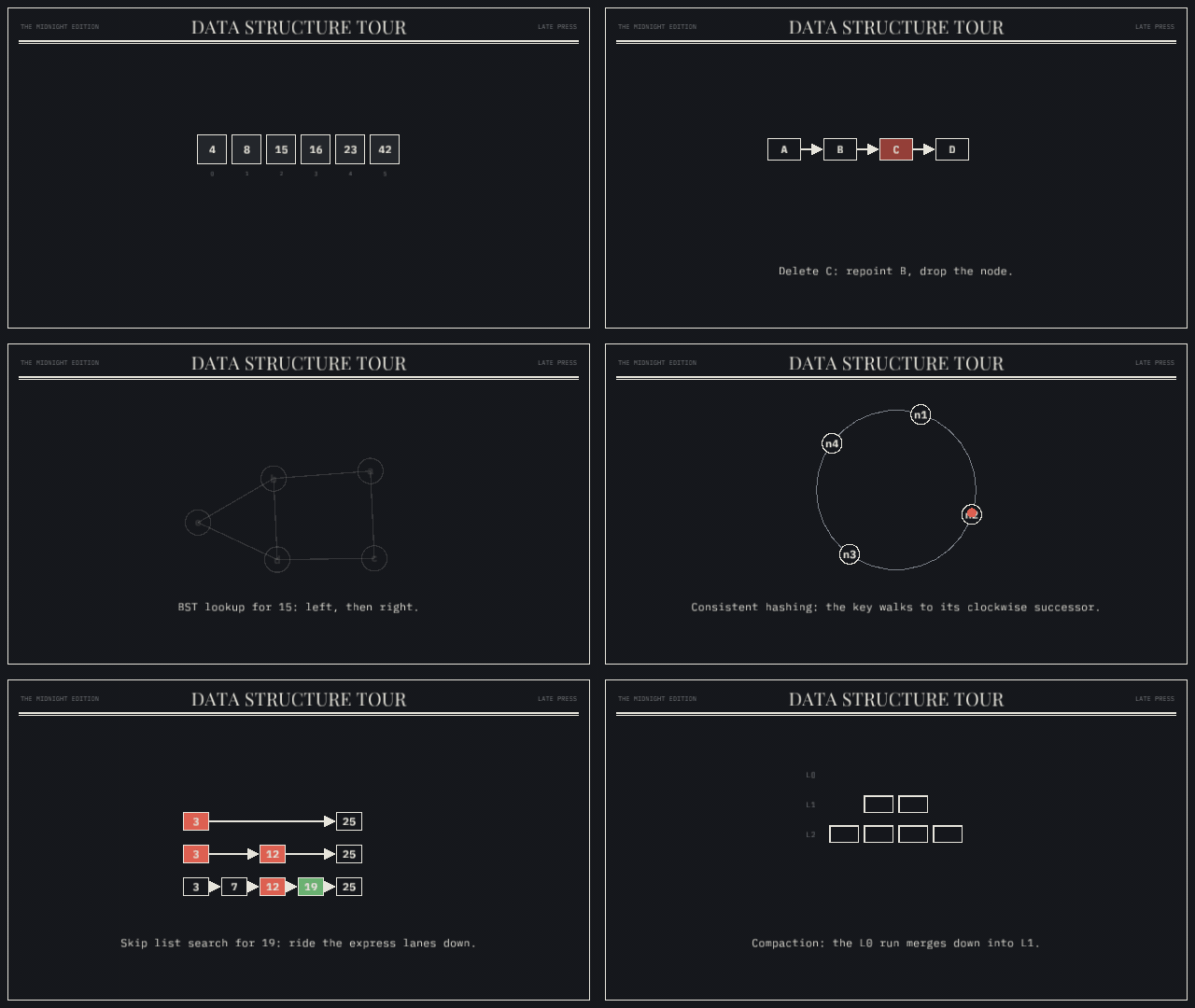
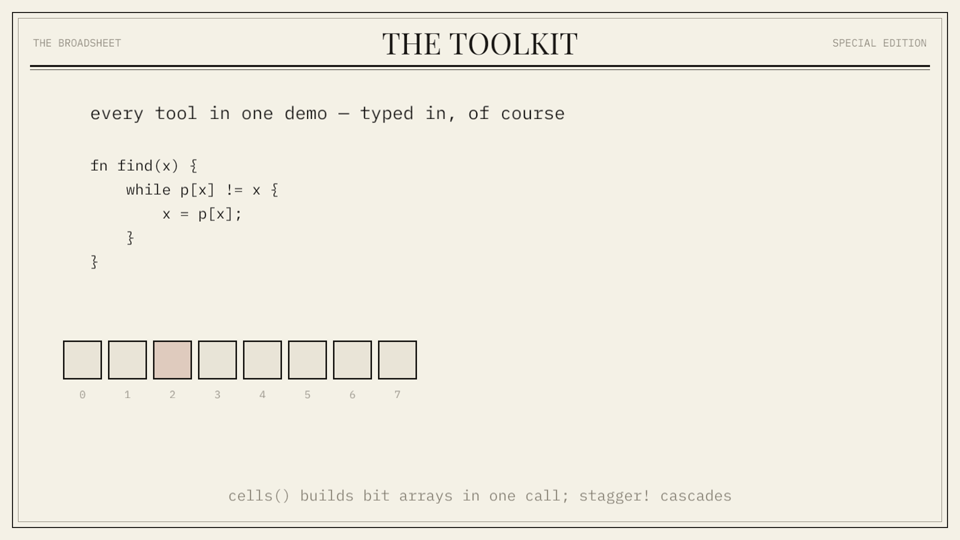
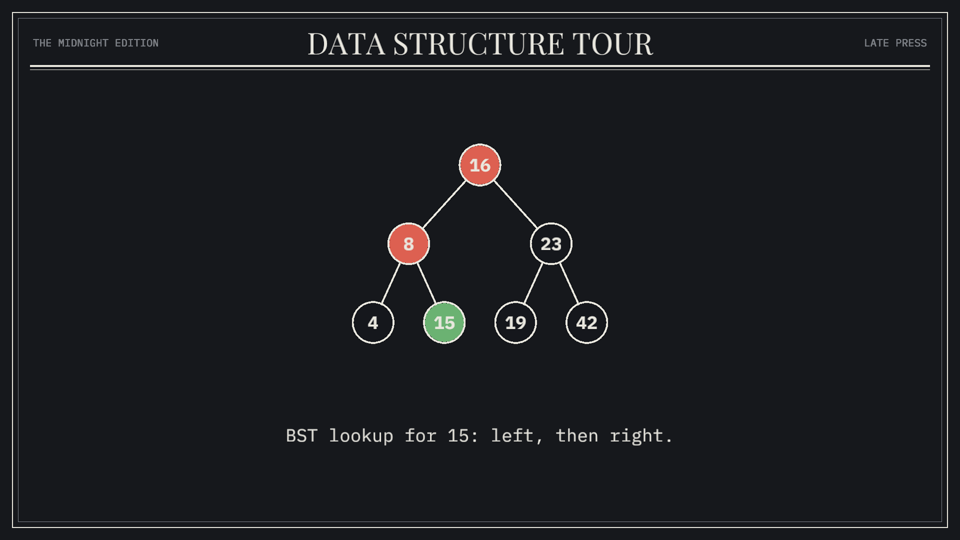
Every render looks like a page from the same broadsheet: off-white paper,
ink strokes, one spot color, serif headlines, mono data. The visual identity
is defined once in `src/style.rs` — and since 0.3.0 it is swappable: pick
`Theme::broadsheet()` (default), `Theme::midnight()`, `Theme::plain()`, or
build your own with `m.set_theme(...)`.
|  |  |  |
[macroquad]: https://github.com/not-fl3/macroquad
## Getting started
```sh
cargo add broadsheet
```
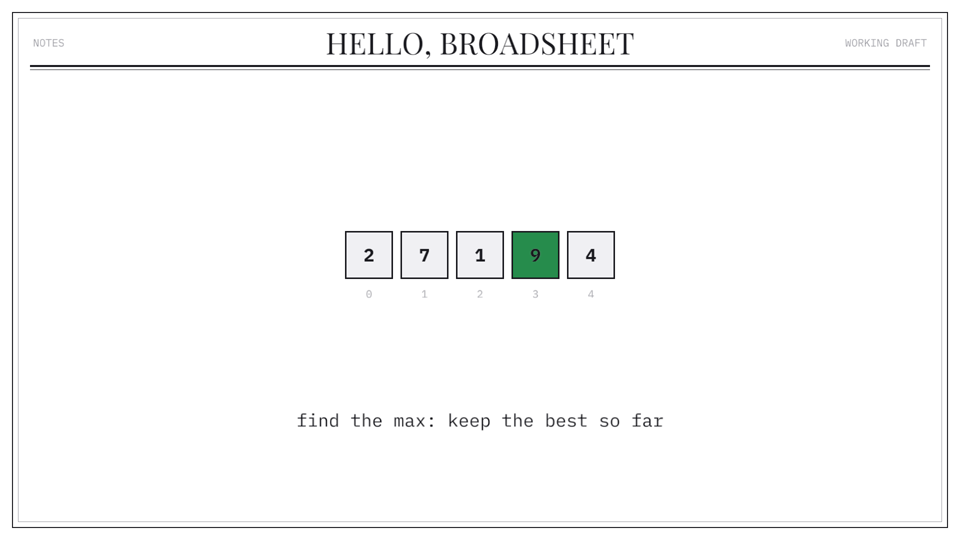
Copy [`examples/hello.rs`](examples/hello.rs) into your `main.rs` — ~30
lines that declare an array widget, animate a max-scan over it, and open a
live preview window. `ffmpeg` on your `PATH` is the only non-Rust
dependency, and only for video export.
## Run the examples
```sh
cargo run --example features_demo # live preview window
cargo run --example lsm_tree
cargo run --example slideshow_demo -- --slideshow # present like a deck
```
Live transport controls (for lining narration up with beats):
| `Space` | pause / play |
| `←` `→` | step one frame |
| `,` `.` | jump ±1 s |
| `1`–`9` | jump to section markers |
| `F` / `Ctrl`+`Cmd`+`F` | toggle fullscreen (fit-to-screen, letterboxed) |
| `R` | restart |
| drag bottom bar | scrub |
The HUD shows exact `t` and frame number; it is never present in recordings.
### Slideshow mode
Drop boundaries in the script with `m.slide("name")`, then run with
`-- --slideshow`: playback pauses at every boundary, `Space`/`→` animates
forward to the next slide, `←` snaps back one. The states between
boundaries become the deck's transitions — ideal for narrating a video live
or presenting. Slide times are also written to `markers.json`.
## Record a video
```sh
cargo run --example features_demo -- --record out/showcase --fps 60
```
Renders at a fixed timestep (`t = frame / fps`, wall clock ignored → output
is deterministic), then pipes raw RGBA frames straight into ffmpeg when it is
installed:
```sh
out/showcase/out.mp4
```
If ffmpeg is missing, or if you pass `--png`, it writes
`out/showcase/frame_00000.png …` and prints the exact stitch command.
Recording supersamples at `--scale 1.5` by default, so the 1280×720 logical
canvas comes out as true 1920×1080 with fonts rasterized at full resolution
(pass `--scale 2` for 1440p). Everything is drawn with 4× MSAA.
Tip: `--fps 2` sparsely samples the whole movie in a few dozen frames —
a fast visual proof-read of a full video. `--frames N` caps the frame count.
Useful export flags: `--still S` writes one PNG at timestamp `S`,
`--from S --to S` records a range, `--alpha` writes transparent PNG frames,
`--gif` pipes a recording to `out.gif`, and `--grain` applies the newsprint
grain/vignette pass.
## Writing a movie
```rust
use broadsheet::prelude::*;
fn main() {
let mut m = Movie::new("Skip Lists", 1280, 720);
// 1. declare the cast (state at t = 0)
m.scene()
.circle("A", v(300., 400.), 40.).label("A")
.circle("B", v(900., 400.), 40.).label("B").hidden()
.arrow("e", v(340., 400.), v(340., 400.)).hidden()
.text("cap", v(640., 620.), "").size(22.).color(FADED).hidden();
// 2. script the beats (cursor advances with each play)
m.play(act().set_text("cap", "two nodes, one pointer"));
m.play(act().fade_in("B").dur(0.4));
m.play(par![ // simultaneous
act().fade_in("e").dur(0.15),
act().grow_to("e", v(860., 400.)).dur(0.5).ease(InOutCubic),
]);
m.play(seq![ // sequential
act().highlight("B", ACCENT),
act().pulse("B"),
wait(0.5), // narration beat
]);
m.section("Level 2"); // newspaper section card + jump marker
m.play(act().move_to("A", v(300., 250.)).dur(0.6).ease(OutBack));
broadsheet::run(m);
}
```
Verbs: `move_to` `move_by` `fade_in` `fade_out` `color_to` `highlight`
(auto-reverts) `scale_to` `pulse` `shake` `grow_to`/`retarget` (line & arrow
endpoints — draws edges, rewires pointers) `set_text` (crossfade).
Tune any act with `.dur(secs)` and `.ease(...)`.
Scene niceties: `.label("A")` puts a mono label riding on a shape
(addressable as `"A.label"`); `.follow(id, offset)` pins any entity to
another; `.wrap(px)` word-wraps long text (captions) into centred lines;
`.hidden()` starts invisible for a later `fade_in`; `m.wait(s)`
leaves silence; `m.at(t, clip)` places a clip at an absolute timestamp;
`m.now()` tells you the cursor time for narration notes; `m.mark("name")`
exports a beat marker to `markers.json` during recording; `.sticky()` keeps
an entity in screen coordinates during camera pan/zoom for HUD-style overlays.
Palette: `INK`, `PAPER`, `ACCENT` (newsprint red), `BLUE`, `FADED`,
`PAPER_SHADE` (the default `Theme::broadsheet()` values).
## Themes & roles
`m.set_theme(Theme::midnight())` swaps the whole token set — page color,
ink, spot colors, masthead strings — before entities are declared. Semantic
`Role`s (`Active`, `Visited`, `Skipped`, `Found`, `Stale`, `Deleted`,
`Maybe`, `Absent`) name algorithm states; each theme maps them to colors:
```rust,ignore
m.scene().circle("n", v(500., 300.), 26.).role(Role::Visited);
m.play(act().color_to("n", m.role(Role::Found)));
```
## Widgets
One call declares a whole data structure and returns a handle with its
entity ids (`broadsheet::widgets`): `array`, `bit_array`, `hash_table`,
`linked_list`, `tree`, `graph` (deterministic seeded spring layout),
`hash_ring`, `lsm_levels`, `skip_list`.
```rust,ignore
let arr = widgets::array(&mut m, "arr", &["4", "8", "15"], v(640., 320.));
m.play(act().highlight(&arr.cell(1), m.role(Role::Active)));
```
Layout helpers (`broadsheet::layout`): `row`, `grid`, `ring`, `tree`,
`levels`, `blocks`, `graph`, plus `rng(seed)` for repeatable jitter.
See `examples/slideshow_demo.rs` for the full tour.
## Extending it
See [ARCHITECTURE.md](ARCHITECTURE.md) — module map, the statelessness
invariant, and step-by-step recipes for adding a primitive or a verb
(the two extension points most movies eventually need). Contributions
welcome: [CONTRIBUTING.md](CONTRIBUTING.md). Release history:
[CHANGELOG.md](CHANGELOG.md).