<div align="center">
# boxdd 0.6 - Rust bindings for Box2D v3
[](https://crates.io/crates/boxdd)
[](https://docs.rs/boxdd)
[](https://frankorz.com/boxdd/)
[](#license)
</div>
`boxdd` 0.6 is the breaking, soundness-focused binding for the pinned Box2D 3.2.0
development snapshot at commit
`56edae79f2949d86142b03450d5d60f63bcf5a6f`. It is not a binding for an arbitrary
Box2D 3.2 checkout. The source revision, precision, private ABI, snapshot layout, recording
format, target, and provider identity are qualified together.
Read the [0.5 to 0.6 migration guide](bevy_boxdd/MIGRATION.md) before upgrading.
## Crates
- `boxdd-sys`: raw FFI, the pinned source tree, generated bindings, and provider identity checks.
- `boxdd`: owner-thread Safe Rust APIs for worlds, objects, queries, callbacks, snapshots,
recordings, and replay.
- `bevy_boxdd`: Bevy 0.19 ECS integration with an explicit local-to-world origin bridge.
## 0.6 Highlights
- `World` is the sole owner of a simulation. Creation returns world-bound IDs for storage;
`World::body`, `shape`, `joint`, `chain`, and `query` acquire borrow-scoped capabilities for
access. Destruction is explicit.
- The Safe Rust surface has one fallible contract. Operations that can fail return `Result`; there
is no parallel panic/`try_*` API family.
- Live `BodyId`, `ShapeId`, `JointId`, `ChainId`, and `ContactId` values cannot be detached,
rebound, reconstructed from raw Box2D IDs, or serialized. Cross-world, stale, recycled,
wrong-kind, and forged identifiers are rejected before native mutation.
- Absolute coordinates use `Position` and `WorldTransform`; local offsets, directions, extents,
and rotations use `Vec2`, `Transform`, and `f32`. The `double-precision` feature changes
`WorldScalar` and the native ABI together.
- World queries take an explicit absolute `Position` origin. Standalone collision helpers return
`LocalManifold`; runtime contact manifolds retain local `f32` anchors with explicit world-point
reconstruction.
- `Foundation::initialize` freezes process-global length units and hooks before the first safe
native use and returns the explicit root for worlds, scale-aware definitions, worldless native
calls, and exclusive replay.
- Native targets can use Box2D's built-in scheduler through validated `WorkerCount` values.
`World` and its borrow-scoped capabilities remain `!Send` and `!Sync`; worker callbacks receive
only thread-safe identifiers and values, never an owning world context. Raw task-system
callbacks are outside the Safe Rust layer.
- `Snapshot`, `RecordingSession`, and `ReplayPlayer` encode distinct ownership models for
same-world restore, operation recording, and exclusive process-local replay. Native snapshot and
recording bytes are not a Safe Rust persistence format.
- Every pinned exported C function has an explicit reviewed disposition. Compiler-backed C/Rust
probes check ABI compatibility, while Rust tests exercise Safe API behavior and callback
boundaries; the inventory does not attempt to infer Rust call graphs.
- Vendored source is the default provider. System and prebuilt native providers are static-only,
exact-manifest adapters; WASM runtime support uses a versioned Emscripten provider.
## Quick Start
```rust
use boxdd::{BodyBuilder, BodyType, Foundation, Position, ShapeDef, Vec2, WorldBuilder, shapes};
fn main() -> Result<(), Box<dyn std::error::Error>> {
let foundation = Foundation::initialize_default()?;
let mut world = foundation.create_world(
WorldBuilder::from(foundation.world_def())
.gravity(Vec2::new(0.0, -9.8))
.build()?,
)?;
let body_id = world.create_body(
BodyBuilder::from(foundation.body_def())
.body_type(BodyType::Dynamic)
.position(Position::new(0.0, 2.0))
.build()?,
)?;
world.body(body_id)?.create_polygon(
&ShapeDef::builder().density(1.0).build()?,
&shapes::box_polygon(0.5, 0.5)?,
)?;
let completed = world.step(1.0 / 60.0, 4)?;
let contact_events = completed.contact_events()?.to_owned()?;
println!("{} contacts began", contact_events.begin.len());
Ok(())
}
```
Keep IDs in application state and acquire a `Body`, `Shape`, `Joint`, or `Chain` capability only
for the duration of an operation. A capability prevents overlapping mutable access to its world;
dropping it releases the borrow and never implicitly destroys the object.
## Spatial Model
- `WorldScalar` is `f32` by default and `f64` with `double-precision`.
- `Position` and `WorldTransform` represent absolute world coordinates.
- `Vec2` and `Transform` always remain local `f32` values.
- Convert an absolute point to a local frame with `Position::checked_relative_to`. The explicit
`relative_to_lossy` method is available only when lossy narrowing is intentional.
- Query AABBs, polygons, and cast geometry remain local to the explicit query origin. Ray hit and
debug draw positions are absolute `Position` values.
- `bevy_boxdd::BoxddWorldOrigin` maps Bevy-local `f32` transforms to absolute Box2D positions and
performs origin rebases atomically.
## Ownership and Callbacks
`World`, its borrow-scoped object/query capabilities, snapshots, recording sessions, and replay
players are owner-thread objects. A dedicated physics thread plus channels is the supported way to
integrate with a multi-threaded or async application.
On native targets, worker-capable callbacks (`set_custom_filter`, `set_pre_solve`, friction mixing,
and restitution mixing) require `Send + Sync + 'static` closures and must not call world APIs.
Query, dynamic-tree, event-view, and debug-draw callbacks are closure-scoped. Every C-to-Rust
callback contains any unwinding panic; the first panic resumes only after native control returns to
a Rust-owned boundary.
WASM adapters currently do not prove cross-module Rust function-pointer transport. Callback-backed
world, query, dynamic-tree, foundation, replay, and debug-draw APIs are therefore absent at compile
time on `wasm32`; callback-free queries such as closest ray casts and mover casts remain available.
Safe Rust does not expose raw live-object IDs or bind/unbind seams. Use application-owned stable
keys for ECS and persistence mappings. Use `boxdd-sys` directly when an application deliberately
accepts the raw FFI contract.
## Foundation and Scheduling
Configure global length units before any other safe Box2D call:
```rust
use boxdd::{Foundation, FoundationConfig, WorkerCount, WorldBuilder};
fn main() -> Result<(), Box<dyn std::error::Error>> {
let foundation = Foundation::initialize(FoundationConfig::new(1.0))?;
let workers = WorkerCount::new(4)?;
let world = foundation.create_world(
WorldBuilder::from(foundation.world_def())
.worker_count(workers)
.build()?,
)?;
drop(world);
Ok(())
}
```
Initialization is idempotent only for the same configuration. A conflicting configuration is an
error. Derive scale-sensitive defaults through `foundation.world_def()` and
`foundation.body_def()`. Derive a joint base from its active owner with
`world.joint_base(...)` or `recording_session.joint_base(...)`; the owner authenticates both body
IDs and preserves the same frozen length-unit contract. Native targets qualify Box2D's built-in
scheduler; current WASM adapters accept exactly one worker. `WorldDef` contains only Safe Rust
configuration and cannot install native task or material callback pointers.
## Snapshots, Recording, and Replay
- `World::snapshot` returns an unforgeable capability for restoring the same world. Successful
restore returns a `SnapshotRestore` mapping. Registrations in the unchanged snapshot/current
identity intersection preserve their Safe IDs; destroyed, replaced, or post-snapshot objects are
invalidated and remapped as needed. Rejection before the native restore call leaves the world
live; a failure after that call makes the world terminal.
- Snapshot native bytes are deliberately opaque. Safe Rust supports only same-world, same-process
restore; durable saves require an application-owned schema that rebuilds a new world.
- `RecordingSession` owns the native recording allocation and is the only world access surface
while recording. `finish` validates the writer output and produces an opaque process-local
`Recording`.
- `ReplayPlayer::open(foundation, &recording, config)` accepts only that opaque `Recording`, copies
its private stream, acquires exclusive process-global access through the same explicit Foundation
root, and exposes closure-scoped, epoch-bound read views. Drop or `close` restores the previous
global state.
The Safe Rust layer does not import or export snapshot or recording bytes. Persist application-level
state separately when long-term or cross-build compatibility is required. See
`boxdd/examples/snapshot_replay.rs` for the in-process checkpoint and replay workflow.
## Providers and Compatibility
| Vendored source | default | Builds the pinned source inventory with matching generated bindings. |
| Local system | `BOXDD_SYS_PROVIDER=system` | Caller-supplied static archive, header, bindings, and exact local attestation manifest. |
| Official prebuilt | `BOXDD_SYS_PROVIDER=prebuilt` | Exact static manifest plus a signed whole-package provenance statement and Sigstore bundle. |
| WASM compile-only | `BOXDD_SYS_PROVIDER=wasm-compile-only` | Type/build qualification only; no runtime claim. |
| WASM runtime | Repository `xtask` provider/Pages entry points | Controlled final link with versioned precision-specific imports; bare `BOXDD_SYS_PROVIDER=wasm-provider` builds fail closed, and official runtime packages carry signed whole-package provenance. |
System and prebuilt adapters never download, extract, cache, discover by name, dynamically link, or
fall back to vendored source. Official prebuilt qualification authenticates the canonical
provenance statement and exact outer archive before extraction; `boxdd-sys` then re-verifies the
already-local complete member inventory and manifest before linking exact bytes. A provider
reporting only `b2GetVersion() == 3.2.0` is insufficient. Single and double precision artifacts,
manifests, bindings, and dependent crate features cannot be mixed.
The official WASM package is a runtime distribution, not a `boxdd-sys` build input. Repository-level
`xtask` builds with an activated Emscripten installation. CI installs the fixed supported version,
builds the provider, authenticates the complete package before extraction, and qualifies the
extracted JavaScript/WASM under Node and Chromium. Building
`boxdd-sys` never discovers, downloads, or executes an Emscripten SDK.
See [`boxdd-sys/README.md`](boxdd-sys/README.md) for manifest inputs and
[`docs/platforms/wasm.md`](docs/platforms/wasm.md) for the WASM runtime boundary.
## Cargo Features
- `double-precision`: use `f64` absolute world coordinates and the matching Box2D ABI.
- `serde`: serialize safe value and configuration types. It does not serialize a `World`, live
object IDs, snapshots, or recordings.
- `mint`, `nalgebra`, `glam`: scalar-correct math interop. World-space conversions use
`WorldScalar`; local vector conversions remain `f32`.
- `bytemuck`: `Pod`/`Zeroable` for layout-qualified value types.
- `simd-avx2`, `disable-simd`, `validate`: forward an explicit native provider identity choice.
There is no `serialize` feature in 0.6. Snapshot, recording, and replay APIs are available through
the normal safe crate surface.
## Development
```bash
git submodule update --init --recursive
cargo fmt --all -- --check
cargo nextest run -p boxdd -p boxdd-sys
cargo nextest run -p boxdd -p boxdd-sys --features boxdd/double-precision
cargo nextest run -p bevy_boxdd
cargo check -p boxdd --examples
cargo check -p boxdd --examples --features double-precision
cargo run -p xtask -- upstream-sync --check
cargo run -p xtask -- api-inventory --check
cargo run -p xtask -- recording-wire-codegen --check
```
The repository pins Rust 1.95 as MSRV and Rust 1.97 as its development toolchain. Provider,
package, sanitizer, Miri, WASM, Pages, and release gates are exposed through `xtask` and CI.
## Examples
- [`boxdd/examples/README.md`](boxdd/examples/README.md) groups the headless core examples by
workflow. Start with `world_basics`, `foundation_scheduler`, `queries`, and `snapshot_replay`.
- [`bevy_boxdd/README.md`](bevy_boxdd/README.md) documents the ECS adapter and explicit
`BoxddWorldOrigin` bridge.
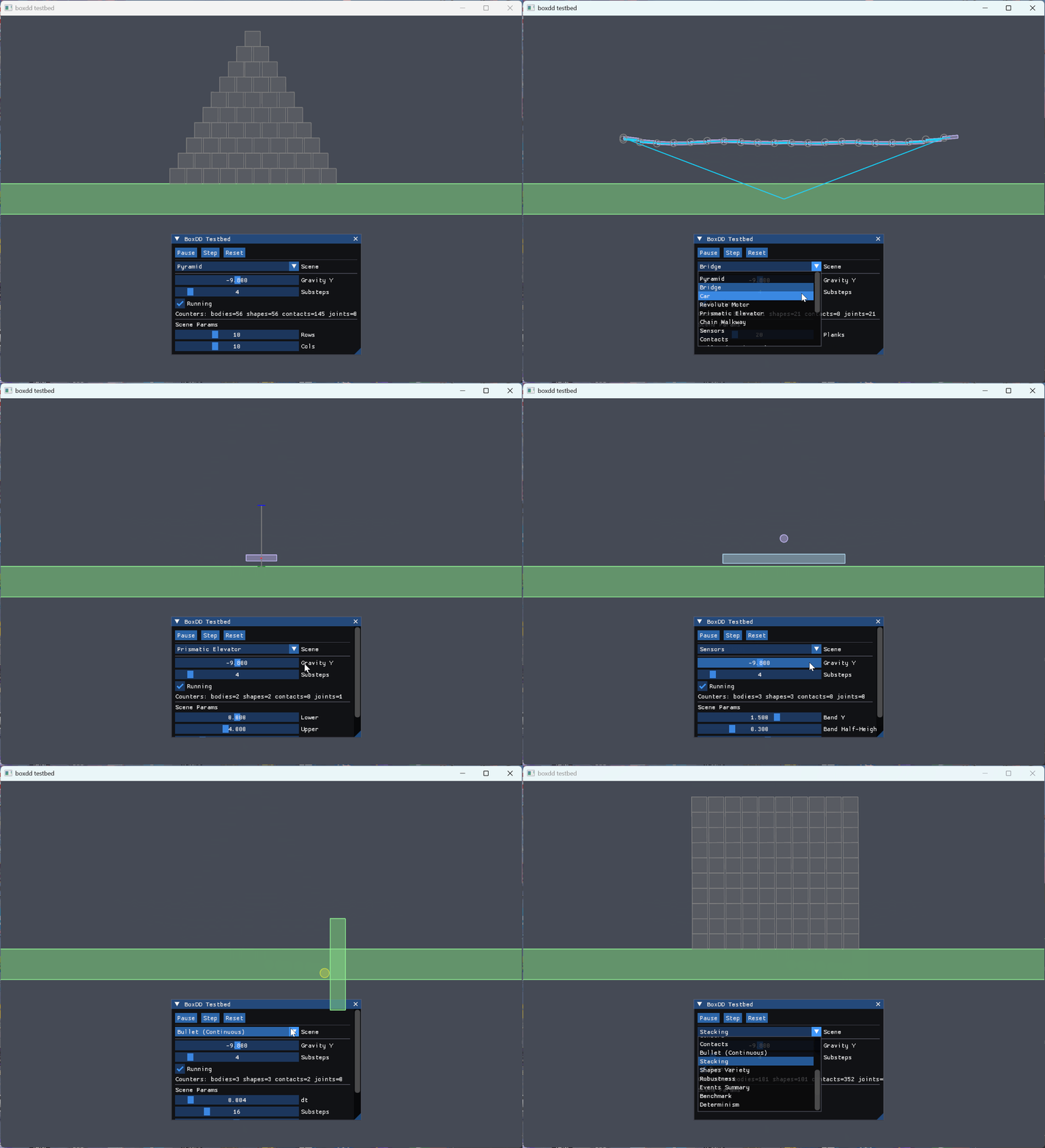
- <https://frankorz.com/boxdd/> hosts the generated single-precision Bevy + egui development
preview; signed tag-bound WASM release packages are the portable distribution artifacts.
## Documentation
- [0.5 to 0.6 migration](bevy_boxdd/MIGRATION.md)
- [FFI lifetime audit](docs/development/ffi-lifetime-audit.md)
- [Rustdoc alignment](docs/development/rustdoc-alignment.md)
- [WASM status](docs/platforms/wasm.md)
- [Changelog](CHANGELOG.md)
- [docs.rs](https://docs.rs/boxdd)
## Acknowledgments
- Thanks to the Rust Box2D bindings project for prior art and inspiration:
<https://github.com/Bastacyclop/rust_box2d>
- Box2D is maintained by Erin Catto: <https://github.com/erincatto/box2d>
## License
`boxdd` and `boxdd-sys` are licensed under MIT OR Apache-2.0. The pinned upstream Box2D source is
MIT-licensed.