# box
[日本語](README.ja.md)
[](https://crates.io/crates/box-cli)
[](LICENSE)
[](https://github.com/yusukeshib/box/actions/workflows/ci.yml)
Sandboxed git workspaces for development. Clone, branch, break things — your repo stays untouched.
## Why box?
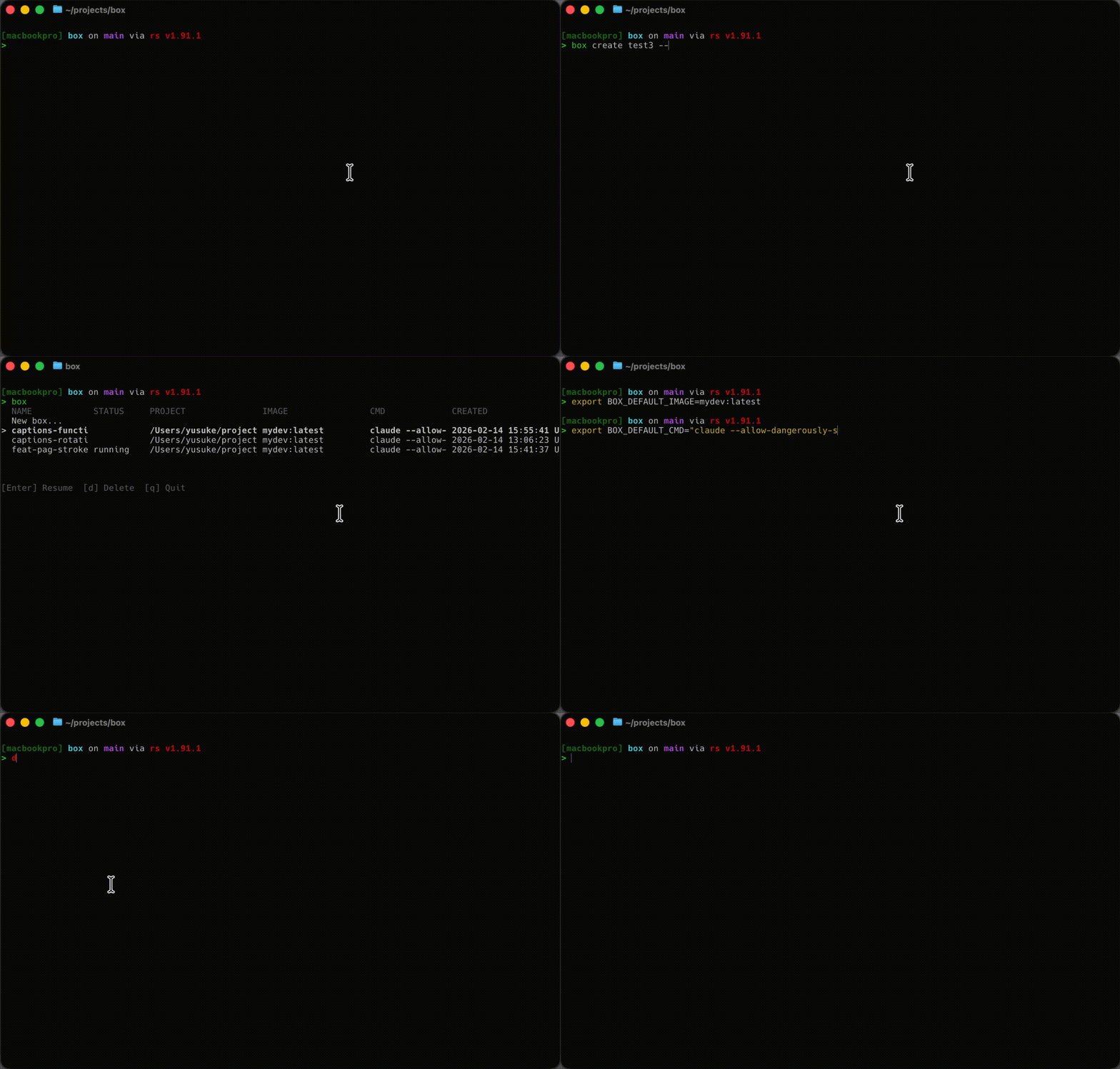
Box gives you **isolated** git workspaces with **session tracking** — so you can freely experiment without touching your original repository.
Each session gets its own workspace. By default, `git clone --local` creates a fully independent repo with hardlinks — fast even for large repos, and nothing you do can affect the original. Alternatively, `--strategy worktree` uses `git worktree` for even faster, space-efficient workspaces that share the object store.
## Features
- **Isolated git workspaces** — `git clone --local` (default) or `git worktree` for per-session workspaces; host files are never modified
- **Session tracking** — metadata tracks project directory, command, strategy, and creation time
- **Multi-repo workspaces** — register repos and create workspaces spanning multiple repos
- **Shell integration** — `cd` into workspaces automatically
## Requirements
- [Git](https://git-scm.com/)
## Install
### Quick install
```bash
### From crates.io
```bash
cargo install box-cli
```
### From source
```bash
cargo install --git https://github.com/yusukeshib/box
```
### Nix
```bash
nix run github:yusukeshib/box
```
### Binary download
Pre-built binaries are available on the [GitHub Releases](https://github.com/yusukeshib/box/releases) page.
## Quick Start
```bash
box new my-feature
# Creates an isolated git workspace and cd's into it
```
Box must be run inside a git repository. It clones the current repo into `~/.box/workspaces/<name>/`.
```bash
# Work in the isolated workspace...
$ git checkout -b experiment
$ make test # break things freely
# Done? Clean up
box remove my-feature
```
Running `box` with no arguments launches the interactive TUI. If sessions exist, you can select one to resume; otherwise it prompts to create one.
## Session Naming
Each session gets a simple name:
```bash
box new my-feature
box new my-feature -- make test
```
## Usage
```bash
box Interactive TUI session manager
box new [name] [options] [-- cmd...] Create a new session
box exec <name> -- <cmd...> Run a command in a session
box list [options] List sessions (alias: ls)
box remove <name> Remove a session or workspace
box cd <name> Print host project directory
box repo add [path] Register a git repo
box repo remove <name> Unregister a repo
box repo list List registered repos (alias: ls)
```
### Create a session
```bash
# Interactive prompt (asks for name, command)
box new
# With a specific command
box new my-feature -- make test
# Multi-repo workspace (select specific repos)
box new my-feature --repo app-a --repo app-b
# Use git worktree instead of clone (faster, shares object store)
box new my-feature --strategy worktree
BOX_STRATEGY=worktree box new my-feature
```
### List and manage sessions
```bash
box list # List all sessions
box ls # Alias
box list -q # Names only (for scripting)
box list -p # Only sessions for the current project
box remove my-feature # Remove session, workspace, and data
```
### Navigate between workspaces
```bash
box cd my-feature # Print the host project directory
```
## Options
### `box new`
| `--strategy <strategy>` | Workspace strategy: `clone` (default) or `worktree`. Overrides `$BOX_STRATEGY` |
| `--repo <name>` | Select specific repos (repeatable). Only with registered repos |
| `-- cmd...` | Command to run (default: `$BOX_DEFAULT_CMD` if set) |
### `box list`
| `--project`, `-p` | Show only sessions for the current project directory |
| `--quiet`, `-q` | Only print session names (useful for scripting) |
## Environment Variables
| `BOX_DEFAULT_CMD` | Default command for new sessions, used when no `-- cmd` is provided |
| `BOX_STRATEGY` | Workspace strategy: `clone` (default) or `worktree` |
## Shell Completions
```bash
# Zsh (~/.zshrc)
eval "$(box config zsh)"
# Bash (~/.bashrc)
eval "$(box config bash)"
```
## How It Works
```
your-repo/ box new my-feature ~/.box/workspaces/my-feature/
.git/ ──── git clone --local ────> .git/ (independent)
src/ src/ (hardlinked)
... ...
```
By default, `git clone --local` creates a fully independent git repo using hardlinks for file objects. The clone has its own `.git` directory — commits, branches, resets, and destructive operations in the workspace cannot affect your original repository.
With `--strategy worktree`, box uses `git worktree add --detach` instead. This shares the object store with the parent repo, making workspace creation faster and more space-efficient. The tradeoff is that worktrees share refs with the parent — use this when you want lightweight workspaces and don't need full git isolation.
| Workspace location | `~/.box/workspaces/<name>/` |
| Session metadata | `~/.box/sessions/<name>/` |
| Git isolation | Full with `clone` (default); shared object store with `worktree` |
| Cleanup | `box remove` deletes workspace and session |
## Design Decisions
<details>
<summary><strong>Why <code>git clone --local</code> as the default?</strong></summary>
| **Bind-mount the host repo** | No isolation at all; modifications affect your actual files |
| **git worktree** | Shares the `.git` directory with the host; checkout, reset, and rebase can affect host branches and refs |
| **Bare-git mount** | Still shares state; branch creates/deletes affect the host |
| **Branch-only isolation** | Nothing stops destructive git commands on shared refs |
| **Full copy (`cp -r`)** | Truly isolated but slow for large repos |
`git clone --local` is fully independent (own `.git`), fast (hardlinks), complete (full history), and simple (no wrapper scripts).
That said, `git worktree` is available via `--strategy worktree` for cases where speed and disk savings matter more than full isolation.
</details>
## Claude Code Integration
Box works well with [Claude Code](https://docs.anthropic.com/en/docs/claude-code) for running AI agents in isolated workspaces:
```bash
box new ai-experiment -- claude
```
Everything the agent does stays in the workspace. Delete the session when you're done.
## License
MIT
