# bma-benchmark
Benchmark for Rust and humans
## What is this for
I like testing different libraries, crates and algorithms. I do benchmarks on
prototypes almost every day and decided to make a simple dedicated crate for
that. Here we go: <https://crates.io/crates/bma-benchmark>
The benchmark engine is very simple to launch and outputs all required data in
a pretty colored readable format.
## How to use
Let us create a simple benchmark, using crate macros only:
```rust.ignore
#[macro_use]
extern crate bma_benchmark;
use std::sync::Mutex;
let n = 100_000_000;
let mutex = Mutex::new(0);
benchmark_start!();
for _ in 0..n {
let _a = mutex.lock().unwrap();
}
benchmark_print!(n);
```
The same can also be done with a single "benchmark" macro:
```rust,ignore
#[macro_use]
extern crate bma_benchmark;
use std::sync::Mutex;
let mutex = Mutex::new(0);
benchmark!(100_000_000, {
let _a = mutex.lock().unwrap();
});
```
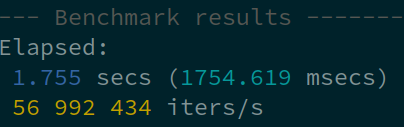
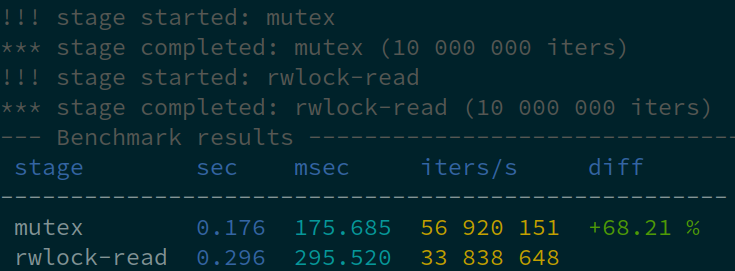
Pretty cool, isn't it? Let us create a more complex staged benchmark and
compare e.g. Mutex vs RwLock. Staged benchmarks display a comparison table. If
the reference stage is specified, the table also contains speed difference for
all others.
```rust,ignore
#[macro_use]
extern crate bma_benchmark;
use std::sync::{Mutex, RwLock};
let n = 10_000_000;
let mutex = Mutex::new(0);
let rwlock = RwLock::new(0);
staged_benchmark_start!("mutex");
for _ in 0..n {
let _a = mutex.lock().unwrap();
}
staged_benchmark_finish_current!(n);
staged_benchmark_start!("rwlock-read");
for _ in 0..n {
let _a = rwlock.read().unwrap();
}
staged_benchmark_finish_current!(n);
staged_benchmark_print_for!("rwlock-read");
```
The same can also be done with a couple of *staged_benchmark* macros:
```rust,ignore
#[macro_use]
extern crate bma_benchmark;
use std::sync::{Mutex, RwLock};
let n = 10_000_000;
let mutex = Mutex::new(0);
let rwlock = RwLock::new(0);
staged_benchmark!("mutex", n, {
let _a = mutex.lock().unwrap();
});
staged_benchmark!("rwlock-read", n, {
let _a = rwlock.read().unwrap();
});
staged_benchmark_print_for!("rwlock-read");
```
Or split into functions with *benchmark_stage* attributes:
```rust,ignore
use std::sync::{Mutex, RwLock};
#[macro_use]
extern crate bma_benchmark;
#[benchmark_stage(i=10_000_000)]
fn benchmark_mutex(mutex: Mutex<u64>) {
let _a = mutex.lock().unwrap();
}
#[benchmark_stage(i=10_000_000,name="rwlock-read")]
fn benchmark_rwlock(rwlock: RwLock<u64>) {
let _a = rwlock.read().unwrap();
}
let mutex = Mutex::new(0);
let rwlock = RwLock::new(0);
benchmark_mutex(mutex);
benchmark_rwlock(rwlock);
staged_benchmark_print_for!("rwlock-read");
```
## Errors
The macros *benchmark_print*, *staged_benchmark_finish* and
*staged_benchmark_finish_current* accept error count as an additional
parameter.
For code blocks, macros *benchmark_check* and *staged_benchmark_check* can be
used. In this case, a statement MUST return true for the normal execution and
false for errors:
```rust.ignore
#[macro_use]
extern crate bma_benchmark;
use std::sync::Mutex;
let mutex = Mutex::new(0);
benchmark_check!(10_000_000, {
mutex.lock().is_ok()
});
```
The *benchmark_stage* attribute has **check** option, which behaves similarly.
If used, the function body MUST (not return but) END with a bool as well.
If any errors are reported, additional columns appear, success count, error
count and error rate:

## Latency benchmarks
```rust,ignore
use bma_benchmark::LatencyBenchmark;
let mut lb = LatencyBenchmark::new();
for _ in 0..1000 {
lb.op_start();
// do something
lb.op_finish();
}
lb.print();
```
```ignore
latency (μs) avg: 883, min: 701, max: 1_165
```
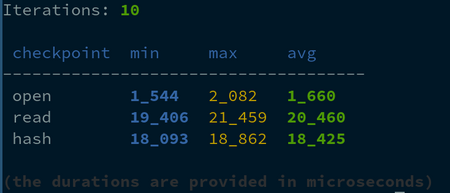
## Performance measurements
```rust,ignore
let file_path = "largefile";
let mut perf = Perf::new();
for _ in 0..10 {
perf.start();
let mut file = File::open(file_path).unwrap();
perf.checkpoint("open");
let mut hasher = Sha256::new();
let mut buffer = Vec::new();
file.read_to_end(&mut buffer).unwrap();
perf.checkpoint("read");
hasher.update(&buffer);
perf.checkpoint("hash");
}
perf.print();
```
Need anything more complex? Check the crate docs and use structures manually.
Enjoy!