# Bigoish: Test the empirical computational complexity of Rust algorithms
Your functions or datastructure methods implement an algorithm; how do you know if they're scaling as expected?
For example, imagine you've implemented a new sorting algorithm.
Decent sorting is typically O(nlogn), but how about _your_ implementation?
Maybe there's a bug somewhere that makes it worse.
With `bigoish`, pronounced "big-o-ish", you can write tests that assert that a particular function has a particular empirical computational complexity.
More accurately, you can assert that an expected complexity model you provide is empirically the best fit for measured runtime, when compared to the fits of a specific set of common complexity models.
Real big-O, in contrast, is a mathematically-proven upper bound.
Here's an example, asserting that Rust's built-in `sort()` fits `n*log(n)` best:
```rust
use bigoish::{N, Log, assert_best_fit, growing_inputs};
// The function whose complexity we want to assert.
fn sort(mut v: Vec<i64>) -> Vec<i64> {
v.sort();
v
}
// Creates a test input of a particular size for `sort()`.
fn make_vec(n: usize) -> Vec<i64> {
// Random number generation library:
use fastrand;
std::iter::repeat_with(|| fastrand::i64(..)).take(n).collect()
}
// Assert that that n*log(n) is the complexity model that fits `sort()` best.
assert_best_fit(
// The expected best-fitting computational complexity model:
N * Log(N),
// The function being tested:
sort,
// Pairs of (input length, input); the inputs will be passed to `sort()`.
[
(10, make_vec(10)), (100, make_vec(100)), (1000, make_vec(1000)),
(10_000, make_vec(10_000)), (100_000, make_vec(100_000))
]
);
// You can use `growing_inputs()` to generate input pairs more easily.
assert_best_fit(
N * Log(N),
sort,
// Starting with input size 10, generate 25 increasingly larger inputs using
// `make_vec()`.
growing_inputs(10, make_vec, 25),
);
```
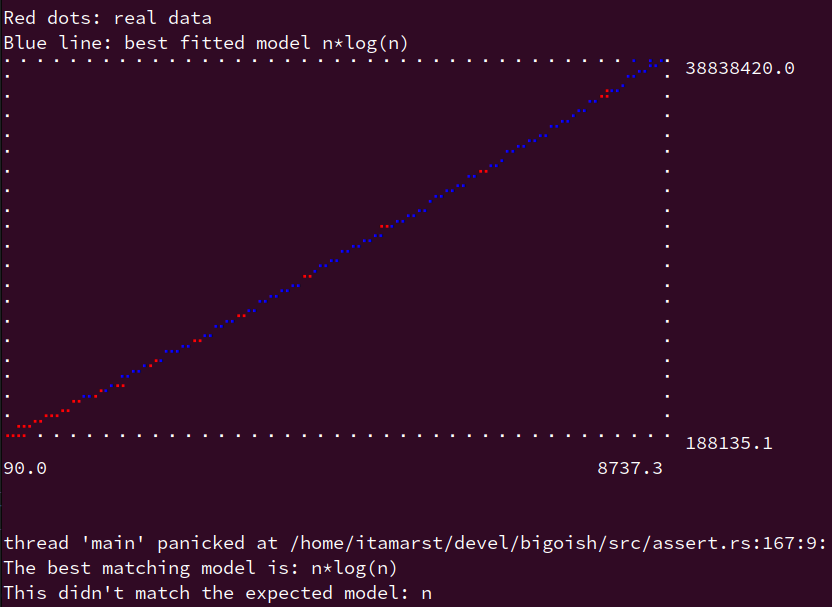
If you were to erroneously assert that `sort()` uses model `N`:
```ignore
assert_best_fit(N, sort, growing_inputs(10, make_vec, 25));
```
You would then get a panic that looks like this:

## Improving your chances of a correct fit
Sometimes [`assert_best_fit`] will misidentify your function's likely complexity, claiming that, for example, `n*log(n)` is the best fit for your function despite it clearly being linear.
Or, it may fail intermittently.
To reduce the chances of this happening, you should:
* Use a sufficient number of inputs.
Using 20 inputs is better than using 4 inputs.
* Make sure your inputs span a number of orders of magnitude.
For example, if your function takes a `Vec`, testing with vectors of length 10, 100, 1000, and 10_000 is better than lengths of 10, 11, 12, and 13.
The [`growing_inputs()`] function is a useful way to generate a sequence of increasingly bigger inputs.
* Make sure the minimal size of your inputs is large enough.
Tiny inputs may have too much noise when the function's runtime is measured.
## Differences between `release` and `test` profiles
Typically `cargo test` runs with the ["test" profile](https://doc.rust-lang.org/cargo/reference/profiles.html), whereas released code runs with the "release" profile.
The latter drops debug assertions, and compiles with optimizations.
As a result, if you're using [`assert_best_fit`] in a `#[test]`, by default when you run `cargo test` you'll be asserting on code that is compiled differently than in released code.
Most of the time, this doesn't matter; the "test" profile will result in _slower_ code, but not in a different computational complexity.
Sometimes, however, "release" profile will allow the compiler to optimize your code into something much more scalable; perhaps a loop can be optimized into a constant-time operation.
In that case, you'll want to run [`assert_best_fit`] under the "release" profile in order to assert the correct complexity model.
You can make your test only run if debug assertions are disabled:
```no_run
#[cfg(not(debug_assertions))]
#[test]
fn complexity_of_sort() {
assert_best_fit(
N * Log(N),
sort,
[
(1000, make_vec(1000)),
(10_000, make_vec(10_000)),
(100_000, make_vec(100_000))
]
)
}
```
And then run tests with the "release" profile:
```bash
cargo test --release
```
## How it works
[`assert_best_fit`] takes an expected complexity model, a single-threaded function, and inputs (or rather, input sizes plus values).
[`assert_best_fit`] then tries to fit pairs of `(input size, measured runtime of function(input))` to the given model, as well as to additional models: constant, n, n², n³, √n, log(n), nlog(n), log(log(n)).
If the best-fitting model is the one you asserted, all is well; if not, [`assert_best_fit`] panics.
You can construct new models from the existing implementations of [`Model`], or create your own.
How runtime is measured depends on your operating system and environment:
* On Windows and macOS, the measurement uses CPU usage time on the current thread.
* On Linux, an attempt will be made to use the CPU instruction count for the current thread.
However, this doesn't work in all environments, for example it doesn't work on GitHub Actions.
If CPU instruction counts are unavailable, CPU usage time will be used instead.
* If you set an environment variable `BIGOISH_TIME_ONLY=1`, CPU usage time will be used regardless.
Notice that in all cases time spent sleeping or otherwise waiting shouldn't be counted, though you probably shouldn't do that in your code in the first place.
## Accessibility
If [`assert_best_fit`] panics and you're using a terminal, it will generate a graph showing how well the best fitting model matches your inputs and their measured runtime.
That way you can visually see if the proposed alternative model makes sense or not.
If you're using a screen reader, you can disable this behavior by setting either `NO_COLORS` or `TERM=dumb` environment variables.
Both, especially the latter, will likely impact the behavior of other programs.
## Credits
This crate is inspired by the Python library [bigO](https://github.com/plasma-umass/bigO/), which in turn is based on [_Measuring Empirical Computational Complexity_](https://theory.stanford.edu/~aiken/publications/papers/fse07.pdf) by Goldsmith et al.