
bevy_fairy
Let a coding agent look inside a running Bevy game, drive it, and ask the person playing it for help — without touching your desktop.



bevy_fairy is two things in one crate:
- a Bevy plugin your game links, which adds debugging methods to the Bevy Remote Protocol (BRP);
- an MCP server,
bevy-fairy, which gives an agent such as Claude Code tools to read the game's state, run the game's own commands, capture what it shows, and inject input.
coding agent ──MCP over stdio──▶ bevy-fairy ──BRP over HTTP :15702──▶ your game + DebuggerPlugin
                                                                            │
                                                        guide card on screen ▼
                                                              the person at the keyboard
[!NOTE] This crate was written by an AI agent working from a human's direction. It is tested against a fixture game and used against a real one, but it has had no line-by-line human audit.
See it work
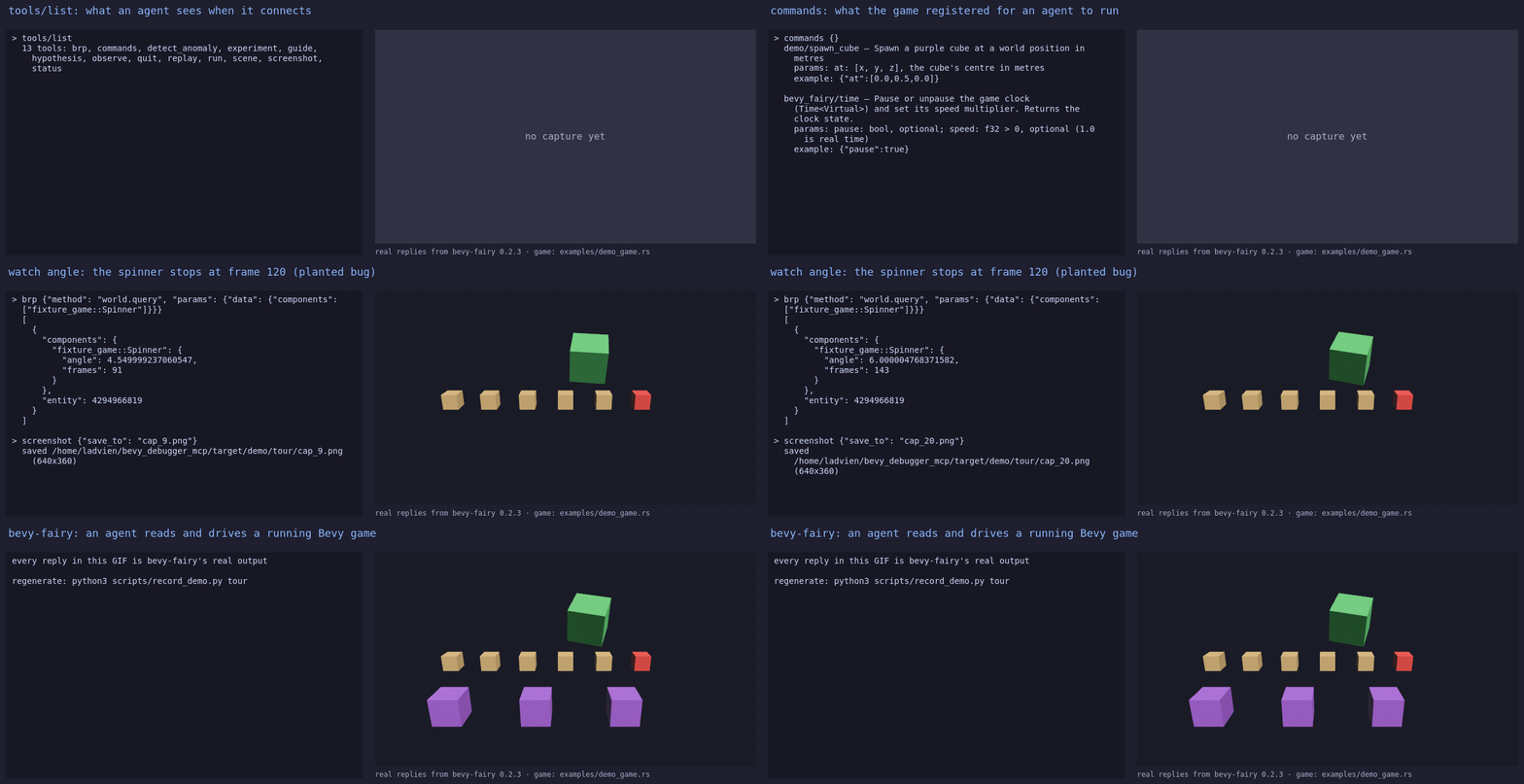
A scripted tour. Every reply is the real server's output; every picture is the game frame its
screenshot tool returned. The game runs at 10 fps here so the planted bug — the spinner stops at
frame 120 — happens mid-tour.
A real agent session. Claude, with no tools but these, told that something in the game which
should spin forever stops, and asked what it is, which of its values stops changing, and on what
frame. The script runs that question as the spinner_stops eval up to three times and draws the
first session that passes; it never draws one that failed.
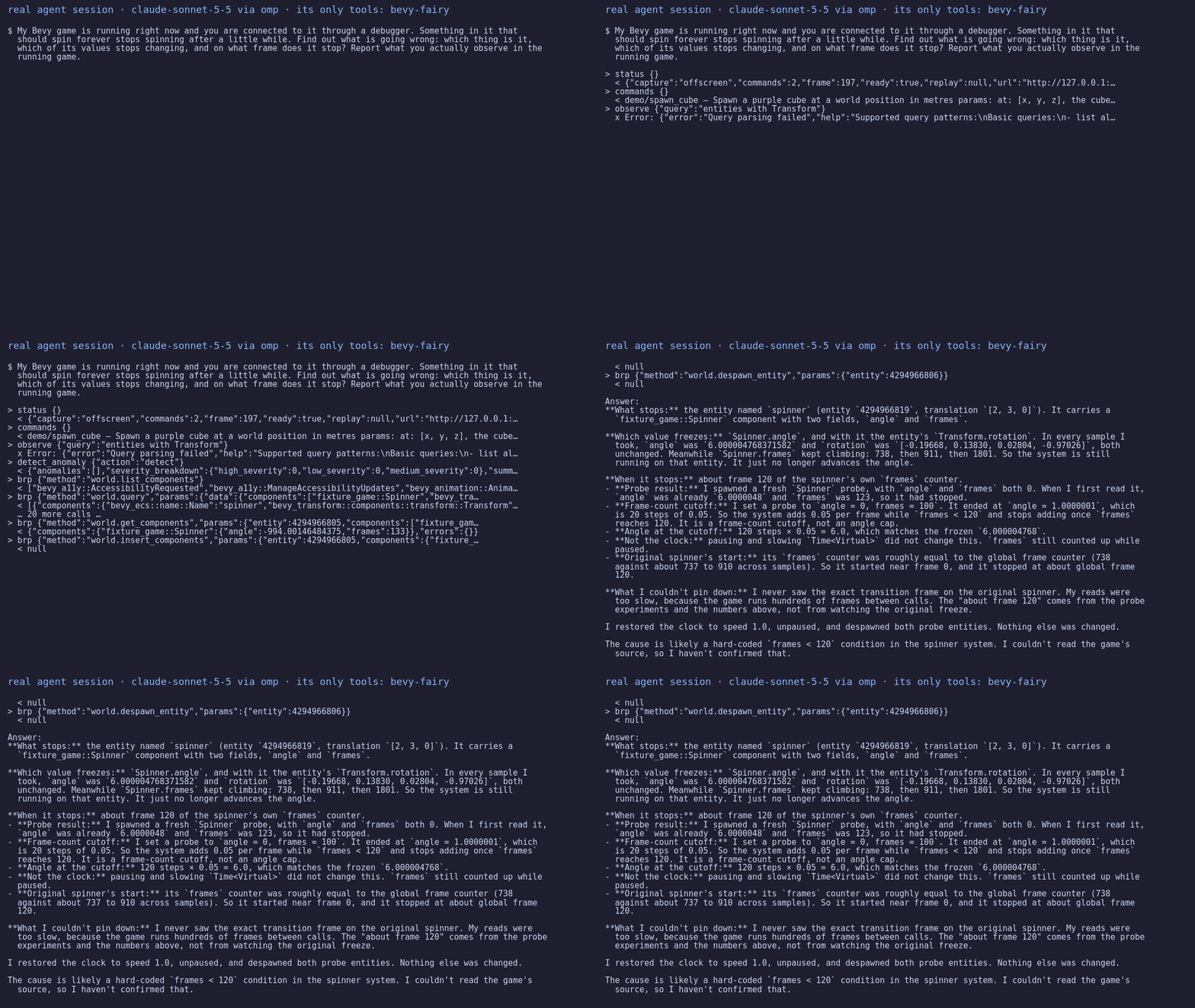
Both are recorded from examples/demo_game.rs
by python3 scripts/record_demo.py all.
Why
An agent that debugs a game by reading source code is guessing. It needs to see the game's actual state, change it, and check what happened. The obvious way to do that, OS screenshots and OS input, needs the game window in front: on the game this was built for, a capture with the window focused had 7,188 distinct colours, and with another app in front it had one. Synthetic OS keystrokes go to whichever window has focus, which is often the one you are typing in.
So nothing here touches the operating system. Captures come from the game's own pixels, input is
written into Bevy's own input streams, and tests/plugin_leaf.rs fails the build if the plugin's
dependency graph ever gains something that could synthesise an OS event.
What an agent can do with it
| How | |
|---|---|
| Read state | Query any entity, component or resource over BRP (brp, observe). |
| Run game actions | Call commands your game registers, each with typed params and a worked example (commands, run). |
| See the screen | Capture a PNG from an offscreen render target, or from the game window (screenshot). |
| Press keys, type, click, drag | Inject keyboard, text, mouse, scroll and cursor input that the game reads like the real thing. |
| Ask a person | Show one instruction at a time on the player's screen and watch for the state it asked for (guide). |
| Record and replay | Save the commands a session ran and replay them when the game starts (scene). |
It cannot see frame time, CPU or memory: BRP does not report them, and the tools say so rather than make up a number.
Quick start
This takes a game you already have and an agent that speaks MCP, such as Claude Code.
1. Add the plugin to your game.
# Cargo.toml
[]
= "0.20"
= { = "0.4", = false, = ["plugin"] }
use *;
use RemoteHttpPlugin;
use DebuggerPlugin;
Run the game, then check it answers:
# {"jsonrpc":"2.0","id":1,"result":{..., "ready":true, ...}}
2. Install the server.
# bevy-fairy 0.4.0
3. Register it with your agent. For Claude Code, from your project directory:
For Claude Desktop or a project .mcp.json:
4. Try it. With the game running, ask the agent: "Call status, then list the game's resources
with brp." It should report ready: true and a list of resource type names. From there, ask it
questions about your game.
If it doesn't work
| Symptom | Cause and fix |
|---|---|
status says no game is answering |
The game is not running, or BEVY_BRP_HOST/BEVY_BRP_PORT do not point at it. The default is localhost:15702. |
| The game panics on start | You added a second RemotePlugin. DebuggerPlugin adds its own; add only a transport such as RemoteHttpPlugin. Or InputPlugin is missing: DefaultPlugins has it, MinimalPlugins does not. |
The agent sees no bevy-fairy tools |
The client cannot find the binary. Run bevy-fairy --version; if that works, give command as the full path (~/.cargo/bin/bevy-fairy) and restart the client. |
screenshot says bevy_fairy/screenshot is not registered |
Build the game with the plugin-screenshot feature. |
A +watch method is refused by brp |
Watching methods stream; brp returns one answer per call. Call the method without +watch again. |
Guides
Let the agent run your game's actions
Register commands with typed params and a worked example. The agent finds them with commands and
runs them with run; a mistyped name is answered with the nearest real one, and wrong params are
refused before your handler runs.
use ;
use ;
// After .add_plugins(DebuggerPlugin::default()):
app.add_debug_command;
Registration is checked at startup: a reserved name (bevy_fairy/, world., ...), a duplicate,
or an example that does not parse as the params type panics then, not when the agent calls it.
If your game needs time to load, build the plugin with DebuggerPlugin::default().host_signals_ready()
and set the DebugReady resource to true when it is; until then every command answers "not
ready yet".
Capture what the game shows
Enable plugin-screenshot, then give the plugin an image one of your cameras renders to:
use DebugCaptureTarget;
commands.insert_resource;
With a DebugCaptureTarget, captures come from that image and never depend on the window. Without
one, screenshot falls back to the game window. That needs nothing from the OS, but a covered or
minimised window can give a stale frame. A full example with the camera setup is
examples/plugin_agent_scene.rs.
Inject input
The agent sends input through brp with the method bevy_fairy/input:
{"kind": "Keyboard", "key": "Space"}                      // a tap: pressed one frame, released the next
{"kind": "Keyboard", "text": "site_67"}                   // typed into a focused text field
{"kind": "Cursor", "x": 640, "y": 360}                    // logical window pixels (see below)
{"kind": "Mouse", "button": "Left", "action": "Press"}
{"kind": "Cursor", "clear": true}                         // hand the pointer back to the real mouse
Input is written into Bevy's own input messages before its input systems run, so just_pressed,
text fields and ButtonInput all see it like a real key.
The pointer reaches picking. Cursor and Mouse also write the WindowEvent messages a real
mouse produces, so bevy_ui buttons, Interaction and On<Pointer<Click | Over | Out | Drag..>>
observers fire with no code on your side. A press at one position, a Cursor move and a release
elsewhere is a drag. A click lands at the last Cursor position; with none set the reply carries a
note saying so.
Coordinates. x/y are logical window pixels, top-left origin, the same space
Window::cursor_position reports, unless the host inserted a DebugCaptureTarget (feature
plugin-screenshot). Then the pointer is routed to that image instead of the window, because a camera
that renders to an image is not hit by a window pointer, and x/y are pixels of that image. One
route per game: a host with both a window UI and a capture target is driven through the image.
A host that reads the pointer itself rather than through picking has one line to write: read it through
bevy_fairy::cursor_position(&window, &debug_cursor), not Window::cursor_position. The plugin never
moves the real pointer, because Bevy would move the physical mouse out from under whoever is at the
machine.
Guide a person through a test
Enable plugin-guide. The agent posts a script with guide; your game shows one step at a time:
A checkpoint is a condition your game registers by name, so the plugin never needs to know your game's vocabulary:
use Checkpoints;
let has_two = app.register_system;
app.world_mut..register;
A step without a checkpoint waits for the person to say it is done. For each step the agent gets back how many times it came up, how many of those its checkpoint passed, and how long it took.
Save and replay a session
Every game command the agent runs is recorded. scene save <path> writes them to a file;
starting the game with BEVY_FAIRY_SCENE=<path> replays them, one step per frame, once the game
reports ready. Scenes record commands, not raw input.
Reference
- Tools: 13 MCP tools.
docs/mcp-tools.mdhas every description and argument, generated from the server's owntools/list. - API: the plugin's types are documented on docs.rs.
BRP methods the plugin registers
| Method | Feature | What it does |
|---|---|---|
bevy_fairy/status |
plugin |
Whether the game is ready, its frame, and what it can capture |
bevy_fairy/commands |
plugin |
The commands the game registered, with params and examples |
bevy_fairy/input |
plugin |
Inject keyboard, text, mouse, scroll and cursor input |
bevy_fairy/scene |
plugin |
Show or clear the recorded commands |
bevy_fairy/time |
plugin |
Pause the game clock or change its speed; the request is re-applied every frame and the reply says whether it held (a built-in command). A host that owns Time<Virtual> adds .host_owns_clock() and reads ClockRequest |
bevy_fairy/quit |
plugin |
Ask the game to exit |
bevy_fairy/ui_text |
plugin-ui-text |
The bevy_ui text the player can read, with each node's rect (a built-in command, called with run) |
bevy_fairy/screenshot, bevy_fairy/capture |
plugin-screenshot |
Capture a frame and fetch it as PNG |
bevy_fairy/guide, bevy_fairy/guide+watch |
plugin-guide |
Post a guide script; stream its progress |
Bevy's own methods (world.query, world.get_resources, registry.schema, ...) work too.
Cargo features
| Feature | Use it for | Turns on |
|---|---|---|
server (default) |
Building the bevy-fairy binary |
The MCP server and its dependencies |
plugin |
Your game | The plugin; four direct dependencies |
plugin-screenshot |
Your game, with capture | plugin + Bevy's renderer |
plugin-guide |
Your game, with the guide overlay | plugin + Bevy UI and picking |
plugin-ui-text |
Your game, if an agent should read its HUD text | plugin + Bevy UI |
A game should depend on bevy_fairy with default-features = false, or it compiles the server too.
Environment variables
| Variable | Read by | Default | Meaning |
|---|---|---|---|
BEVY_BRP_HOST |
server | localhost |
Where the game's BRP endpoint is |
BEVY_BRP_PORT |
server | 15702 |
Its port |
BEVY_FAIRY_CAPTURE_DIR |
server | ./debug_captures |
Where screenshot saves PNGs |
RUST_LOG |
server | info |
Log level; logs go to stderr, stdout carries MCP |
BEVY_FAIRY_SCENE |
game | unset | A saved scene to replay at startup |
Examples
None of these need a window or a GPU unless noted. Each prints what happened.
| Command | Shows |
|---|---|
cargo run --features plugin --example plugin_injected_input_lands |
An injected key is just_pressed for exactly one frame |
cargo run --features plugin --example plugin_typed_text_lands |
Typed text reaches a text field |
cargo run --features plugin --example plugin_cursor_drag_lands |
A click-drag lands where it was aimed |
cargo run --features plugin-guide --example plugin_guided_steps_land |
A three-step guide script, driven to completion |
cargo run --features plugin-screenshot --example plugin_agent_scene |
A small game with a command and an offscreen capture target (opens a window) |
cargo run --features plugin --example fixture_game |
The headless game the tests and evals check the tools against |
cargo run --features plugin-screenshot --example demo_game |
The fixture game rendered offscreen, headless; the GIFs above are recorded from it |
Development
UPDATE_TOOL_REFERENCE=1 Tool behaviour is tested against examples/fixture_game.rs, whose state is known from its own
constants. evals/ measures
whether an agent with only this server can answer debugging questions about that game.
CLAUDE.md explains the design
decisions that are easy to undo by accident.
Issues and pull requests are welcome at github.com/Ladvien/bevy_fairy.
Changelog
See CHANGELOG.md.
License
Licensed under either of MIT or Apache-2.0, at your option.