# Walkthrough
A short tour of the SPA's surface.
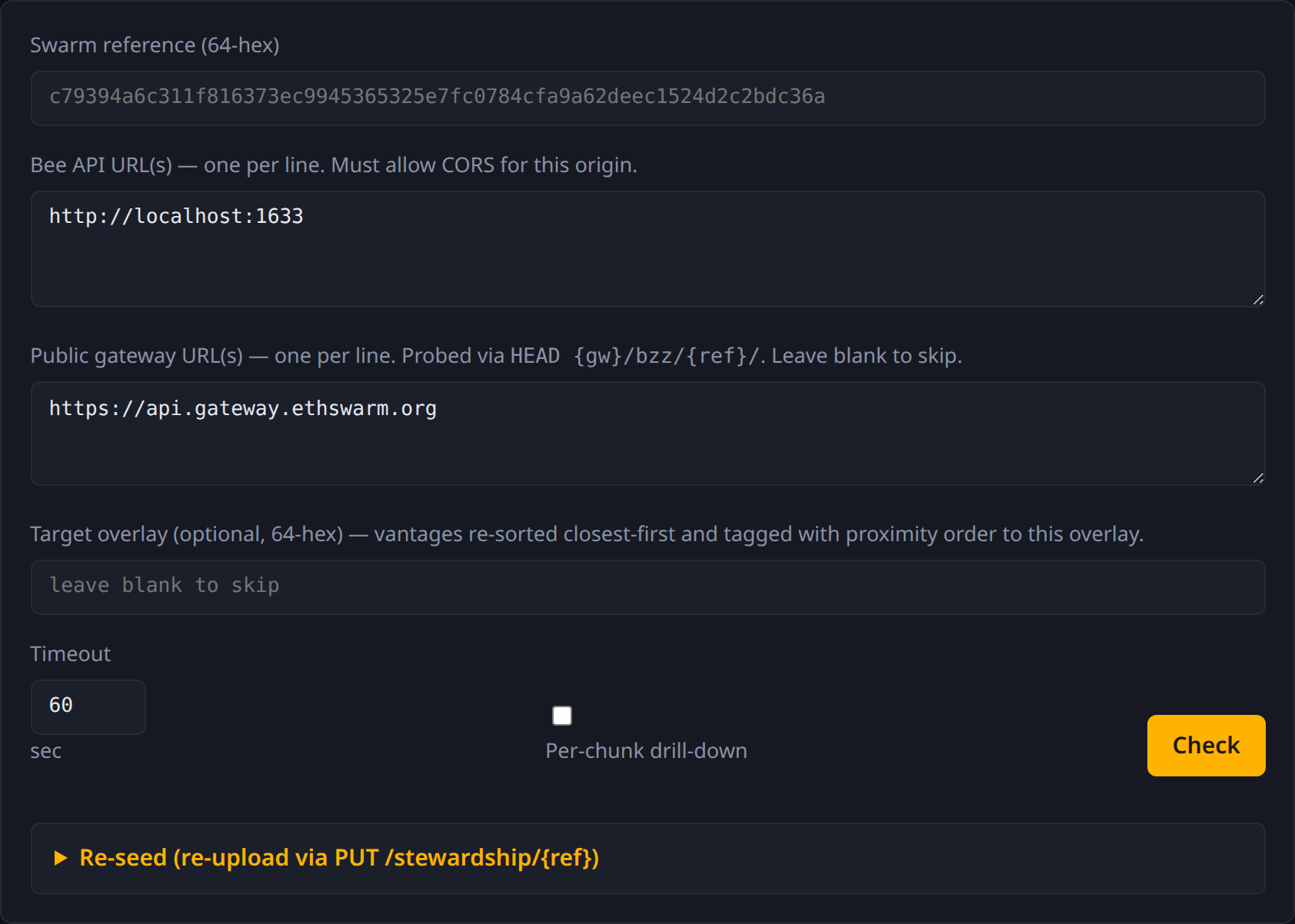
## The form
- **Swarm reference** — 64-hex address, or `feed:OWNER:TOPIC` for a
feed.
- **Bee API URL(s)** — one per line. Each becomes a vantage.
- **Public gateway URL(s)** — one per line. Each becomes a gateway
probe. Leave blank to skip.
- **Target overlay** — optional 64-hex. When set, vantages re-sort
closest-first and gain a `target_proximity` badge.
- **Timeout** — per-request cap in seconds.
- **Per-chunk drill-down** — checkbox. When on, after the basic
probe the page walks the manifest and probes every chunk.
- **Cold download** — checkbox. When on, the page also streams
`GET /bytes/{ref}` from each Bee URL and `GET /bzz/{ref}/` from
each gateway, recording total bytes and elapsed time.
- **Check** button — runs the probe. While drilling, the button
shows live progress (`Probing chunks N/M…`).
## The report

Renders top-to-bottom:
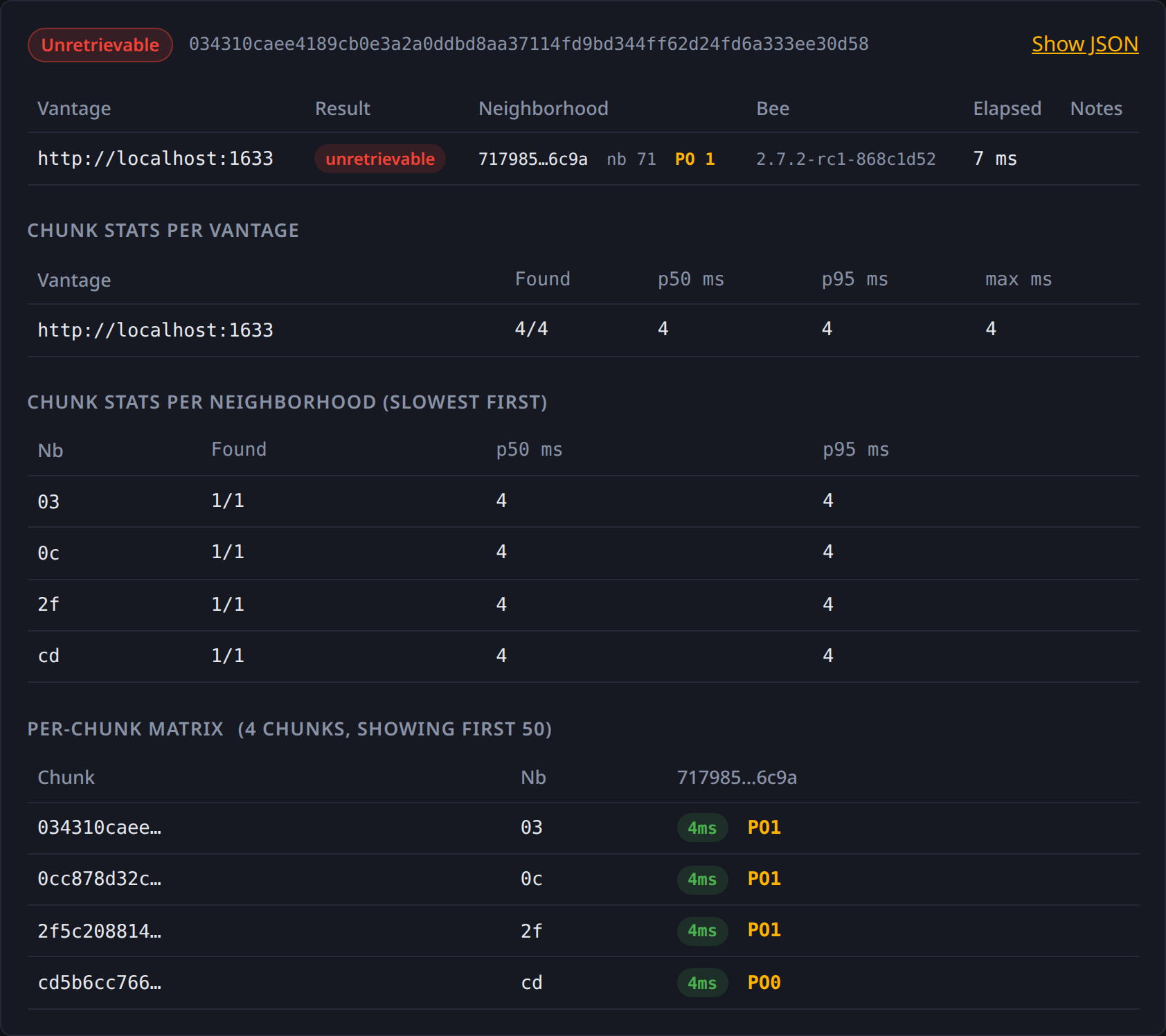
1. **Status pill + reference** at the top.
2. **Vantages table** — one row per Bee URL with: result pill,
neighborhood/overlay + PO, Bee version, elapsed_ms, notes.
3. **Gateways table** — if any gateway URLs were given.
4. **Chunk stats per vantage** — if `--per-chunk` was enabled.
Rows: vantage → found/total + p50/p95/max latency.
5. **Chunk stats per neighborhood** (slowest first) — same shape,
keyed on chunk neighborhood. Top-10.
6. **Per-chunk matrix** — first 50 chunks × all vantages, with
per-cell elapsed_ms + PO badges (× pill on miss).
7. **Resolution** — present when input was a feed handle.
8. **Show JSON** — toggle to expand the full report as raw JSON for
copy/paste.
A `--per-chunk` run rendered:
## The re-seed panel

Collapsed by default. Expand it to reveal:
- **Postage batch ID** — 64-hex.
- **Pre-flight stamp** button — calls `GET /stamps/{id}`, reports
`exists / usable / TTL` and any warnings.
- **Re-seed now** button — only enabled after pre-flight reports
healthy. Fires `PUT /stewardship/{ref}` against the first Bee URL.
## Drag-and-drop a report
Drop any `bee-check --output json` file anywhere on the page (or
any report file the SPA itself produced) and it'll render in place
of running a fresh probe. Useful for sharing diagnostics: a teammate
runs the CLI, attaches the JSON in a message, you drop it on the
page.