# Balanced Directions
**Balanced Directions** is a Rust crate for modeling directions and movements in a 3x3 grid using a balanced
ternary-inspired logic. It provides comprehensive tools to manipulate positions, paths, and directions on a grid-based
structure, making it particularly useful in scenarios requiring discrete grid movement, coordinated navigation, or 2D
spatial logic.

## Features
- **Enum Representation (`Balance`)**:
Represents positions in a 3x3 grid with easy access to their 2D vector representation.
- **Grid Navigation**:
Convenient methods for grid-based movement operations (`up`, `down`, `left`, `right`) as well as rotations, flips, and
vector transformations.
- **Path Manipulation**:
A `Path` structure for modeling sequences of movements, offering utilities to normalize, reverse, and transform paths.
- **Ternary Integration (Optional)**:
[Balanced ternary]()-based coordinates when integrating with the `balanced-ternary` crate.
- **`#![no_std]` Compatibility**:
A lightweight design for use in embedded or low-level systems.
## Examples
### Position Representation and Movement
The core `Balance` enum represents positions in a 3x3 grid. For example, you can easily identify positions such as
`TopLeft` or `Center`. Use movement methods to perform grid operations.
```rust
use balanced_directions::Balance;
fn example_usage() {
let position = Balance::TopLeft;
assert_eq!(position.to_vector(), (-1, -1));
let moved = position.right();
assert_eq!(moved, Balance::Top);
let rotated = moved.rotate_left();
assert_eq!(rotated, Balance::Left);
}
```
### Path Representation and Manipulation
The `Path` structure enables you to work with sequences of grid movements.
```rust
use balanced_directions::{Balance, Path};
fn path_example() {
let movements = vec![Balance::Top, Balance::Right, Balance::Bottom];
let path = Path::new(movements);
assert_eq!(path.len(), 3);
assert_eq!(path.to_vector(), (1, 0)); // Cumulative movement: right by 1
let normalized_path = path.normalized();
assert_eq!(normalized_path.to_vector(), (1, 0)); // Same result after normalization
}
```
### Integration with Balanced Ternary
With the feature `"ternary"`, you can convert grid positions to and from balanced ternary representations.
```rust
use balanced_directions::Balance;
use balanced_ternary::Digit;
fn ternary_example() {
let position = Balance::Top;
let ternary_pair = position.to_ternary_pair();
assert_eq!(ternary_pair, (Digit::Zero, Digit::Neg)); // Top is represented as (0, -1)
let recreated_position = Balance::from_ternary_pair(Digit::Zero, Digit::Neg);
assert_eq!(recreated_position, Balance::Top);
}
```
## API Overview
### `Balance`
The `Balance` enum represents nine positions of a 3x3 grid:
- `TopLeft`, `Top`, `TopRight`
- `Left`, `Center`, `Right`
- `BottomLeft`, `Bottom`, `BottomRight`
#### Operations:
##### Binary operations
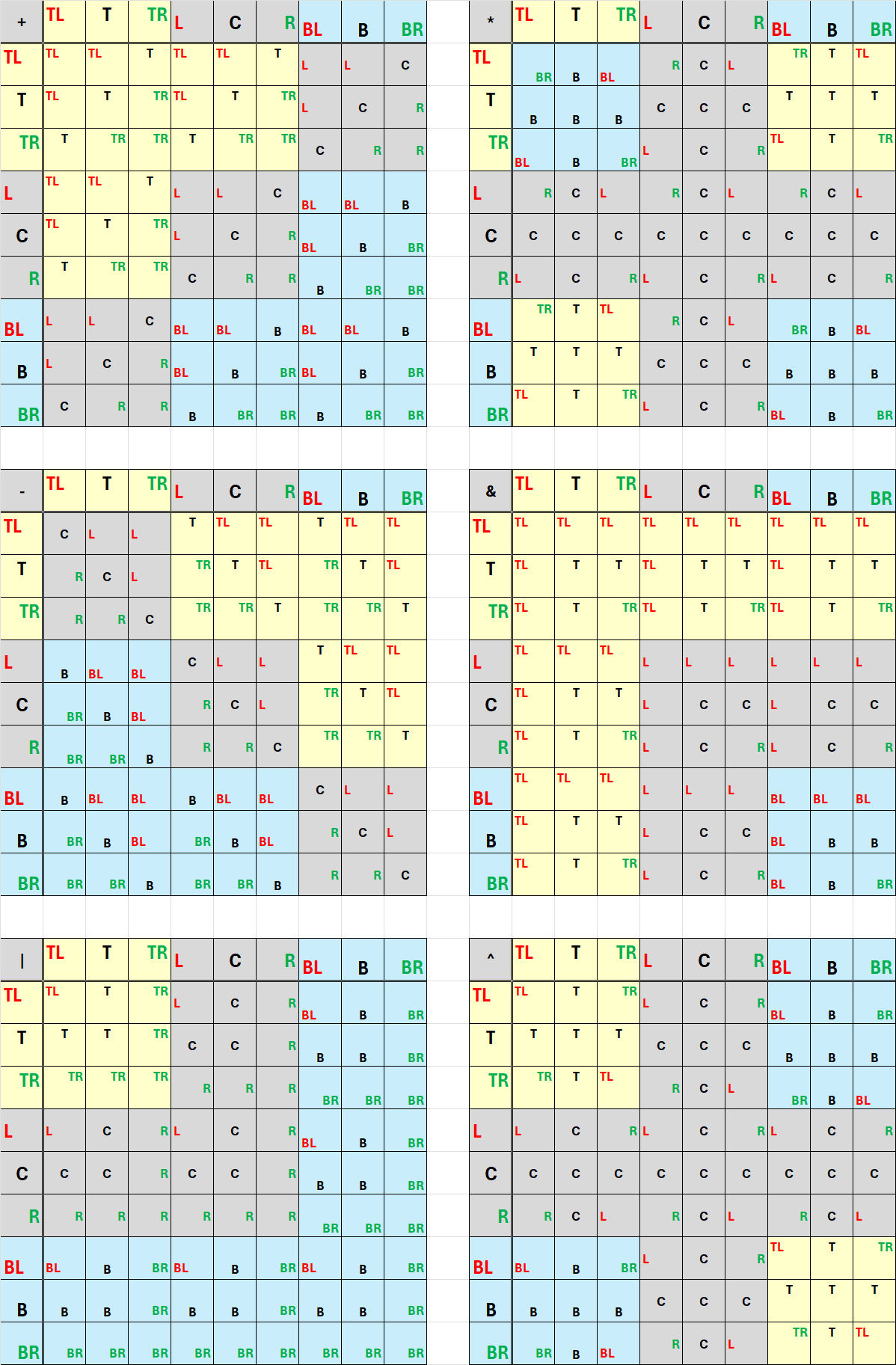
##### Unary operations

### `Path`
A collection of `Balance` movements stored as steps in a sequence. Paths can be created, traversed, and normalized for
efficient representation of cumulative movement.
#### Key Methods:
- **Construction**: `new()`, `from_vector()`
- **Traversal**: `iter()`, `iter_mut()`
- **Transformation**:
`normalized()`, `reversed()`, `each()`, `each_zip()`
## Cases
1. **Grid-based Movement in Games**
Simulate and manipulate movements within 3x3 environments for character navigation, AI paths, or puzzle logic.
2. **Embedded Robotics Applications**
Represent grid movements for sensor or actuator navigation without relying on the standard library.
3. **Spatial Modeling or Math-based Algorithms**
Perform 2D spatial computations with a high-level abstraction for vector-based movements.
## Documentation
The complete API documentation is available on [docs.rs](https://docs.rs/balanced-direction). It contains details on each type, method, and their use
cases.
## Related Libraries
- [`balanced-ternary`](https://crates.io/crates/balanced-ternary): Provides balanced ternary number manipulations used
for optional integration.
## License
Copyright (c) 2025 [Sébastien GELDREICH](mailto:dev@trehinos.eu)
`Balanced Direction` is licensed under the [MIT License](LICENSE).


