use std::sync::Arc;
use rustfft::num_complex::Complex;
pub use rustfft::FftDirection;
use rustfft::{Fft, FftNum, FftPlanner};
use audio_processor_traits::num::traits::FloatConst;
use audio_processor_traits::simple_processor::MonoAudioProcessor;
use audio_processor_traits::{AudioContext, Float};
use crate::window_functions::{make_window_vec, WindowFunctionType};
pub struct FftProcessorOptions {
pub size: usize,
pub direction: FftDirection,
pub overlap_ratio: f32,
pub window_function: WindowFunctionType,
}
impl Default for FftProcessorOptions {
fn default() -> Self {
Self {
size: 8192,
direction: FftDirection::Forward,
overlap_ratio: 0.0,
window_function: WindowFunctionType::Hann,
}
}
}
pub type FftProcessor = FftProcessorImpl<f32>;
pub struct FftProcessorImpl<ST> {
input_buffer: Vec<ST>,
fft_buffer: Vec<Complex<ST>>,
scratch: Vec<Complex<ST>>,
cursor: usize,
window: Vec<ST>,
step_len: usize,
size: usize,
fft: Arc<dyn Fft<ST>>,
has_changed: bool,
}
impl<ST: FftNum + std::iter::Sum + Float + FloatConst> Default for FftProcessorImpl<ST> {
fn default() -> Self {
Self::new(Default::default())
}
}
impl<ST: FftNum + std::iter::Sum + Float + FloatConst> FftProcessorImpl<ST> {
pub fn new(options: FftProcessorOptions) -> Self {
let FftProcessorOptions {
size,
direction,
overlap_ratio,
window_function,
} = options;
let mut planner = FftPlanner::new();
let fft = planner.plan_fft(size, direction);
let mut input_buffer = Vec::with_capacity(size);
input_buffer.resize(size, ST::zero());
let mut fft_buffer = Vec::with_capacity(size);
fft_buffer.resize(size, ST::zero().into());
let scratch_size = fft.get_inplace_scratch_len();
let mut scratch = Vec::with_capacity(scratch_size);
scratch.resize(scratch_size, ST::zero().into());
let window = make_window_vec(size, window_function);
let step_len = Self::calculate_hop_size(size, overlap_ratio);
Self {
input_buffer,
fft_buffer,
window,
scratch,
size,
step_len,
cursor: 0,
fft,
has_changed: false,
}
}
fn calculate_hop_size(size: usize, overlap_ratio: f32) -> usize {
(size as f32 * (1.0 - overlap_ratio)) as usize
}
pub fn size(&self) -> usize {
self.size
}
pub fn buffer(&self) -> &Vec<Complex<ST>> {
&self.fft_buffer
}
pub fn fft(&self) -> &Arc<dyn Fft<ST>> {
&self.fft
}
pub fn buffer_mut(&mut self) -> &mut Vec<Complex<ST>> {
&mut self.fft_buffer
}
pub fn input_mut(&mut self) -> &mut [ST] {
&mut self.input_buffer
}
pub fn scratch_mut(&mut self) -> &mut Vec<Complex<ST>> {
&mut self.scratch
}
pub fn step_len(&self) -> usize {
self.step_len
}
pub fn process_fft_buffer(&mut self, samples: &mut [Complex<ST>]) {
self.fft.process_with_scratch(samples, &mut self.scratch);
}
pub fn has_changed(&self) -> bool {
self.has_changed
}
pub fn input_buffer_sum(&self) -> ST {
self.input_buffer.iter().map(|f| f.abs()).sum()
}
#[inline]
pub fn perform_fft(&mut self, start_idx: usize) {
for i in 0..self.size {
let index = (start_idx + i) % self.size;
let sample = self.input_buffer[index];
let magnitude = sample * self.window[i];
assert!(!magnitude.is_nan());
let complex = Complex::new(magnitude, ST::zero());
assert!(!complex.re.is_nan());
assert!(!complex.im.is_nan());
self.fft_buffer[i] = complex;
}
self.fft
.process_with_scratch(&mut self.fft_buffer, &mut self.scratch);
}
}
impl<ST: FftNum + Float + std::iter::Sum + FloatConst> MonoAudioProcessor for FftProcessorImpl<ST> {
type SampleType = ST;
#[inline]
fn m_process(
&mut self,
_context: &mut AudioContext,
sample: Self::SampleType,
) -> Self::SampleType {
self.has_changed = false;
self.input_buffer[self.cursor] = sample;
self.cursor = self.cursor + 1;
if self.cursor >= self.size {
self.cursor = 0;
}
if self.cursor % self.step_len == 0 {
let start_idx = (self.cursor as i32 - self.size as i32) as usize % self.size;
self.perform_fft(start_idx);
self.has_changed = true;
}
sample
}
}
#[cfg(test)]
mod test {
use std::cmp::Ordering;
use std::time::Duration;
use audio_processor_testing_helpers::{
charts::draw_vec_chart, oscillator_buffer, relative_path, sine_generator,
};
use audio_processor_traits::simple_processor::process_buffer;
use audio_processor_traits::{AudioBuffer, AudioProcessorSettings};
use super::*;
#[test]
fn test_hop_size_is_correct() {
let hop_size = FftProcessor::calculate_hop_size(2048, 0.75);
assert_eq!(hop_size, 512);
let hop_size = FftProcessor::calculate_hop_size(2048, 0.875);
assert_eq!(hop_size, 256);
}
#[test]
fn test_create_fft() {
let mut fft_processor = FftProcessor::new(FftProcessorOptions::default());
assert_eq!(fft_processor.size(), FftProcessorOptions::default().size);
assert_eq!(
fft_processor.buffer().len(),
FftProcessorOptions::default().size
);
assert_eq!(
fft_processor.scratch_mut().len(),
FftProcessorOptions::default().size
);
assert_eq!(
fft_processor.step_len(),
FftProcessorOptions::default().size
);
}
#[test]
fn test_create_fft_with_4x_overlap() {
let mut fft_processor = FftProcessor::new(FftProcessorOptions {
overlap_ratio: 0.75,
..FftProcessorOptions::default()
});
assert_eq!(fft_processor.size(), FftProcessorOptions::default().size);
assert_eq!(
fft_processor.buffer().len(),
FftProcessorOptions::default().size
);
assert_eq!(
fft_processor.scratch_mut().len(),
FftProcessorOptions::default().size
);
assert_eq!(
fft_processor.step_len(),
FftProcessorOptions::default().size / 4
);
}
#[test]
fn test_perform_fft_over_silence() {
let mut fft_processor = FftProcessor::default();
let input_buffer = vec![0.0; fft_processor.size()];
fft_processor.input_mut().copy_from_slice(&input_buffer);
fft_processor.perform_fft(0);
let result = fft_processor.buffer();
assert_eq!(result.len(), fft_processor.size());
assert_eq!(result.iter().map(|c| c.norm()).sum::<f32>(), 0.0);
}
#[test]
fn test_perform_fft_over_sine() {
let mut fft_processor = FftProcessor::default();
let mut input_buffer = vec![0.0; fft_processor.size()];
let frequency = 441.0;
let sample_rate = 44100.0;
for i in 0..input_buffer.len() {
let sine = (2.0 * std::f32::consts::PI * frequency * i as f32 / sample_rate).sin();
input_buffer[i] = sine;
}
fft_processor.input_mut().copy_from_slice(&input_buffer);
fft_processor.perform_fft(0);
let result = fft_processor.buffer();
assert_eq!(result.len(), fft_processor.size());
let (maximum_index, _) = result
.iter()
.take(fft_processor.size() / 2)
.enumerate()
.max_by(|(_, c1), (_, c2)| c1.norm().partial_cmp(&c2.norm()).unwrap_or(Ordering::Equal))
.unwrap();
assert_eq!(
maximum_index,
(440.0 / sample_rate * fft_processor.size() as f32) as usize + 1
);
}
#[test]
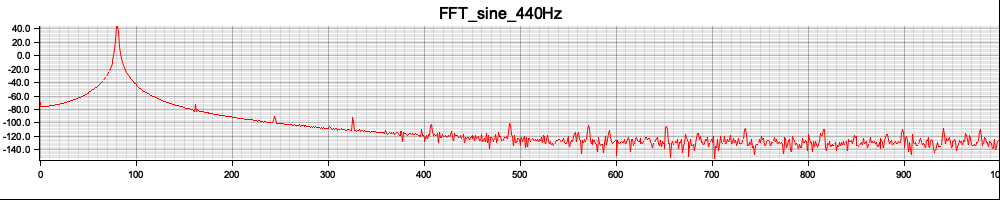
fn test_draw_fft() {
println!("Generating signal");
let signal = oscillator_buffer(44100.0, 440.0, Duration::from_millis(1000), sine_generator);
let mut context = AudioContext::from(AudioProcessorSettings::new(44100.0, 1, 1, 512));
let mut signal = AudioBuffer::from_interleaved(1, &signal);
println!("Processing");
let mut fft_processor = FftProcessor::default();
process_buffer(&mut context, &mut fft_processor, &mut signal);
println!("Drawing chart");
let mut output: Vec<f32> = fft_processor
.buffer()
.iter()
.map(|c| 20.0 * (c.norm() / 10.0).log10())
.collect();
output.reverse();
let output: Vec<f32> = output.iter().take(1000).copied().collect();
draw_vec_chart(
&relative_path!("src/fft_processor.png"),
"FFT_sine_440Hz",
output,
);
}
#[test]
fn test_usize_cast() {
let i = -1;
let i = i as usize % 2;
assert_eq!(i, 1)
}
}