1
2
3
4
5
6
7
8
9
10
11
12
13
14
15
16
17
18
19
20
21
22
23
24
25
26
27
28
29
30
31
32
33
34
35
36
37
38
39
40
41
42
43
44
45
46
47
48
49
50
51
52
53
54
55
56
57
58
59
60
61
62
63
64
65
66
67
68
69
70
71
72
73
74
75
76
77
78
79
80
81
82
83
84
85
86
87
88
89
90
91
92
93
94
95
96
97
98
99
100
101
102
103
104
105
106
107
108
109
110
111
112
113
114
115
116
117
118
119
120
121
122
123
124
125
126
127
128
129
130
131
132
133
134
135
136
137
138
139
140
141
142
143
144
145
146
147
148
149
150
151
152
153
154
155
156
157
158
159
160
161
162
163
164
165
166
167
168
169
170
171
172
173
174
175
176
177
178
179
180
181
182
183
184
185
186
187
188
189
190
191
192
193
194
195
196
197
198
199
200
201
202
203
204
205
206
207
208
209
210
211
212
213
214
215
216
217
218
219
220
221
222
223
224
225
226
227
228
229
230
231
232
233
234
235
236
237
238
239
240
241
242
243
244
245
246
247
248
249
250
251
252
253
254
255
256
257
258
259
260
261
262
263
264
265
266
267
268
269
270
271
272
273
274
275
276
277
278
279
280
281
282
283
284
285
286
287
288
289
290
291
292
293
294
295
296
297
298
299
300
301
302
303
304
305
306
307
308
309
310
311
312
313
314
315
316
317
318
319
320
321
322
323
324
325
326
327
328
329
330
331
332
333
334
335
336
337
338
339
340
341
342
343
344
345
346
347
348
349
350
351
352
353
354
355
356
357
358
359
360
361
362
363
364
365
366
367
368
369
370
371
372
373
374
375
376
377
378
379
380
381
382
383
384
385
386
387
388
389
390
391
392
393
394
395
396
397
398
399
400
401
402
403
404
405
406
407
408
409
410
411
412
413
414
415
416
417
418
419
420
421
422
423
424
425
426
//!
//! This package provides an OWL API that provides as an implementation as close as possible to
//! the OWL 2 Web Ontology Language [Structural Specification](https://www.w3.org/TR/owl2-syntax/).
//!
//! As the structural specification relies heavily on an object-oriented model with inheritence
//! of key concepts there has had to be a mapping from the modeling in the specification to the
//! API herein. That mapping can be describe as follows.
//!
//! 1. Parent types, which are usually abstract, in the OWL 2 specification are present in the
//! API as enumerated types.
//! 1. The `strum` crate provides `is_{variant}` and `trye_as_{variant}` methods on the enum
//! to access sub-types.
//! 2. As all sub-types are distinct each super-type provides implementations of `From`
//! between parent and each child type.
//! 2. Attributes present on parent types are pushed down (replicated) on all sub-types; however,
//! accessors are present on the enumeration for these attributes.
//! 3. Constructors, usually `new(...)`, are provided for simple cases such as `Declaration`
//! with more complex cases using a builder pattern.
//!
//! As the primary goal in the design of the package interface is consistency with the OWL 2
//! structural specification, rather than writing documentation from scratch we will rely on the
//! text of the OWL specification. Each section of Rust documentation will have a sub-section
//! titled **Specification (Section X.Y)** denoting the source location. Examples in the Rust
//! documentation will reference examples in the same section of the source, with the OWL
//! functional syntax shown with Rust equivalent when relevant.
//!
//! ## OWL 2 (Section §1 -- Introduction)
//!
//! An OWL 2 ontology is a formal description of a domain of interest. OWL 2 ontologies consist
//! of the following three different syntactic categories:
//!
//! * *Entities*, such as classes, properties, and individuals, are identified by IRIs. They form
//! the primitive *terms* of an ontology and constitute the basic elements of an ontology. For
//! example, a class *a:Person* can be used to represent the set of all people. Similarly, the
//! object property *a:parentOf* can be used to represent the parent-child relationship. Finally,
//! the individual *a:Peter* can be used to represent a particular person called "Peter".
//! * *Expressions* represent complex notions in the domain being described. For example, a *class
//! expression* describes a set of individuals in terms of the restrictions on the individuals'
//! characteristics.
//! * *Axioms* are statements that are asserted to be true in the domain being described. For
//! example, using a *subclass axiom*, one can state that the class *a:Student* is a subclass of
//! the class *a:Person*.
//!
//! ## Specification (Section -- §Abstract)
//!
//! The OWL 2 Web Ontology Language, informally OWL 2, is an ontology language for the Semantic
//! Web with formally defined meaning. OWL 2 ontologies provide classes, properties, individuals,
//! and data values and are stored as Semantic Web documents. OWL 2 ontologies can be used along
//! with information written in RDF, and OWL 2 ontologies themselves are primarily exchanged as
//! RDF documents. The OWL 2 Document Overview describes the overall state of OWL 2, and should be
//! read before other OWL 2 documents.
//!
//! ## Feature flags
//!
extern crate alloc;
use crate::;
use ;
use ;
use Vec;
// ------------------------------------------------------------------------------------------------
// Public Types
// ------------------------------------------------------------------------------------------------
///
/// A functional-style syntax ontology document is a sequence of Unicode characters accessible via
/// some IRI by means of the standard protocols such that its text matches the `ontologyDocument`
/// production of the grammar defined in this specification document, and it can be converted into
/// an ontology by means of the canonical parsing process described in Section 3.6 and other parts
/// of [this specification document](https://www.w3.org/TR/owl2-syntax/). A functional-style syntax
/// ontology document should use the UTF-8 encoding.
///
/// Note that the Rust type `OntologyDocument` implements the internal production
/// `ontologyDocument`.
///
/// ## Specification (Section §3.7 -- Functional-Style Syntax)
///
/// ```bnf
/// ontologyDocument := { prefixDeclaration } Ontology
///
/// prefixDeclaration := 'Prefix' '(' prefixName '=' fullIRI ')'
/// ```
///
/// ## Examples
///
/// ```owl
/// Prefix(:=<http://www.example.com/ontology1#>)
/// Ontology( <http://www.example.com/ontology1>
/// Import( <http://www.example.com/ontology2> )
/// Annotation( rdfs:label "An example" )
///
/// SubClassOf( :Child owl:Thing )
/// )
/// ```
///
/// ```rust
/// use athene_owlapi::{
/// Ontology, OntologyDocument,
/// axioms::SubClassOf,
/// builders::{AnnotationBuilder, Builder},
/// entities::{Class, EntityTrait},
/// things::owl,
/// };
/// use rdftk_iri::Iri;
/// use std::str::FromStr;
///
/// let document = OntologyDocument::builder()
/// .with_default_namespace(Iri::from_str("http://www.example.com/ontology1#").unwrap())
/// .with_ontology(Ontology::builder()
/// .with_ontology_iri(Iri::from_str("http://www.example.com/ontology1").unwrap())
/// .with_direct_import(Iri::from_str("http://www.example.com/ontology2").unwrap())
/// .with_rdfs_label("An example")
/// .with_class_axiom(SubClassOf::new(
/// Class::new(Iri::from_str("http://www.example.com/ontology1#Child").unwrap()),
/// Class::new(owl::thing_iri()),
/// ))
/// .build()
/// .expect("could not build Ontology"))
/// .build()
/// .expect("could not build OntologyDocument");
/// ```
///
///
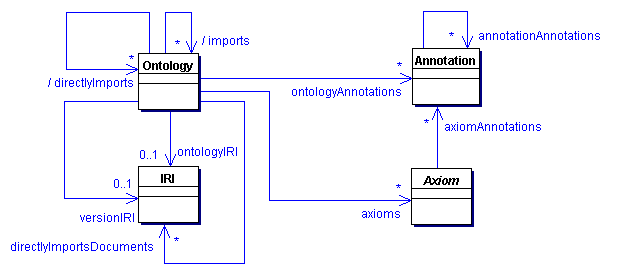
/// An OWL 2 *ontology& is an instance $O$ of the **Ontology** UML class from the structural
/// specification of OWL 2 shown in Figure 1 that satisfies certain conditions given below.
///
/// The main component of an OWL 2 ontology is its set of axioms, the structure of which is
/// described in more detail in Section 9. Because the association between an ontology and its
/// axioms is a set, an ontology cannot contain two axioms that are structurally equivalent.
/// Apart from axioms, ontologies can also contain ontology annotations (as described in more
/// detail in Section 3.5), and they can also import other ontologies (as described in Section
/// 3.4).
///
/// 
///
/// ## Specification (Section §3.7 -- Functional-Style Syntax)
///
/// ```bnf
/// Ontology :=
/// 'Ontology' '(' [ ontologyIRI [ versionIRI ] ]
/// directlyImportsDocuments
/// ontologyAnnotations
/// axioms
/// ')'
///
/// ontologyIRI := IRI
///
/// versionIRI := IRI
///
/// directlyImportsDocuments := { 'Import' '(' IRI ')' }
///
/// axioms := { Axiom }
/// ```
///
/// ## Examples
///
/// From section 3.4 *Imports*.
///
/// ```owl
/// Ontology( <http://www.example.com/importing-ontology>
/// Import( <http://www.example.com/my/2.0> )
///
/// # ...
/// )
/// ```
///
/// ```rust
/// use athene_owlapi::{Ontology, OntologyDocument, builders::Builder};
/// use rdftk_iri::Iri;
/// use std::str::FromStr;
///
/// let document = OntologyDocument::builder()
/// .with_default_namespace(Iri::from_str("http://www.example.com/importing-ontology").unwrap())
/// .with_ontology(
/// Ontology::builder()
/// .with_ontology_iri(Iri::from_str("http://www.example.com/importing-ontology").unwrap())
/// .with_direct_import(Iri::from_str("http://www.example.com/my/2.0").unwrap())
/// .build()
/// .expect("could not build Ontology"))
/// .build()
/// .expect("could not build OntologyDocument");
/// ```
///
///
/// This *pseudo-function* simply wraps an IRI value, but by providing a type of it's own it
/// has it's own implementation behavior and serialization rules.
///
/// ## Specification (Section §3.7 -- Functional-Style Syntax)
///
/// ```bnf
/// 'Import' '(' IRI ')'
/// ```
///
// ------------------------------------------------------------------------------------------------
// Public Functions
// ------------------------------------------------------------------------------------------------
///
/// This is a list of all reserved IRIs defined in the standard, the prefix names for
/// these are fixed and **may not** be redefined.
///
/// ## Specification (Section §2.4 -- IRIs)
///
/// See Table 2, *Declarations of the Standard Prefix Names*.
///
// ------------------------------------------------------------------------------------------------
// Implementations ❯ OntologyDocument
// ------------------------------------------------------------------------------------------------
// ------------------------------------------------------------------------------------------------
// Implementations ❯ Ontology
// ------------------------------------------------------------------------------------------------
impl_display_pretty!;
impl_has_annotations!;
// ------------------------------------------------------------------------------------------------
// Implementations ❯ Import
// ------------------------------------------------------------------------------------------------
impl_display_pretty!;
// ------------------------------------------------------------------------------------------------
// Modules
// ------------------------------------------------------------------------------------------------