
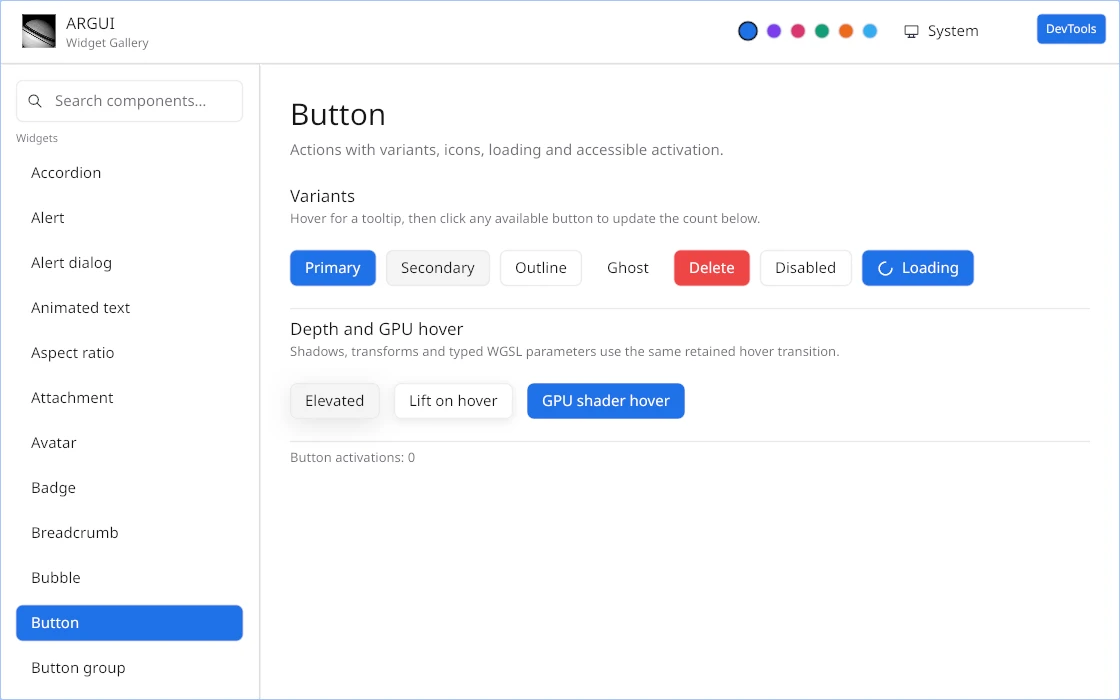
Try it
Explore the live gallery, or run it locally:
For state-preserving Rust patches, install Dioxus CLI and run the gallery with
dx serve --package argui-widget-gallery --features hot-reload --hot-patch.
The hot-reload guide explains the executable layout and
the changes that still require a restart.
Use Rust 1.98 or newer. Linux builds with all features also need the native dependencies.
Build your interface in Rust
Argui brings a retained UI tree, GPU rendering and a growing widget collection to one Rust API. Compose your interface, keep state in models and let the runtime update what changed. The same rendering stack runs on desktop, WebAssembly and the opt-in Android/iOS shells.
- Responsive by design. Flex and grid layout, light and dark themes, animation and virtualized lists.
- Accessible controls. Keyboard navigation, focus, text editing, native AccessKit integration and browser semantics.
- GPU effects. Custom WGSL shaders, gradients, shadows, blur and liquid glass.
- Native integrations. Multiple windows, file pickers, trays, WebViews and popovers that can extend beyond the window on supported backends.
- Optional updates. A signed update engine with a separate, reusable progress dialog.
- Inspect as you build. Element inspection, live styles, theme editing and profiling through optional DevTools.
- Keep state while editing. Optional Subsecond hot patching refreshes Rust views and handlers in native debug builds.
- Fluent i18n is here. Optional locale negotiation, fallback chains, variables, plurals and
live locale switching are provided by
argui-i18nand demonstrated in the Widget Gallery.
Widgets and platform integrations are enabled individually. Idle interfaces do not request animation frames. Read the performance measurements for workloads, memory figures and reproduction commands.
Feature status
- Retained application models, scoped state, tasks and multi-window commands
- Flexbox, grid, scrolling, virtualization and responsive layout
- WGPU rendering on desktop, Android, iOS and WebAssembly
- Text shaping, editing, selection, bidirectional text and IME input
- Mouse, touch, keyboard, focus and accessible semantics
- Light/dark themes, animation, images, SVG and custom WGSL effects
- Fluent localization through the optional
i18nfeature - State-preserving Subsecond patches through the optional
hot-reloadfeature - Optional DevTools, file picker, updater, WebView, tray, native popovers and desktop backdrop
- Android/iOS bootstrap crates, safe areas and packaged Widget Gallery CI artifacts
The public integration flags are i18n, hot-reload, tasks, devtools,
devtools-all-smi, file-picker, updater, widget-updater,
webview, tray, native-popups, desktop-backdrop and widgets-all.
argui-effects additionally exposes artistic, blur, color, liquid-glass,
refraction, scroll and shadow. Every flag is opt-in; argui has no default
feature bundle.
Choose only what the application uses
| Need | Feature(s) | Targets |
|---|---|---|
| Core runtime, WGPU renderer, layout and text | none | All supported targets |
| Android native entry point | add argui-android |
Android only; fully opt-in |
| iOS native entry point | add argui-ios |
iOS only; fully opt-in |
| Fluent locale negotiation, messages and plurals | i18n |
All targets |
| Async model tasks | tasks |
All targets |
| Every widget | widgets-all |
All targets |
| A small widget set | the matching widget-* flags |
All targets |
| Inspector and profiler | devtools |
Desktop and WebAssembly |
| NVIDIA/AMD/Intel sensor collection | devtools-all-smi |
Supported desktop hosts |
| State-preserving Rust patches | hot-reload |
Native desktop debug builds |
| System file dialogs | file-picker; add widget-file-picker for its UI |
Desktop and browser |
| Signed native update engine and dialog | updater, widget-updater |
Desktop |
| Retained WebViews | webview |
Desktop and browser frame support |
| System tray | tray |
Linux, Windows, macOS |
| Windows outside the main surface | native-popups |
Linux, Windows, macOS |
| Acrylic, Mica and native blur materials | desktop-backdrop |
Linux, Windows, macOS |
Linux, Windows, macOS and WebAssembly are selected by the Cargo target and do not need an OS feature. A focused application can enable capabilities directly:
[]
= { = "0.2.1", = false, = [
"i18n", "tasks", "widget-button", "widget-input",
] }
For mobile, add the platform entry crate as a separate dependency:
# Android
= { = "0.2.1", = ["i18n", "widgets-all"] }
= "0.2.1"
# iOS
= { = "0.2.1", = ["i18n", "widgets-all"] }
= "0.2.1"
Available widget flags are widget-accordion, widget-alert,
widget-alert-dialog, widget-animated-text, widget-aspect-ratio,
widget-attachment, widget-avatar, widget-badge, widget-breadcrumb,
widget-bubble, widget-button, widget-button-group, widget-calendar,
widget-card, widget-carousel, widget-chart, widget-checkbox,
widget-collapsible, widget-color-picker, widget-combobox,
widget-command-palette, widget-context-menu, widget-data-table,
widget-date-picker, widget-dialog, widget-direction, widget-drawer,
widget-empty, widget-field, widget-file-picker, widget-hover-card,
widget-icons, widget-input, widget-input-group, widget-input-otp,
widget-item, widget-kbd, widget-label, widget-list, widget-marker,
widget-menu, widget-menubar, widget-message, widget-message-scroller,
widget-native-select, widget-navigation-menu, widget-pagination,
widget-popover, widget-progress, widget-questionnaire,
widget-radio-group, widget-range, widget-scroll-area, widget-select,
widget-separator, widget-sheet, widget-sidebar, widget-skeleton,
widget-slider, widget-spinner, widget-split-pane, widget-switch,
widget-table, widget-tabs, widget-text-selection, widget-textarea,
widget-toast, widget-toggle, widget-toggle-group, widget-tooltip,
widget-tree-view, widget-typography and widget-vlist.
Platform roadmap
- Linux native application and CI coverage
- Windows native implementation and complete-workspace CI compile
- macOS native implementation and complete-workspace CI compile
- WebAssembly application and browser gallery
- Android debug APK and unsigned release AAB built by CI
- iOS XCFramework and unsigned Simulator app built by CI
- Shared logical-pixel safe-area API with Android and iOS detection
- Android production release support — physical-device validation, mobile services and owner-managed Play signing remain
- iOS production release support — simulator/device validation, mobile services, archive signing and TestFlight remain
Follow the native mobile integration guide for the current Android/iOS architecture, build commands and completion checklist. The repository structure lists every crate, direct dependency and crates.io publication position.
But… what about package size?
Features stay opt-in so applications only compile the integrations they choose. The table below measures the real Linux x86-64 Widget Gallery executable with Rust 1.98.0. “Base gallery” already contains every widget, Fluent i18n, tasks, effects and DevTools; “all features” additionally enables the updater, WebView, native popups, desktop backdrop and all-smi support.
| Profile | Gallery features | Executable | After strip |
|---|---|---|---|
| Debug | Base gallery (--no-default-features) |
98.63 MiB | 29.73 MiB |
| Debug | hot-reload |
100.29 MiB | 30.40 MiB |
| Debug | --all-features |
107.00 MiB | 33.23 MiB |
| Release | Base gallery (--no-default-features) |
36.04 MiB | 26.81 MiB |
| Release | hot-reload |
36.03 MiB | 26.79 MiB |
| Release | --all-features |
39.21 MiB | 29.17 MiB |
The development bridge costs 1.66 MiB in the debug executable, or 0.67 MiB after stripping. In release, the 0.02 MiB difference is code-generation noise: Argui compiles out its Subsecond connection and dispatch path, and the linker does not retain the unused patch engine. Enabling the feature can still increase release compilation time because Cargo builds its optional dependencies.
Reproduce a row with cargo build -p argui-widget-gallery --bin argui-widget-gallery --no-default-features, adding --features hot-reload or
--all-features, and --release for the release rows. Sizes are stat -c %s
converted with 1 MiB = 1,048,576 bytes; stripped values come from a copied
binary processed by GNU strip. This measures the executable itself and
excludes shared system libraries and installer compression.
Release WebAssembly startup
The optimized browser applications also reach their first usable frame in less than one second on the measured machine:
| Application | Release .wasm |
Median to ready | Five-run range |
|---|---|---|---|
| AI streaming harness | 6.15 MiB | 0.30 s | 0.26–0.46 s |
| Widget Gallery | 9.84 MiB | 0.79 s | 0.59–0.99 s |
These are five cache-disabled loads from a local static server in Chrome 153.0.8010.36 on Linux, measured from navigation start until the release renderer announced readiness and its target semantic node existed. The machine uses an Intel Core Ultra 5 125H. Remote startup also depends on transfer speed, HTTP compression and browser caching. The raw measurements record every sample and the exact environment.
Compose a view
Add only the widgets your application uses:
[]
= { = "0.2.1", = ["widget-button"] }
use ;
Continue with the product-shaped example applications,
models and state,
localization, hot reload, the
widget catalogue or the complete examples.
The protected CI publishes [PUBLISH] commits in dependency order and creates
the matching GitHub release. See the
release workflow.
Where things stand
Contributions go through pull requests. Start with the
contributor guide; every crate must meet
the 85% floor for lines, functions, regions and branches. Cargo builds use at
most six jobs. Join the Argui Discord to discuss
the project. The website lives in website/.
License
Dual-licensed under MIT or Apache-2.0, at your option.