1
2
3
4
5
6
7
8
9
10
11
12
13
14
15
16
17
18
19
20
21
22
23
24
25
26
27
28
29
30
31
32
33
34
35
36
37
38
39
40
41
42
43
44
45
46
47
48
49
50
51
52
53
54
55
56
57
58
59
60
61
62
63
64
65
66
67
68
69
70
71
72
73
74
75
76
77
78
79
80
81
82
83
84
85
86
87
88
89
90
91
92
93
94
95
96
97
98
99
100
101
102
103
104
105
106
107
108
109
110
111
112
113
114
115
116
117
118
119
120
121
122
123
124
125
126
127
128
129
130
131
132
133
134
135
136
137
138
139
140
141
142
143
144
145
146
147
148
149
150
151
152
153
154
155
156
157
158
159
160
161
162
163
164
165
166
167
168
169
170
171
172
173
174
175
176
177
178
179
180
181
182
183
184
185
186
187
188
189
190
191
192
193
194
195
196
197
198
199
200
201
202
203
204
205
206
207
208
209
210
211
212
213
214
215
216
217
218
219
220
221
222
223
224
225
226
227
228
229
230
231
232
233
234
235
236
237
238
239
240
241
242
243
244
245
246
247
248
249
250
251
252
253
254
255
256
257
258
259
260
261
262
263
264
265
266
267
268
269
270
271
272
273
274
275
276
277
278
279
280
281
282
283
284
285
286
287
288
289
290
291
292
293
294
295
296
297
298
299
300
301
302
303
304
//! **ARAEL** -- Algorithms for Robust Autonomy, Estimation, and Localization.
//!
//! Nonlinear optimization framework with compile-time symbolic differentiation.
//!
//! Define model structs with optimizable parameters, write constraints as
//! symbolic expressions, and the framework symbolically differentiates at
//! compile time, applies common subexpression elimination, and generates
//! compiled cost, gradient, and Gauss-Newton hessian (J^T J approximation)
//! code.
//!
//! # Features
//!
//! - **Symbolic math** -- expression trees with automatic differentiation,
//! simplification, LaTeX/Rust code generation (via `arael-sym`)
//! - **Compile-time constraint code generation** -- write constraints
//! symbolically, get compiled derivative code with CSE
//! - **Levenberg-Marquardt solver** -- with robust error suppression
//! via the [Starship method (US12346118)](https://patents.google.com/patent/US12346118)
//! `gamma * atan(r / gamma)` and switchable
//! constraints (`guard = expr`)
//! - **Multiple solver backends** via `LmSolver` trait:
//! - Dense Cholesky (nalgebra) -- fixed-size dispatch up to 9x9
//! - Band Cholesky -- pure Rust O(n*kd^2) for block-tridiagonal systems
//! - Sparse Cholesky (faer, pure Rust) -- for general sparse hessians
//! - Eigen SimplicialLLT and CHOLMOD (SuiteSparse) -- optional C++ backends via FFI
//! - LAPACK band -- optional dpbsv/spbsv backend
//! - **Indexed sparse assembly** -- precomputed position lists for
//! zero-overhead hessian assembly after first iteration
//! - **f32 and f64 precision** -- `#[arael(root)]` for f64,
//! `#[arael(root, f32)]` for f32 throughout
//! - **Model trait** -- hierarchical serialize/deserialize/update protocol
//! - **Type-safe references** -- `Ref<T>`, `Vec<T>`, `Deque<T>`, `Arena<T>`
//! - **Runtime differentiation** -- parse equations from strings at runtime,
//! auto-differentiate symbolically, and optimize via `ExtendedModel` +
//! `TripletBlock` (see `examples/runtime_fit_demo.rs`)
//! - **Hessian blocks** -- `SelfBlock<A>` and `CrossBlock<A, B>` for 1- and
//! 2-entity constraints (packed dense); `TripletBlock` for 3+ entities (COO sparse)
//! - **Jacobian computation** -- `#[arael(root, jacobian)]` generates
//! `calc_jacobian()` returning a sparse [`Jacobian<T>`](model::Jacobian)
//! matrix for DOF analysis via SVD.
//! [`#[arael(constraint_index)]`](model::JacobianRow) tracks constraint
//! provenance per row. See `examples/jacobian_demo.rs`.
//! - **Gimbal-lock-free rotations** -- `EulerAngleParam` optimizes a small
//! delta around a reference rotation matrix
//! - **WASM/browser support** -- compiles to WebAssembly; the `arael-sketch`
//! constraint editor runs in the browser via eframe/egui
//!
//! # Scope
//!
//! Arael is a **nonlinear optimization framework**, not a complete SLAM or
//! state estimation system. The SLAM and localization demos show how to use
//! arael as the optimizer backend, but a production SLAM pipeline would
//! additionally need:
//!
//! - **Front-end perception**: feature detection, descriptor extraction
//! - **Data association**: matching observed features to existing landmarks,
//! handling ambiguous or incorrect matches
//! - **Landmark management**: initializing new landmarks from observations,
//! merging duplicates, pruning unreliable ones
//! - **Keyframe selection**: deciding when to add new poses vs. discard
//! redundant frames
//! - **Loop closure**: detecting revisited places, verifying loop closure
//! candidates, and injecting constraints
//! - **Outlier rejection logic**: deciding which observations to reject
//! - **Marginalization / sliding window**: limiting optimization scope for
//! real-time operation, marginalizing old poses while preserving their
//! information
//! - **Map management**: spatial indexing, map saving/loading, multi-session
//! map merging
//!
//! Arael provides the compile-time-differentiated solver that sits at the
//! core of such a system. Everything above is application-level logic that
//! builds on top of it.
//!
//! # Example: Symbolic Math
//!
//! ```ignore
//! use arael::sym::*;
//!
//! arael::sym! {
//! let x = symbol("x");
//! let f = sin(x) * x + 1.0;
//!
//! println!("f(x) = {}", f); // sin(x) * x + 1
//! println!("f'(x) = {}", f.diff("x")); // x * cos(x) + sin(x)
//!
//! let vars = std::collections::HashMap::from([("x", 2.0)]);
//! println!("f(2.0) = {}", f.eval(&vars).unwrap()); // 2.8185...
//! }
//! ```
//!
//! The `sym!` macro auto-inserts `.clone()` on variable reuse, so you write
//! natural math without ownership boilerplate.
//! See [docs/SYM.md](https://github.com/harakas/arael/blob/master/docs/SYM.md)
//! for the full symbolic math reference.
//!
//! # Example: Robust Linear Regression
//!
//! Define a model with optimizable parameters and a residual expression.
//! The Starship method `gamma * atan(plain_r / gamma)` suppresses outlier
//! influence while preserving smooth differentiability:
//!
//! ```ignore
//! #[arael::model]
//! struct DataEntry { x: f32, y: f32 }
//!
//! #[arael::model]
//! #[arael(fit(data, |e| {
//! let plain_r = (a * e.x + b - e.y) / sigma;
//! gamma * atan(plain_r / gamma)
//! }))]
//! struct LinearModel {
//! a: Param<f32>,
//! b: Param<f32>,
//! data: Vec<DataEntry>,
//! sigma: f32,
//! gamma: f32,
//! }
//! ```
//!
//! The macro generates `calc_cost()`, `calc_grad_hessian()`, and `fit()`
//! with symbolically differentiated, CSE-optimized compiled code.
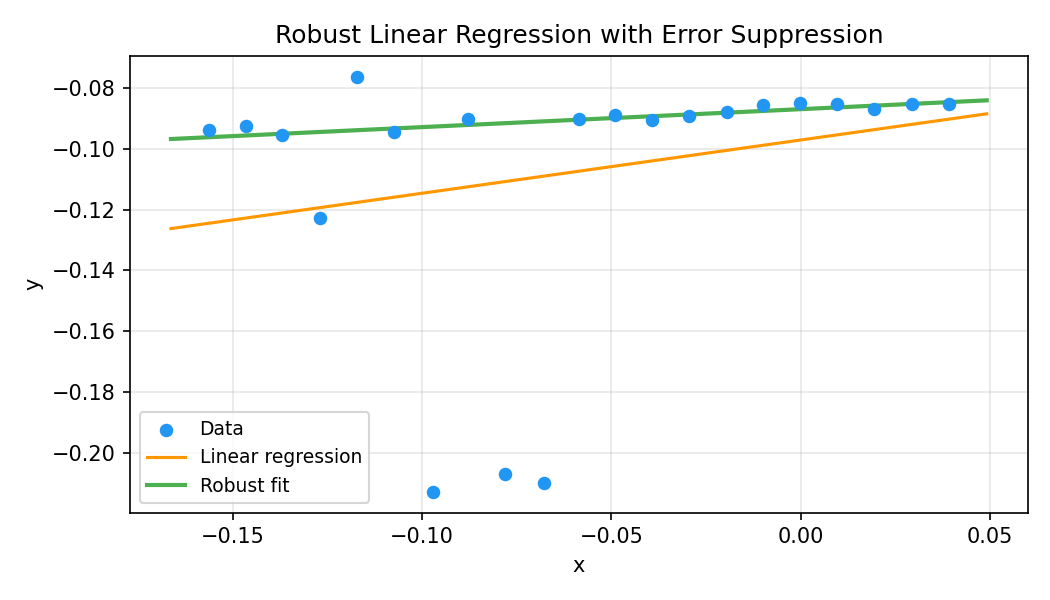
//! The robust fit ignores outliers while tracking the inlier data:
//!
//! 
//!
//! See [examples/linear_demo.rs](https://github.com/harakas/arael/blob/master/examples/linear_demo.rs) for the full source.
//!
//! # Runtime Differentiation
//!
//! Compile-time differentiation generates optimized Rust code with CSE at
//! build time -- ideal when the model structure is fixed. But many
//! applications need equations that are only known at runtime: user-typed
//! formulas in a CAD parametric dimension, configuration-driven curve
//! fitting, or symbolic constraints loaded from a file.
//!
//! Arael supports this through **runtime differentiation**: parse an
//! equation string with `arael_sym::parse`, symbolically differentiate
//! once at setup with `E::diff`, then evaluate the expression tree
//! numerically each solver iteration. The
//! [`ExtendedModel`](model::ExtendedModel) trait and
//! [`TripletBlock`](model::TripletBlock) provide the integration point
//! with the LM solver.
//!
//! The sketch editor (`arael-sketch`) uses this extensively for parametric
//! expression dimensions -- a user can type `d0 * 2 + 3` as a dimension
//! value, and the solver constrains the geometry to satisfy the equation
//! in real time, with full symbolic derivatives.
//!
//! The model uses `#[arael(root, extended)]` and implements
//! [`ExtendedModel`](model::ExtendedModel) to push residuals and
//! derivatives into a [`TripletBlock`](model::TripletBlock) at each
//! solver iteration:
//!
//! ```ignore
//! #[arael::model]
//! #[arael(root, extended)]
//! struct RegressionModel {
//! coeffs: refs::Vec<Coefficient>, // optimizable parameters
//! hb: TripletBlock<f64>, // Gauss-Newton accumulator
//! residual_expr: Option<arael_sym::E>, // parsed equation
//! derivs: Vec<(String, u32, arael_sym::E)>, // pre-computed derivatives
//! // ...
//! }
//!
//! impl ExtendedModel for RegressionModel {
//! fn extended_compute64(&mut self, params: &[f64]) {
//! for &(x, y) in &self.data {
//! vars.insert("x", x);
//! vars.insert("y", y);
//! let r = residual.eval(&vars).unwrap();
//! let dr: Vec<f64> = self.derivs.iter()
//! .map(|(_, _, d)| d.eval(&vars).unwrap()).collect();
//! self.hb.add_residual(r, &indices, &dr);
//! }
//! }
//! }
//! ```
//!
//! See
//! [examples/runtime_fit_demo.rs](https://github.com/harakas/arael/blob/master/examples/runtime_fit_demo.rs)
//! for a complete example that accepts an arbitrary equation from the
//! command line and fits it to data with robust error suppression.
//!
//! # 2D Sketch Editor
//!
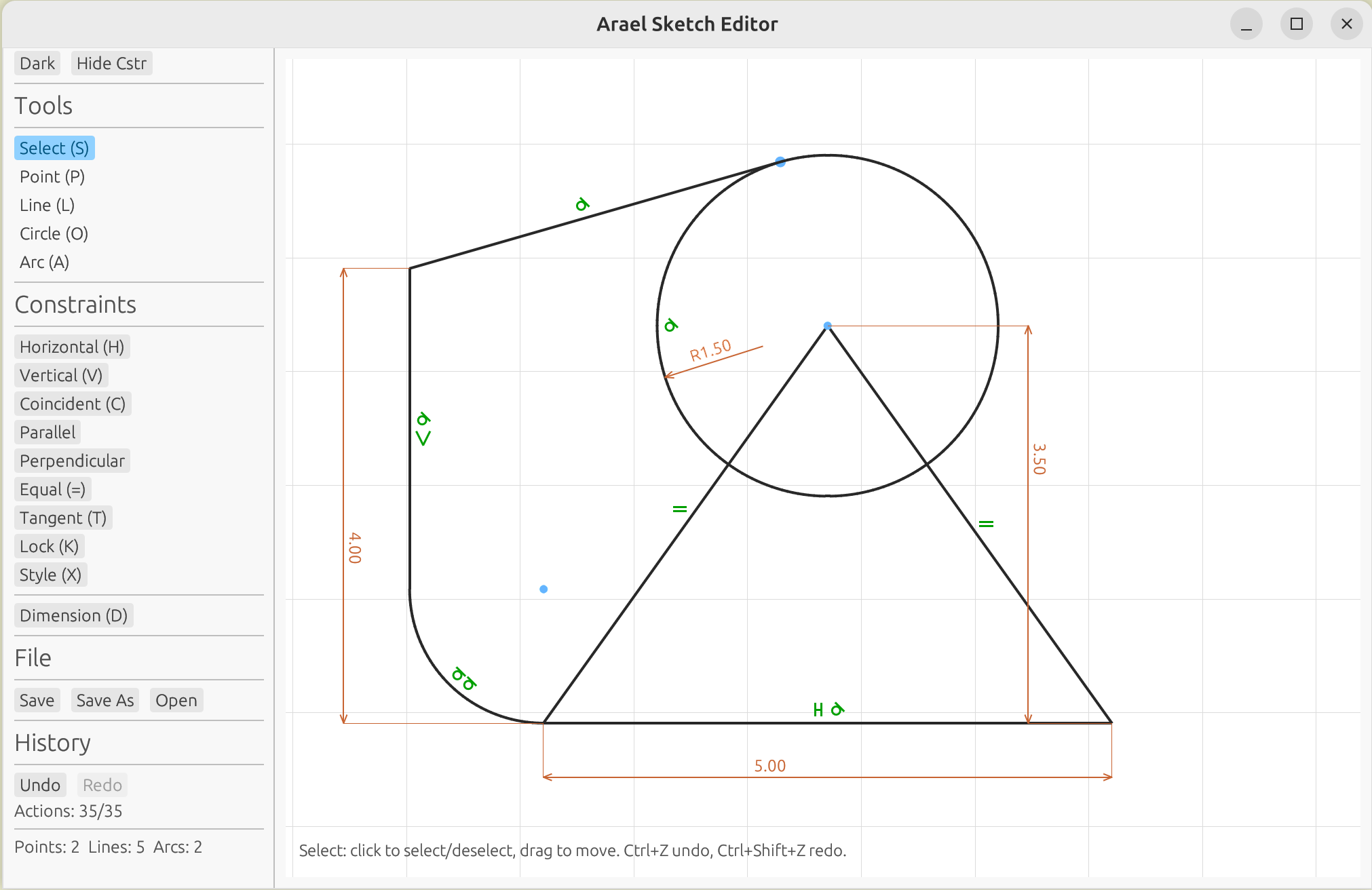
//! The `arael-sketch` crate provides an interactive constraint-based 2D sketch
//! editor built on the optimization framework. It combines both differentiation
//! modes: geometric constraints (horizontal, coincident, parallel, tangent, etc.)
//! use compile-time differentiation, while parametric dimensions use runtime
//! differentiation -- the user types an expression like `d0 * 2 + 3` and the
//! solver constrains the geometry to satisfy it in real time, with full symbolic
//! derivatives. Dimensions can reference each other, entity properties
//! (`L0.length`, `A0.radius`), and arithmetic expressions, making it a fully
//! parametric constraint solver. Runs natively and in the browser via
//! WebAssembly.
//!
//! [](https://sketch.mare.ee/)
//!
//! [Try it in the browser](https://sketch.mare.ee/)
//!
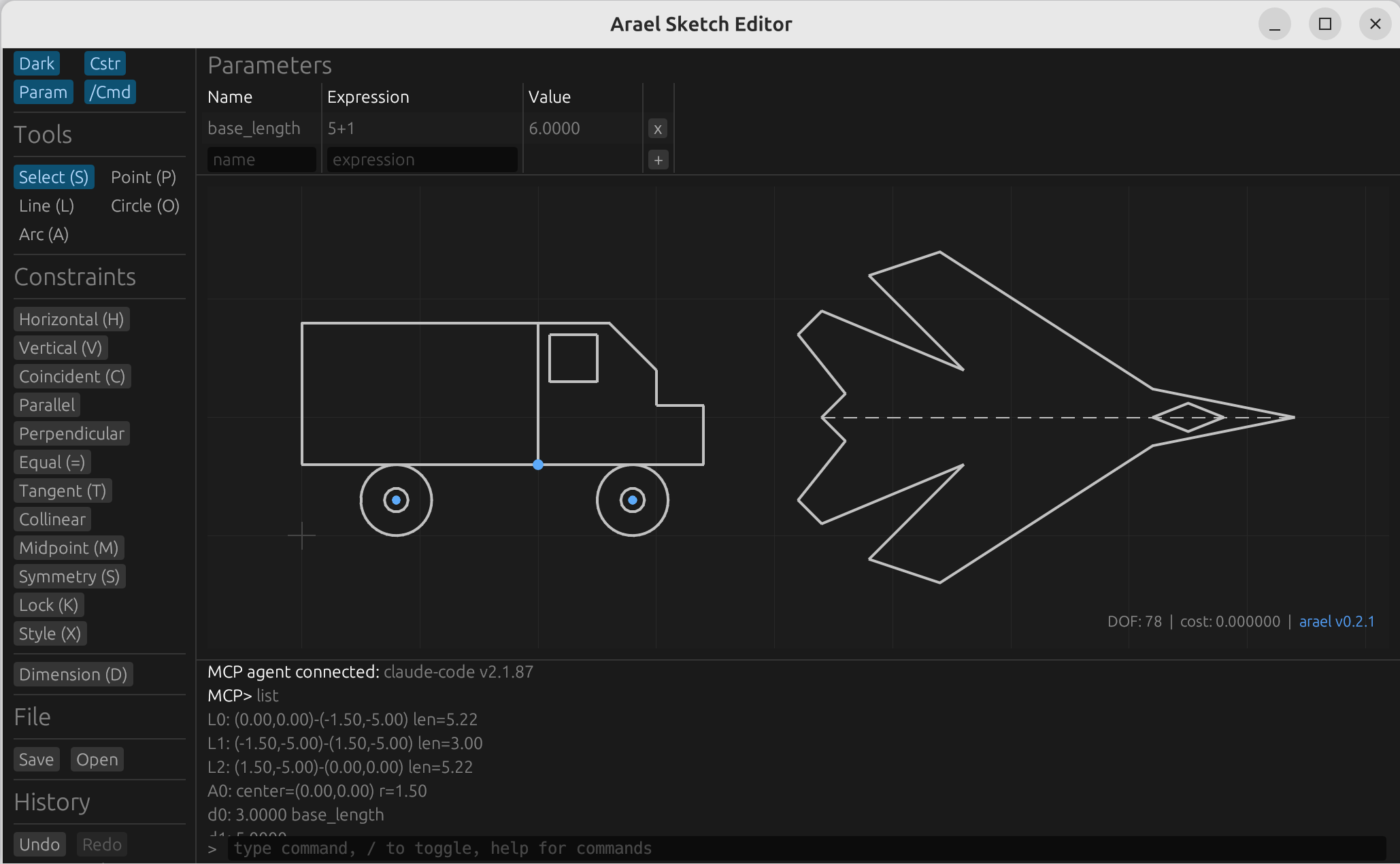
//! The editor includes a command panel (`/` to toggle) with 40+ scripting
//! commands, and an embedded MCP server (`--mcp`) that enables AI agents
//! like Claude Code to create and modify sketches programmatically.
//!
//! 
//!
//! # Example: SLAM Constraints
//!
//! For multi-body optimization (SLAM, bundle adjustment), define model
//! hierarchies with constraints. The macro handles symbolic differentiation,
//! reference resolution, and code generation.
//!
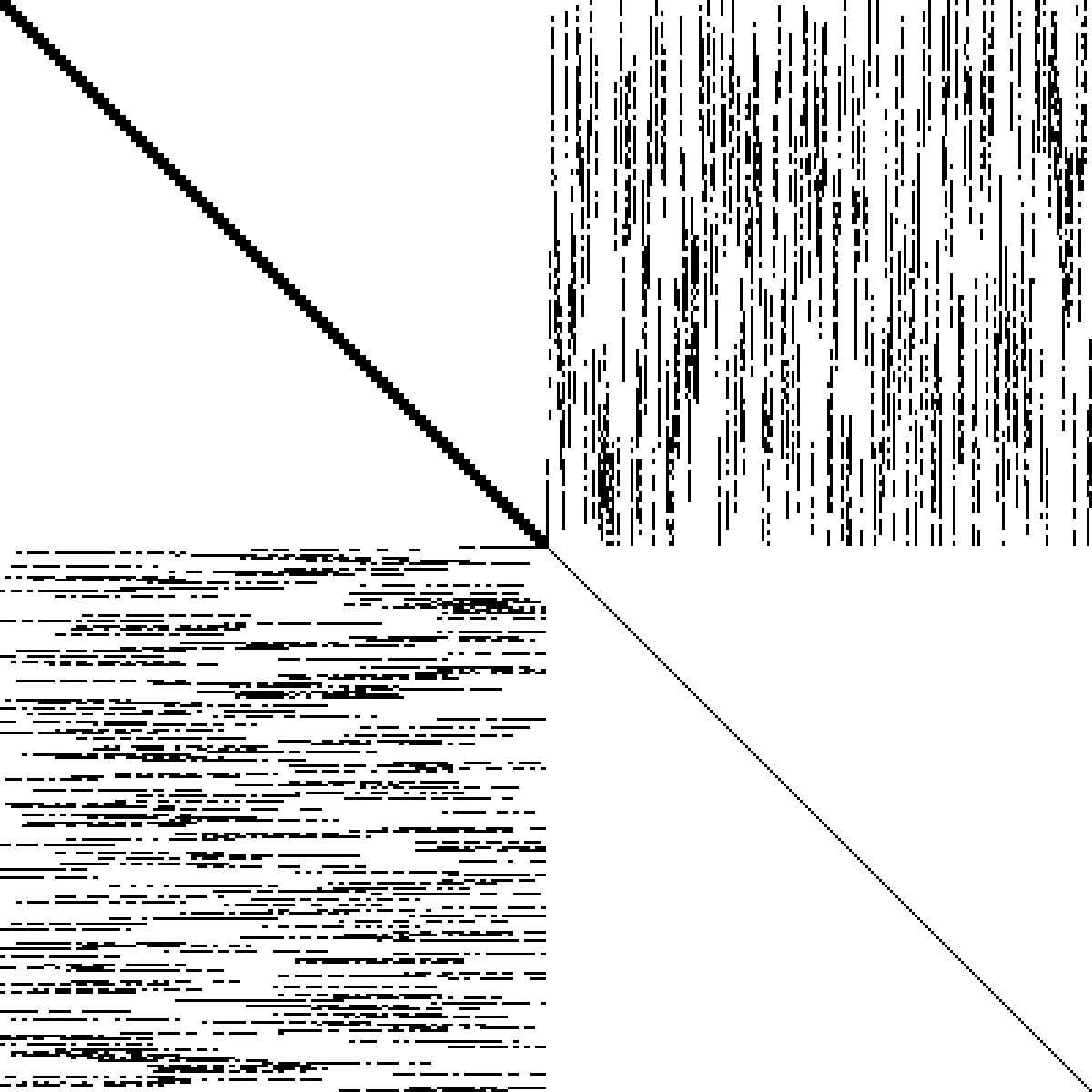
//! 
//!
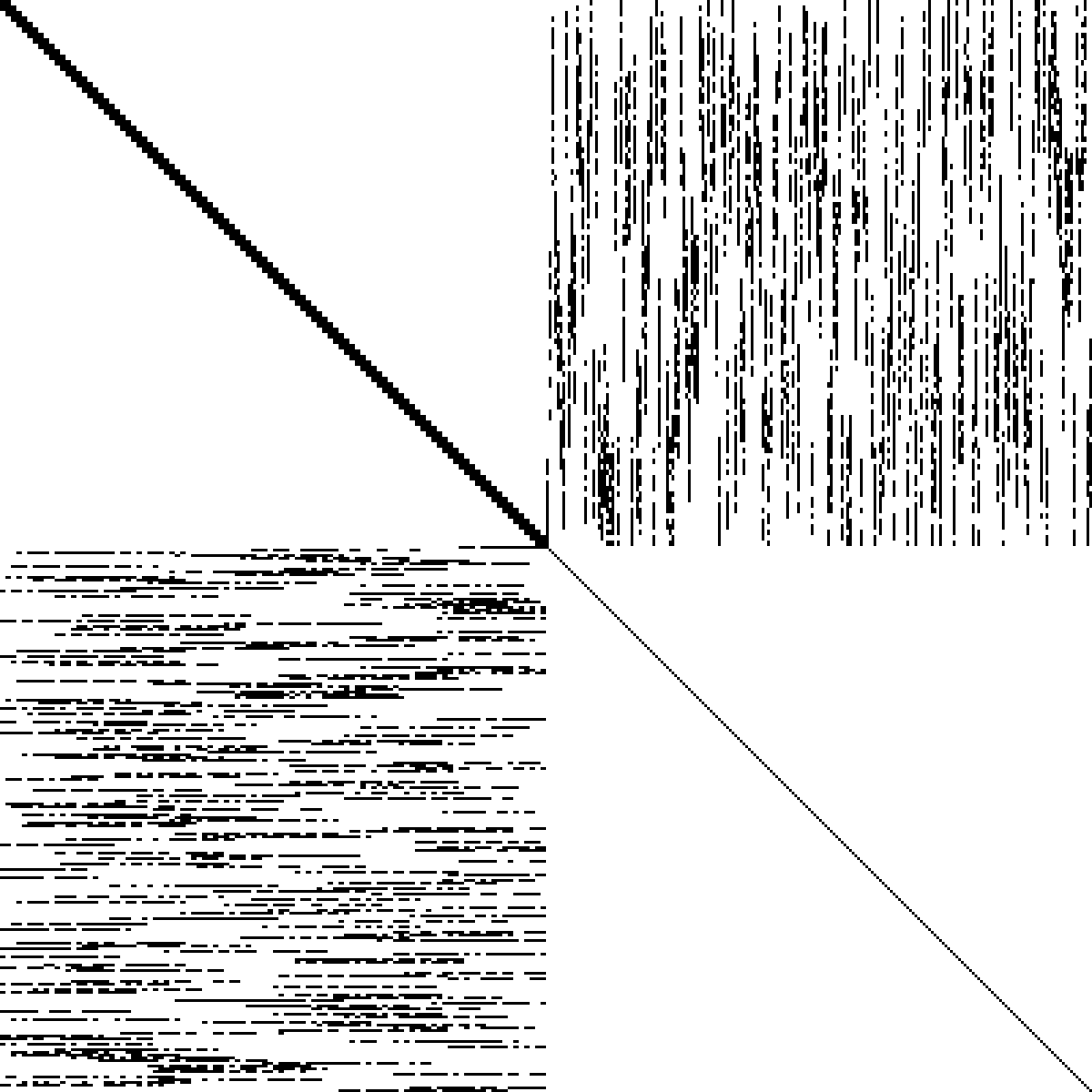
//! The sparsity pattern shows pose-pose blocks (upper-left), pose-landmark
//! coupling (off-diagonal), and landmark self-blocks (lower-right). Sparse
//! Cholesky exploits this for large speedups over dense.
//!
//! ```ignore
//! #[arael::model]
//! #[arael(constraint(hb_pose, guard = self.info.gps.is_some(), {
//! // GPS constraint (guarded -- only when data present)
//! let raw = pose.pos - pose.info.gps.pos;
//! let whitened = pose.info.gps.cov_r.transpose() * raw;
//! [gamma * atan(whitened.x * pose.info.gps.cov_isigma.x / gamma), ...]
//! }))]
//! #[arael(constraint(hb_pose, {
//! // Tilt sensor -- accelerometer constrains roll and pitch
//! [(pose.ea.x - pose.info.tilt_roll) * path.tilt_isigma,
//! (pose.ea.y - pose.info.tilt_pitch) * path.tilt_isigma]
//! }))]
//! struct Pose {
//! pos: Param<vect3f>,
//! ea: SimpleEulerAngleParam<f32>,
//! info: PoseInfo,
//! hb_pose: SelfBlock<Pose>,
//! }
//!
//! // Observation linking a landmark to a pose
//! #[arael::model]
//! #[arael(constraint(hb, parent=lm, {
//! let mr2w = pose.ea.rotation_matrix();
//! let lm_r = mr2w.transpose() * (lm.pos - pose.pos);
//! let r_f = feature.mf2r.transpose() * (lm_r - feature.camera_pos);
//! [gamma * atan(atan2(r_f.y, r_f.x) * feature.isigma.x / gamma),
//! gamma * atan(atan2(r_f.z, r_f.x) * feature.isigma.y / gamma)]
//! }))]
//! struct PointFrine {
//! #[arael(ref = root.poses)]
//! pose: Ref<Pose>,
//! #[arael(ref = pose.info.features)]
//! feature: Ref<PointFeature>,
//! hb: CrossBlock<PointLandmark, Pose>,
//! }
//! ```
//!
//! See [examples/slam_demo.rs](https://github.com/harakas/arael/blob/master/examples/slam_demo.rs) for the full 60-pose, 240-landmark SLAM demo
//! with GPS, odometry, tilt sensor, graduated optimization, and covariance
//! estimation.
//! See [docs/SLAM.md](https://github.com/harakas/arael/blob/master/docs/SLAM.md) for the full walkthrough.
//!
//! # Example: Localization
//!
//! Same model as SLAM but landmarks are fixed (known map). With only pose
//! parameters the hessian is block-tridiagonal, so the band solver gives
//! O(n) scaling -- 9.4x faster than dense at 500 poses.
//! See [examples/loc_demo.rs](https://github.com/harakas/arael/blob/master/examples/loc_demo.rs).
//!
//! # Crate structure
//!
//! - `arael-sym` -- symbolic math engine (expression trees, differentiation, CSE)
//! - `arael-macros` -- proc macros (`#[arael::model]`, `#[derive(Model)]`)
//! - `arael` (this crate) -- runtime: model traits, solvers, geometry, vectors
/// Numeric traits (`Float`).
/// 2D and 3D vector types.
/// 3x3 and 2x2 matrix types with rotation and linear algebra.
/// Quaternion type for 3D rotations.
/// Type-safe indexed collections: `Ref`, `Vec`, `Deque`, `Arena`.
/// Re-export of the `arael-sym` symbolic math crate.
pub use arael_sym as sym;
/// Model trait, parameter types, and Hessian blocks.
/// Levenberg-Marquardt solver with dense, band, and sparse backends.
/// Camera model and geometric utilities.
/// Re-export Jacobian types for convenient access.
pub use ;
/// The `sym!` auto-clone macro for symbolic expressions (from `arael-sym`).
pub use sym;
/// Derive macro for the `Model` trait.
pub use Model;
/// Attribute macro: `#[arael::model]`.
pub use model;