# Contributing to SIMD Collectors
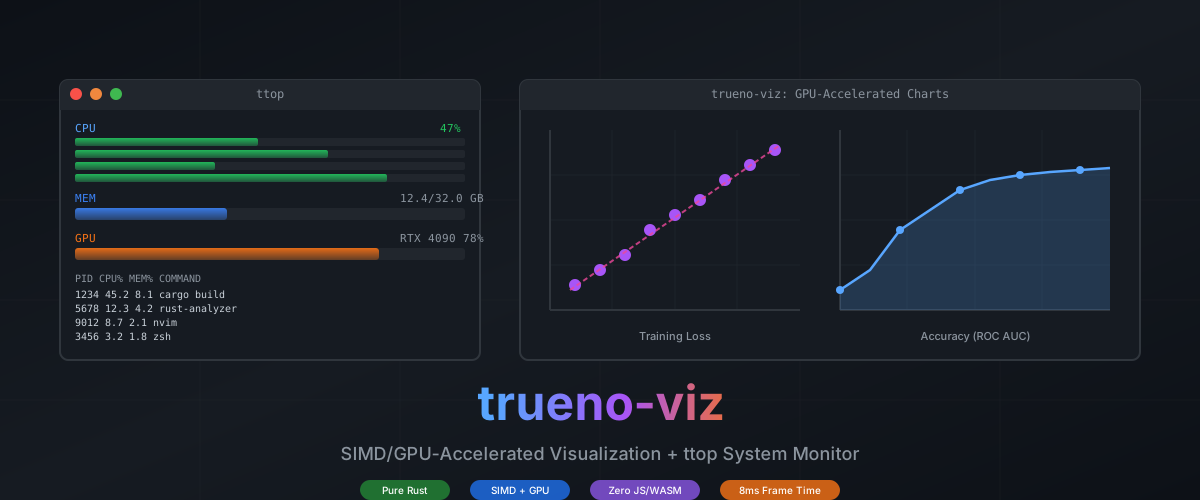
This guide explains how to contribute to the SIMD-accelerated metric collectors in trueno-viz.
## Architecture Overview
The SIMD system consists of several layers:
```
src/monitor/simd/
├── mod.rs # Backend detection, SimdStats, constants
├── kernels.rs # Core SIMD operations (parse, delta, percentage)
├── ring_buffer.rs # SimdRingBuffer with O(1) statistics
├── soa.rs # Structure-of-Arrays layouts
├── compressed.rs # Delta encoding for historical data
├── correlation.rs # Pearson correlation calculations
└── integration_tests.rs
src/monitor/collectors/
├── cpu_simd.rs # CPU metrics collector
├── memory_simd.rs # Memory metrics collector
├── network_simd.rs # Network metrics collector
├── disk_simd.rs # Disk I/O metrics collector
├── process_simd.rs # Process enumeration collector
├── gpu_simd.rs # GPU metrics aggregator
└── battery_sensors_simd.rs # Battery and sensor collector
```
## Adding a New SIMD Kernel
### Step 1: Define the Kernel in `kernels.rs`
```rust
/// SIMD-accelerated operation description.
///
/// # Performance Target
/// - Throughput: ≥Nx vs scalar
/// - Latency: < Yμs for Z elements
///
/// # Example
/// ```
/// let result = simd_my_operation(&input);
/// ```
#[must_use]
pub fn simd_my_operation(input: &[u64]) -> Vec<u64> {
// Implementation using trueno or std::simd
}
```
### Step 2: Add Unit Tests
```rust
#[cfg(test)]
mod tests {
use super::*;
#[test]
fn test_simd_my_operation_basic() {
let input = vec![1, 2, 3, 4];
let result = simd_my_operation(&input);
assert_eq!(result, vec![/* expected */]);
}
#[test]
fn test_simd_my_operation_empty() {
let result = simd_my_operation(&[]);
assert!(result.is_empty());
}
#[test]
fn test_simd_my_operation_large() {
let input: Vec<u64> = (0..10000).collect();
let start = std::time::Instant::now();
let _ = simd_my_operation(&input);
let elapsed = start.elapsed();
assert!(elapsed.as_millis() < 10);
}
}
```
### Step 3: Add Integration Test
Add a test to `integration_tests.rs`:
```rust
#[test]
fn test_my_operation_integration() {
// Test that the operation works with real collectors
}
```
## Adding a New Collector
### Step 1: Create the SoA Layout
In `soa.rs`:
```rust
/// SoA layout for MyMetrics.
#[repr(C, align(64))]
#[derive(Debug)]
pub struct MyMetricsSoA {
/// Field 1 values across all items.
pub field1: Vec<u64>,
/// Field 2 values across all items.
pub field2: Vec<f64>,
/// Number of active items.
pub count: usize,
}
impl MyMetricsSoA {
pub fn new(capacity: usize) -> Self {
let aligned = ((capacity + 7) / 8) * 8;
Self {
field1: vec![0; aligned],
field2: vec![0.0; aligned],
count: 0,
}
}
}
```
### Step 2: Create the Collector
In `collectors/my_simd.rs`:
```rust
use crate::monitor::error::Result;
use crate::monitor::simd::{kernels, SimdRingBuffer};
use crate::monitor::types::{Collector, Metrics};
#[derive(Debug)]
pub struct SimdMyCollector {
// SoA storage
metrics: MyMetricsSoA,
// History buffers
history: SimdRingBuffer,
}
impl Collector for SimdMyCollector {
fn id(&self) -> &'static str {
"my_collector_simd"
}
fn collect(&mut self) -> Result<Metrics> {
// 1. Read raw data
// 2. Parse with SIMD kernels
// 3. Store in SoA layout
// 4. Update history
// 5. Return metrics
}
fn display_name(&self) -> &'static str {
"My Collector (SIMD)"
}
}
```
### Step 3: Register in `collectors/mod.rs`
```rust
pub mod my_simd;
pub use my_simd::SimdMyCollector;
```
## Performance Guidelines
### Memory Alignment
All SoA structures must be 64-byte aligned for AVX-512 compatibility:
```rust
#[repr(C, align(64))]
pub struct MyStruct { ... }
```
### Zero-Allocation Hot Paths
Avoid allocations in `collect()`:
```rust
// BAD: Allocates on every call
fn collect(&mut self) -> Result<Metrics> {
let buffer = Vec::new(); // Allocation!
...
}
// GOOD: Reuse pre-allocated buffer
fn collect(&mut self) -> Result<Metrics> {
self.buffer.clear(); // No allocation
...
}
```
### Chunk Processing
Process data in SIMD-friendly chunks:
```rust
const CHUNK_SIZE: usize = 8; // AVX2 = 4 f64, process 2 at a time
for chunk in data.chunks(CHUNK_SIZE) {
// SIMD process chunk
}
```
## Benchmarking
### Running Benchmarks
```bash
# Run all benchmarks
cargo bench --features monitor
# Run specific benchmark
cargo bench --features monitor simd_parse
# Generate HTML report
cargo bench --features monitor -- --noplot
```
### Writing Benchmarks
In `benches/simd_bench.rs`:
```rust
use criterion::{black_box, criterion_group, criterion_main, Criterion};
fn bench_simd_operation(c: &mut Criterion) {
let data: Vec<u64> = (0..1000).collect();
c.bench_function("simd_my_operation", |b| {
b.iter(|| simd_my_operation(black_box(&data)))
});
}
criterion_group!(benches, bench_simd_operation);
criterion_main!(benches);
```
### Performance Targets
From the specification, key targets are:
| Integer parsing | ≥8x vs scalar | H₁ |
| Ring buffer push | ≥5x vs VecDeque | H₉ |
| Correlation (1K samples) | ≥8x vs scalar | H₁₂ |
| End-to-end collection | p99 < 500μs | H₅ |
## Testing Checklist
Before submitting a PR:
- [ ] All existing tests pass: `cargo test --features monitor`
- [ ] New tests added for new functionality
- [ ] Performance tests validate targets
- [ ] No new clippy warnings: `cargo clippy --features monitor`
- [ ] Documentation updated if API changed
- [ ] Integration tests added to `integration_tests.rs`
## Code Style
### Documentation
Every public function needs:
```rust
/// Brief description of function.
///
/// # Performance Target
/// - Specific measurable target
///
/// # Arguments
/// * `arg1` - Description
///
/// # Returns
/// Description of return value
///
/// # Example
/// ```
/// let result = function(input);
/// ```
#[must_use]
pub fn function(arg1: Type) -> ReturnType { ... }
```
### Error Handling
Use the `Result` type from `monitor::error`:
```rust
use crate::monitor::error::{MonitorError, Result};
fn might_fail() -> Result<Value> {
// On error:
return Err(MonitorError::CollectionFailed {
collector: "my_collector".to_string(),
details: "specific error".to_string(),
});
}
```
## Questions?
- Check the specification: `docs/specifications/full-SIMD-collectors-queue.md`
- Review existing collectors for patterns
- Open an issue for design discussions