
Alaya







A memory engine for AI agents that remembers, forgets, and learns.
Alaya (Sanskrit: alaya-vijnana, "storehouse consciousness") is an embeddable Rust library. One SQLite file. No external services. Your agent stores conversations, retrieves what matters, and lets the rest fade. The graph reshapes through use, like biological memory.
let store = open?;
store.store_episode?; // store
let results = store.query?; // retrieve
store.consolidate?; // distill knowledge
store.transform?; // dedup, LTD, discover categories
store.forget?; // decay what's stale
let cats = store.categories?; // emergent ontology
store.purge?; // cascade delete + tombstones
The Problem
Most AI agents treat memory as flat files. OpenClaw writes to MEMORY.md.
Claudesidian writes to Obsidian. Hand-rolled systems write to JSON or
Markdown. It works at first.
Then the files grow. Context windows fill. The agent dumps everything into the prompt and hopes the LLM finds what matters.
The cost is measurable. OpenClaw injects ~35,600 tokens of workspace files into every message, 93.5% of which is irrelevant (#9157). Heavy users report $3,600/month in token costs. Community tools like QMD and memsearch cut 70-96% of that waste by replacing full-context injection with ranked retrieval (Levine, 2026).
The structure problem compounds the cost. MEMORY.md conflates decisions,
preferences, and knowledge into one unstructured blob. Users independently
invent decision.md
files, working-context.md snapshots, and
12-layer memory architectures
to compensate. Monday you mention "Alice manages the auth team." Wednesday
you ask "who handles auth permissions?" The agent retrieves both memories
by text similarity but cannot connect them
(Chawla, 2026).
How Alaya Solves It
| Problem | File-based memory | Alaya |
|---|---|---|
| Token waste | Full-context injection (~35K tokens/message) | Ranked retrieval returns only top-k relevant memories |
| No structure | Everything in one file (users invent decision.md workarounds) |
Three typed stores: episodes, knowledge, preferences |
| No forgetting | Files grow until you manually curate | Bjork dual-strength decay: weak memories fade, strong ones persist |
| No associations | Flat files, no links between memories | Hebbian graph strengthens through co-retrieval; spreading activation finds indirect connections |
| Brittle preferences | Agent-authored summary, easily drifts | Preferences emerge from accumulated impressions, crystallize at threshold |
| LLM required | Can't function without one | Optional. No embeddings? BM25-only. No LLM? Episodes accumulate. Every feature works independently |
Getting Started
MCP Server (recommended for agents)
The fastest way to add Alaya memory to any MCP-compatible agent (Claude Desktop, OpenClaw, Cline, etc.):
# Build the MCP server
# With auto-consolidation (calls an LLM to extract knowledge automatically)
Add to your agent's MCP config (e.g. claude_desktop_config.json):
The env block is optional — without it, the server works in prompt mode
(reminds the agent to call learn after 10 episodes). With an API key and
the llm feature, it auto-consolidates instead.
That's it. Your agent now has 13 memory tools:
| Tool | What it does |
|---|---|
remember |
Store a conversation message (auto-prompts consolidation after 10 episodes) |
recall |
Search memory with hybrid retrieval (+ category boost) |
learn |
Teach extracted knowledge directly — agent extracts facts and calls this |
status |
Rich memory statistics: episodes, knowledge breakdown, categories, graph, embeddings |
preferences |
Get learned user preferences |
knowledge |
Get distilled semantic facts (+ category filter) |
maintain |
Run memory cleanup (dedup, decay) |
purge |
Delete memories by session, age, or all |
categories |
List emergent categories with stability filter |
neighbors |
Graph neighbors via spreading activation |
node_category |
Which category a node belongs to |
import_claude_mem |
Import observations from a claude-mem database |
import_claude_code |
Import conversation history from Claude Code JSONL files |
See docs/mcp-quickstart.md for a full walkthrough with sample interactions and recommended system prompt.
Data is stored in ~/.alaya/memory.db (override with ALAYA_DB env var).
Single SQLite file, no external services.
Example interaction — what your agent sees when using Alaya:
Agent: [calls remember(content="User prefers dark mode", role="user", session_id="s1")]
Alaya: Stored episode 1 in session 's1'

Agent: [calls recall(query="user preferences")]
Alaya: Found 1 memories:
  1. [user] (score: 0.847) User prefers dark mode

Agent: [calls status()]
Alaya: Memory Status:
  Episodes: 1 (1 this session, 1 unconsolidated)
  Knowledge: none
  Categories: 0
  Preferences: 0 crystallized, 0 impressions accumulating
  Graph: 0 links
  Embedding coverage: 0/1 nodes (0%)
Environment variables:
| Variable | Default | Description |
|---|---|---|
ALAYA_DB |
~/.alaya/memory.db |
Path to SQLite database |
ALAYA_LLM_API_KEY |
(none) | API key for auto-consolidation (enables ExtractionProvider). Requires llm feature. |
ALAYA_LLM_API_URL |
https://api.openai.com/v1/chat/completions |
OpenAI-compatible chat completions endpoint |
ALAYA_LLM_MODEL |
gpt-4o-mini |
Model name. Any small/fast model works (GPT-4o-mini, Haiku, Gemini Flash, etc.) |
Rust Library
For embedding Alaya directly into a Rust application:
[]
= "0.2.0"
Quick Start (Rust)
use ;
// Open a persistent database (or use open_in_memory() for tests)
let store = open?;
// Store a conversation episode
store.store_episode?;
// Query with hybrid retrieval (BM25 + vector + graph + RRF)
let results = store.query?;
for mem in &results
// Get crystallized preferences
let prefs = store.preferences?;
// Run lifecycle (NoOpProvider works without an LLM)
store.consolidate?;
store.transform?;
store.forget?;
Run the Demo
The demo walks through all eleven capabilities with annotated output and no external dependencies:
Architecture
Alaya is a library, not a framework. Your agent owns the conversation loop, the LLM, and the embedding model. Alaya owns memory.
Your Agent                          Alaya
─────────                           ─────

Via MCP (stdio):                    alaya-mcp binary
  remember(content, role, session)    ──▶ episodic store + graph links
  recall(query, boost_category?)      ──▶ BM25 + vector + graph → RRF → rerank
  learn(facts, session_id?)           ──▶ agent-driven knowledge extraction
  status()                            ──▶ rich stats (episodes, knowledge, graph, embeddings)
  preferences(domain?)                ──▶ crystallized behavioral patterns
  knowledge(type?, category?)         ──▶ consolidated semantic nodes
  maintain()                          ──▶ dedup + decay
  purge(scope)                        ──▶ selective or full deletion
  categories(min_stability?)          ──▶ emergent ontology with hierarchy
  neighbors(node, depth?)             ──▶ graph spreading activation
  node_category(node_id)              ──▶ category assignment lookup
  import_claude_mem(path?)            ──▶ import from claude-mem.db
  import_claude_code(path)            ──▶ import from Claude Code JSONL

Via Rust library:                   AlayaStore struct
  store_episode()                     ──▶ episodic store + graph links
  query()                            ──▶ BM25 + vector + graph → RRF → rerank
  preferences()                      ──▶ crystallized behavioral patterns
  knowledge()                        ──▶ consolidated semantic nodes
  categories()                       ──▶ emergent ontology with hierarchy
  subcategories()                    ──▶ children of a parent category
  neighbors()                        ──▶ graph spreading activation
  node_category()                    ──▶ category assignment lookup
  set_embedding_provider()           ──▶ auto-embed in store + query
  set_extraction_provider()          ──▶ enable auto-consolidation
  consolidate(provider)              ──▶ episodes → semantic knowledge
  learn(nodes)                       ──▶ provider-less knowledge injection
  auto_consolidate()                 ──▶ extract + learn (needs ExtractionProvider)
  perfume(interaction, provider)     ──▶ impressions → preferences
  transform()                        ──▶ dedup, LTD, prune, split categories
  forget()                           ──▶ Bjork strength decay + archival
  purge(scope)                       ──▶ cascade deletion + tombstones
Three Stores
| Store | Analog | Purpose |
|---|---|---|
| Episodic | Hippocampus | Raw conversation events with full context |
| Semantic | Neocortex | Distilled knowledge extracted through consolidation |
| Implicit | Alaya-vijnana | Preferences and habits that emerge through perfuming |
Retrieval Pipeline
flowchart LR
    Q[Query] --> BM25[BM25 / FTS5]
    Q --> VEC[Vector / Cosine]
    Q --> GR[Graph Neighbors]

    BM25 --> RRF[Reciprocal Rank Fusion]
    VEC --> RRF
    GR --> RRF

    RRF --> RR[Context-Weighted Reranking]
    RR --> SA[Spreading Activation + Enrichment]
    SA --> RIF[Retrieval-Induced Forgetting]
    RIF --> OUT[Top 3-5 Results<br/>Episodes + Semantic + Preferences]
Lifecycle Processes
| Process | Inspiration | What it does |
|---|---|---|
| Consolidation | CLS theory (McClelland et al.) | Distills episodes into semantic knowledge |
| Perfuming | Vasana (Yogacara Buddhist psychology) | Accumulates impressions, crystallizes preferences |
| Transformation | Asraya-paravrtti | Deduplicates, LTD link decay, prunes, discovers categories |
| Forgetting | Bjork & Bjork (1992) | Decays retrieval strength, archives weak nodes |
| RIF | Anderson et al. (1994) | Retrieval-induced forgetting suppresses competing memories |
| Emergent Ontology | Vikalpa (conceptual construction) | Hierarchical categories emerge from clustering; auto-split when too broad |
Integration Guide
Implementing ConsolidationProvider
The ConsolidationProvider trait connects Alaya to your LLM for knowledge
extraction:
use *;
Use NoOpProvider without an LLM. Episodes accumulate and BM25 retrieval
works without consolidation.
Implementing ExtractionProvider (auto-consolidation)
The ExtractionProvider trait enables automatic knowledge extraction without
manual consolidate() calls. When configured, the MCP server auto-consolidates
after 10 unconsolidated episodes:
use *;
let mut store = open?;
store.set_extraction_provider;
// Now auto_consolidate() works without a ConsolidationProvider
let report = store.auto_consolidate?;
The llm feature flag provides a ready-to-use LlmExtractionProvider that
calls any OpenAI-compatible API:
use LlmExtractionProvider;
let provider = builder
.api_key
.model // default; any small model works
.build?;
Lifecycle Scheduling
| Method | When to call | What it does |
|---|---|---|
consolidate() |
After accumulating 10+ episodes | Extracts semantic knowledge from episodes |
perfume() |
On every user interaction | Extracts behavioral impressions, crystallizes preferences |
transform() |
Daily or weekly | Deduplicates, LTD link decay, prunes weak links, discovers categories |
forget() |
Daily or weekly | Decays retrieval strength, archives truly forgotten nodes |
purge() |
On user request | Cascade deletes by session/age/all with tombstone tracking |
API Reference
Design Principles
-
Memory is a process, not a database. Every retrieval changes what is remembered. The graph reshapes through use.
-
Forgetting is a feature. Strategic decay and suppression improve retrieval quality over time.
-
Preferences emerge, they are not declared. Behavioral patterns crystallize from accumulated observations.
-
The agent owns identity. Alaya stores seeds. The agent decides which seeds matter and how to present them.
-
Graceful degradation. No embeddings? BM25-only. No LLM? Episodes accumulate. Every feature works independently.
Research Foundations
Architecture grounded in neuroscience, Buddhist psychology, and information retrieval. For detailed mappings, see docs/theoretical-foundations.md.
Neuroscience: Hebbian LTP/LTD (Hebb 1949, Bliss & Lomo 1973), Complementary Learning Systems (McClelland et al. 1995), spreading activation (Collins & Loftus 1975), encoding specificity (Tulving & Thomson 1973), dual-strength forgetting (Bjork & Bjork 1992), retrieval-induced forgetting (Anderson et al. 1994), working memory limits (Cowan 2001).
Yogacara Buddhist Psychology: Alaya-vijnana (storehouse consciousness), bija (seeds), vasana (perfuming), asraya-paravrtti (transformation), vijnaptimatrata (perspective-relative memory).
Information Retrieval: Reciprocal Rank Fusion (Cormack et al. 2009), BM25 via FTS5, cosine similarity vector search.
Comparison with Alternatives
graph LR
    AGENT["AI Agent"]

    subgraph SIMPLE["Simple"]
        FILE["File-Based<br/><i>MEMORY.md<br/>OpenClaw</i>"]
    end

    subgraph INTEGRATED["Integrated"]
        FW["Framework Memory<br/><i>LangChain · CrewAI<br/>Letta</i>"]
        CODE["Coding Agent<br/><i>Beads · Engram<br/>via MCP</i>"]
    end

    subgraph ENGINES["Memory Engines"]
        DED["Dedicated Systems<br/><i><b>Alaya</b> · Vestige<br/>mem0 · Zep</i>"]
    end

    subgraph INFRA["Infrastructure"]
        VDB["Vector DBs<br/><i>Pinecone · Chroma<br/>Weaviate</i>"]
    end

    RESEARCH["Research<br/><i>Generative Agents<br/>SYNAPSE · HippoRAG</i>"]

    AGENT <--> FILE
    AGENT <--> FW
    AGENT <--> CODE
    AGENT <--> DED
    DED -.->|storage| VDB
    FW -.->|storage| VDB
    RESEARCH -.->|ideas| DED
    RESEARCH -.->|ideas| FW
Alaya is a dedicated memory engine with lifecycle management, hybrid retrieval, and graph dynamics. Closest peers: Vestige (Rust, FSRS-6, spreading activation) and SYNAPSE (unified episodic-semantic graph, lateral inhibition).
Why Alaya over...
| Alternative | What it does well | What Alaya adds |
|---|---|---|
| MEMORY.md | Zero setup | Ranked retrieval (not full-context injection), typed stores, automatic decay |
| mem0 | Managed cloud memory with auto-extraction | Local-only (single SQLite file), no API keys, Hebbian graph dynamics |
| Zep | Production-ready with cloud/self-hosted options | No external services, association graph, preference crystallization |
| Vestige | Rust, FSRS-6 spaced repetition | Three-store architecture, Hebbian co-retrieval, spreading activation |
| LangChain Memory | Framework-integrated, many backends | Framework-agnostic, lifecycle management, works without an LLM |
- Full comparison: 90+ systems, grounded in the CoALA taxonomy (Sumers et al., 2024)
- Interactive landscape (D3.js force-directed graph)
- Theoretical foundations (neuroscience and Buddhist psychology)
- The MEMORY.md problem (community workarounds and how Alaya addresses each)
v0.1.0 — What's In This Release
- Three-store architecture (episodic/semantic/implicit) + Hebbian graph overlay
- 7 lifecycle operations: consolidate, transform, forget, perfume, emergent ontology, RIF, purge
- Modular RAG retrieval: BM25 + vector + graph + RRF fusion + semantic/preference enrichment
- Bjork dual-strength forgetting with retrieval-induced suppression (RIF)
- LTD (Long-Term Depression): Hebbian link decay weakens unused associations each transform cycle
- Enriched retrieval: query results include semantic knowledge and preferences alongside episodes
- Emergent flat categories via dual-signal clustering (embedding + graph)
- Tombstone tracking: cascade deletion records audit trail for every purged node
- Zero-dependency Rust library with SQLite WAL + FTS5
- 210 tests (201 core + 9 MCP) + property-based tests via proptest
- MCP server (optional
mcpfeature flag)
v0.2.0 (current)
- Category hierarchy with
parent_id— categories form tree structures viastore_categoryandcategories() - Category evolution — categories with 8+ members and coherence < 0.6 automatically split into sub-categories during
transform() - Cross-domain bridging via
MemberOflinks — spreading activation traverses category boundaries - EmbeddingProvider trait —
embed()+embed_batch()with default implementation; wired intostore_episode()andquery()for automatic embedding generation - 8 MCP tool extensions —
learn,import_claude_mem,import_claude_code+categories,neighbors,node_category+knowledgecategory filter +recallcategory boost + enhancedstatuswith knowledge breakdown, graph stats, and embedding coverage learntool — agent-driven consolidation: extract facts from episodes and teach Alaya directly, with full lifecycle wiring (strength, categories, graph links)- Import tools —
import_claude_memreads claude-mem.db observations;import_claude_codereads Claude Code JSONL conversation files - ExtractionProvider trait —
extract()enables auto-consolidation without manualconsolidate()calls;LlmExtractionProvider(behindllmfeature flag) calls any OpenAI-compatible API using a small/fast model - Auto-lifecycle —
rememberauto-triggers maintenance every 25 episodes; withExtractionProviderset, auto-consolidates after 10 unconsolidated episodes (otherwise prompts the agent to calllearn) - 232 tests (223 core + 9 MCP) across unit, integration, property-based (proptest), and doc tests
Benchmark Evaluation
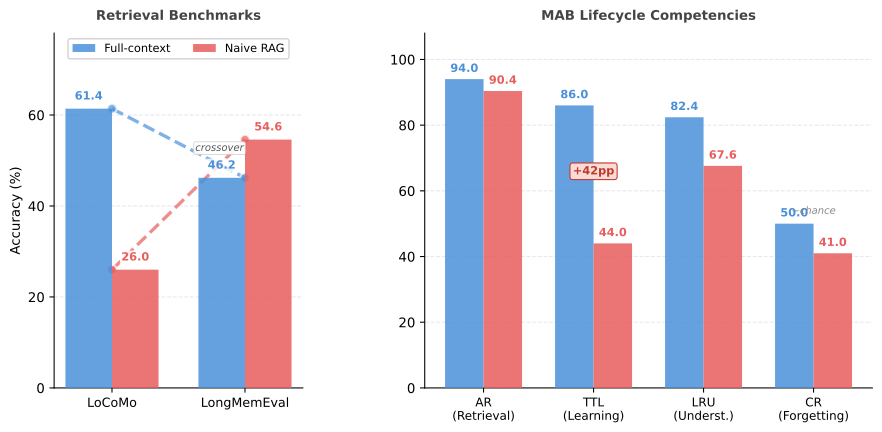
We evaluate two canonical baselines — full-context injection and naive vector RAG — on three benchmarks: LoCoMo (1,540 questions), LongMemEval (500 questions), and MemoryAgentBench (734 questions across 4 competencies). Generator: Gemini-2.0-Flash-001; Judge: GPT-4o-mini. Full methodology and statistical analysis: docs/benchmark-evaluation.md.
Key findings:
- Retrieval crossover: Full-context dominates on shorter conversations (LoCoMo, 16–26K tokens) but naive RAG wins on longer histories (LongMemEval, ~115K tokens). Both differences statistically significant (McNemar's test, p < 0.001).
- Test-time learning gap: The largest gap across all benchmarks — 86% vs 44% (+42pp) — RAG destroys the sequential structure needed for in-context learning.
- Conflict resolution is unsolved: Both baselines score ~50% on contradiction handling, confirming that neither full-context nor retrieval provides a mechanism for resolving conflicting information.
- Neither baseline addresses what lifecycle management is designed for.
Development
# Run all library tests
# Run MCP integration tests
# Run LLM extraction tests
# Run all tests
# Build the MCP server
# Build with auto-consolidation support
# Run the demo (no external dependencies)
License
MIT