
akima_spline
A lightweight (only one dependency with 18 SLoC) implementation of a 1d Akima spline with optional smooth extrapolation and derivative calculation.
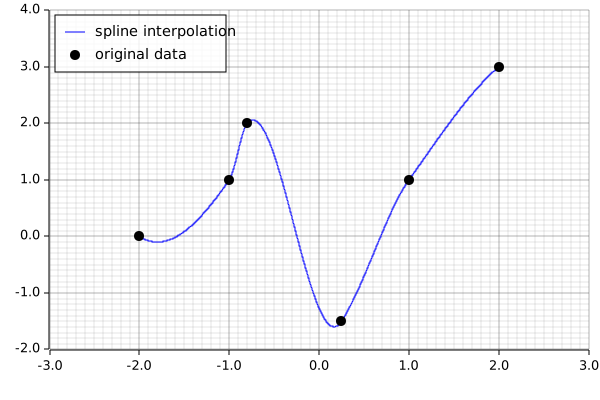
This crate implements a 1d Akima spline as described in:
Akima, Hiroshi: A new method of interpolation and smooth curve fitting based on local procedures. Journal of the Association for Computing Machinery, Vol. 17, No. 4, October 1970, pp.589-602.
A spline can be constructed by providing x/y data points in the form of two
vectors xs and ys holding the respective coordinates:
use AkimaSpline;
use approx;
// Coordinates used in the plot above
let xs = vec!;
let ys = vec!;
let spline = new.expect;
// Data inside the spline
assert_abs_diff_eq!;
// Outside the defined points:
assert!;
// But it is also possible to evaluate the spline "infallible" via a simple
// flat interpolation using the last known datapoint:
assert_eq!;
AkimaSpline also offers the option of providing left-side (x < xs[0])
and right-side (x > xs[xs.len() - 1]) extrapolation polynoms. To make sure the
transition between extrapolation and spline is "smooth" (first derivatives equal
at the transition point), the polynoms within the spline are adjusted. This can
be clearly seen when comparing splines made from the same datapoints with and
without extrapolation:
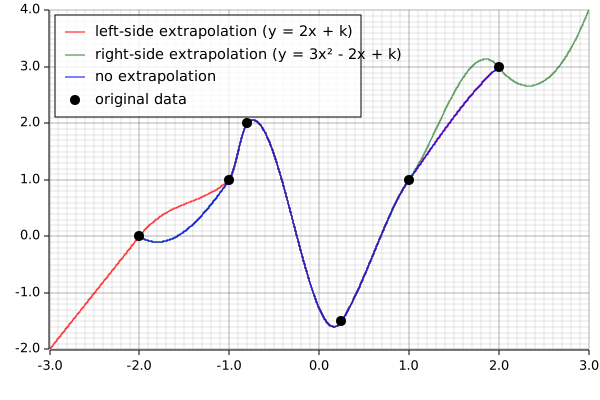
The extrapolation polynoms can be of any degree n defined by the length of the
given vector with the first value being the coefficient of the x^n term. The
constant part of the polynom is omitted, since it is inferred from the given
datapoints.
use AkimaSpline;
let xs = vec!;
let ys = vec!;
// Polynom 2(x-x0) + k, where k is 0 (first ys-value) and x0 is -2 (first xs-value)
let extrapl = Some;
// Polynom 3(x-x0)² - 2(x-x0) + k, where k is 3 (last ys-value) and x0 is 2 (last xs-value)
let extrapr = Some;
let spline = new.expect;
// Left-side extrapolation
assert_eq!;
// Right-side extrapolation
assert_abs_diff_eq!;
Derivatives
The spline can be differentiated by an arbitrary degree at any position x
using the derivative method.
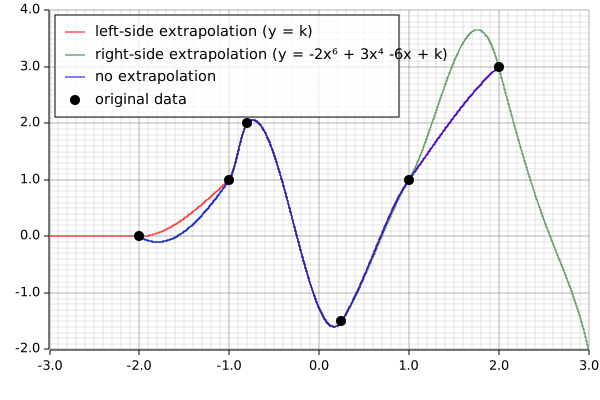
use AkimaSpline;
let xs = vec!;
let ys = vec!;
// Polynom k (constant)
let extrapl = Some;
// Polynom -2(x-x0)⁶ + 3(x-x0)⁴ - 6(x-x0) + k, where k is 3 (last ys-value) and x0 is 2 (last xs-value)
let extrapr = Some;
// Extrapolation to both sides
let spline = new.expect;
// Differentiation inside the spline
// =============================================================================
// Zeroth degree -> This just evaluates the spline
assert_abs_diff_eq!;
// First degree derivative
assert_abs_diff_eq!;
// Second degree derivative
assert_abs_diff_eq!;
// Tenth degree derivative = 0, since AkimaSpline uses a 3rd degree polynom internally
assert_eq!;
// First derivative at transition points
// =============================================================================
// Derivatives near the transition points are very similar, because of the enforced
// smoothness of the extrapolation.
// Left side
assert_abs_diff_eq!; // Outside spline
assert_abs_diff_eq!; // Transition point
assert_abs_diff_eq!; // Inside spline
// Right side
assert_abs_diff_eq!; // Inside spline
assert_abs_diff_eq!; // Transition point
assert_abs_diff_eq!; // Outside spline
It is of course possible to extrapolate only on one side of the spline. One
should note that specifying an empty extrapolation term vector is NOT equal to
None, since the derivative condition is still enforced (in that case, the
derivative at the transition point is zero).
use AkimaSpline;
let xs = vec!;
let ys = vec!;
let extrapr = Some; // This results in constant extrapolation
let spline = new.expect;
// Evaluation left of the spline
assert!;
// Evaluation inside the spline
assert_abs_diff_eq!;
// Evaluation right of the spline (always equal to y-value of last datapoint,
// because a zeroth degree polynom was defined)
assert_eq!;
assert_eq!;
// At the left transition point, the "natural" derivative is calculated:
assert!; // Outside spline
assert_abs_diff_eq!; // Transition point
assert_abs_diff_eq!; // Inside spline
// On the right side, the derivative is forced to be zero
// (derivative of p(x) = k is 0)
assert_abs_diff_eq!; // Outside spline
assert_abs_diff_eq!; // Transition point
assert_abs_diff_eq!; // Inside spline
The full documentation is available at https://docs.rs/akima_spline/0.1.5.
Serialization and deserialization
The AkimaSpline struct can be serialized / deserialized if the serde
feature is enabled. The serialized representation only stores the raw data
xs and ys as well as the extrapolation coefficients (without constant
component k).
Alternatives
- makima_splines implements the same algorithm from Hiroshi Akima as this crate and extrapolates using the leftmost / rightmost internal polynom of the spline (see their README.md).
- scirs2-interpolate reimplements SciPy's interpolation module in Rust, offering Akima spline interpolation besides various other algorithms.
- peroxide offers a variety of tools for scientific computing, including Akima spline interpolation.
Documentation
The full API documentation is available at https://docs.rs/akima_spline/0.1.5/akima_spline/.
The doc images are created by a second crate docs/create_doc_images which uses
this crate and the awesome plotters crate.
The images shown in this documentation can be created with cargo run from
within docs/create_doc_images.