
Aggligator — your friendly link aggregator



Aggligator combines one or more network links (for example TCP connections) between two endpoints into one logical connection. When several links are available, data is distributed across their combined capacity. Links can fail, return, be added or be removed while the connection runs.
If every link disappears, transport connectors keep trying to re-establish one while the logical connection remains open for a configurable time. A device can therefore switch between Wi-Fi, mobile data and Ethernet, even with an IP address change, without restarting the application connection.
It serves the same purpose as Multipath TCP and SCTP but works over existing, widely adopted protocols such as TCP, HTTPS, TLS, USB and WebSockets and is completely implemented in user space without the need for any support from the operating system. In networking terms, Aggligator provides link aggregation (also known as channel bonding), failover between links and roaming between networks, all for a single application connection rather than the whole machine.
Aggligator is written in 100% safe Rust and builds upon the Tokio asynchronous runtime. It works on all major native platform as well as WebAssembly.
Crate features
The following optional crate features are available:
dump— enables saving of analysis data to disk, mainly useful for debugging connection performance issues; also enables Serde support on some data types,js— enables support for execution in a JavaScript runtime environment (web browser).
JavaScript and web support
Aggligator supports compiling to the WebAssembly targets wasm32-unknown-unknown,
wasm32-wasip1 and wasm32-wasip1-threads. If you are targeting a JavaScript
runtime environment (like a web browser) you must enable the js crate feature.
This will enable JavaScript promises support and spawn tasks onto the browser's
native event queue.
Companion crates
The following crates provide transports:
- aggligator-transport-bluer — transport over Bluetooth on Linux,
- aggligator-transport-socks — transport through SOCKS5 proxies,
- aggligator-transport-tcp — transport over TCP with optional TLS encryption,
- aggligator-transport-usb — transport over USB for native platforms,
- aggligator-transport-webusb — transport over WebUSB for the web targeting WebAssembly,
- aggligator-transport-websocket — transport over WebSockets for native platforms,
- aggligator-transport-websocket-web — transport over WebSockets for the web targeting WebAssembly.
The following crates provide transport wrappers:
- aggligator-wrapper-tls — transport wrapper providing TLS security.
The following crates provide utility functions and command line tools:
- aggligator-monitor — interactive text-based link monitor and speed test,
- aggligator-util — command line utilities including tunneling of TCP connections.
Demo
Two machines are connected via Ethernet and Wi-Fi.
Machine A, called dino and acting as the speed test server, has two interfaces:
enp8s0 (gigabit ethernet, IP address ending in ::b01) and wlp6s0 (Wi-Fi, IP address ending in ::83e).
Both IP addresses are registered with the DNS server.
Machine B, acting as the speed test client, has four interfaces: enp0s25 (gigabit ethernet),
enxf8eXXXXdd (gigabit ethernet via USB), enxf8eXXXXc5 (gigabit ethernet via USB) and wlp3s0 (Wi-Fi).
Running the agg-speed tool from the aggligator-util crate on Machine B shows the following.
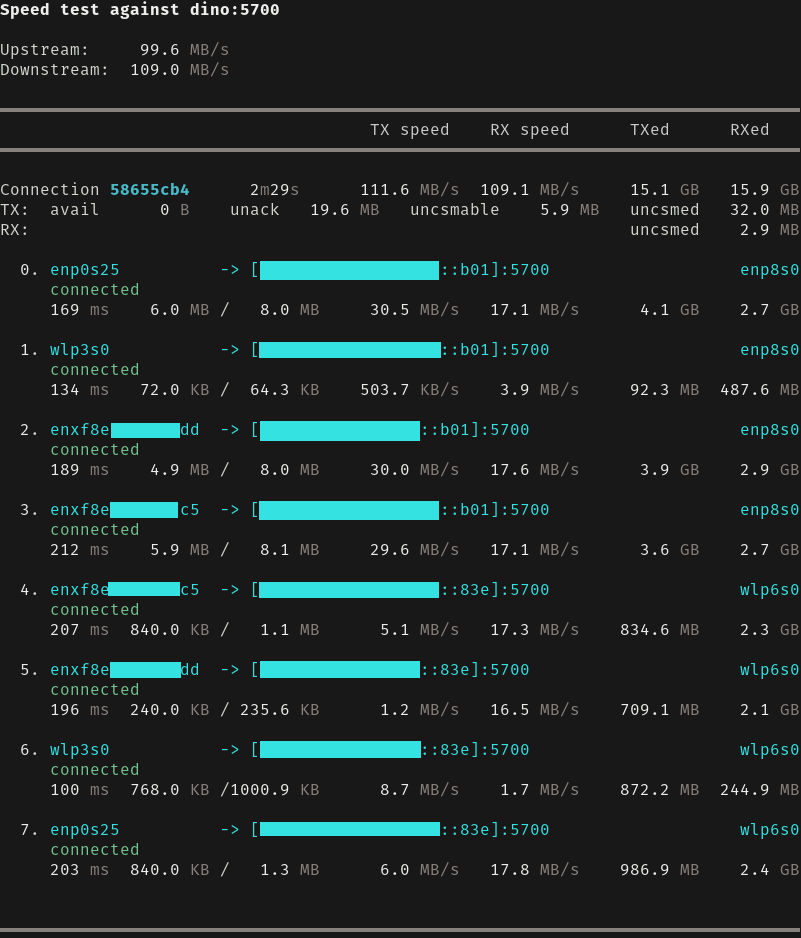
Aggligator has created 8 links between the machines, one for each pair of machine A and machine B interfaces. The connection speed is about 100 MB/s in both directions which is expected from a full-duplex gigabit ethernet link.
Unplugging ethernet cables or disabling the Wi-Fi results in redistribution of the traffic over the remaining links, but has no effect on the connection. If the ethernet cable is plugged in again or Wi-Fi is re-enabled, the link is automatically re-established.
Minimum supported Rust version
The minimum supported Rust version (MSRV) is 1.97.
Development
Development on native platforms is straightforward. Use cargo test to run tests as usual.
To run tests in a JavaScript runtime environment (for example wasm32-unknown-unknown with js feature)
install wasm-bindgen-test-runner and
Google ChromeDriver.
Then use the following command to execute the test suite:
WASM_BINDGEN_USE_BROWSER=1 WASM_BINDGEN_TEST_TIMEOUT=300 cargo +nightly test --target wasm32-unknown-unknown --features js --release --tests -p aggligator
A proper web-compatible runtime environment is required. Thus Node.js will not work. Deno should work, but it currently has some issues with the interaction between WebAssembly and async execution.
License
Aggligator is licensed under the Apache 2.0 license.
Contribution
Unless you explicitly state otherwise, any contribution intentionally submitted for inclusion in Aggligator by you, shall be licensed as Apache 2.0, without any additional terms or conditions.