
agd



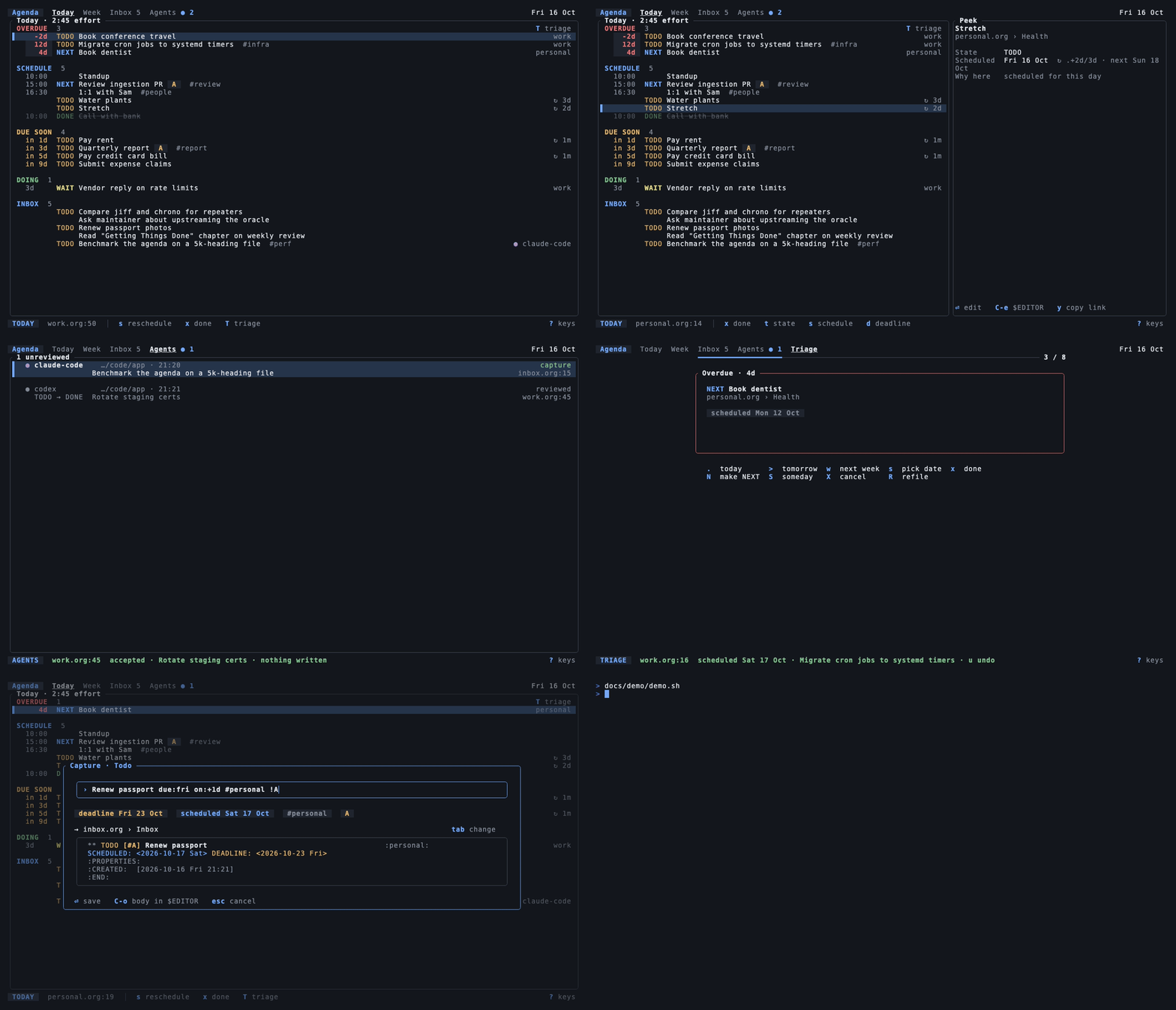
agd is an org-agenda for the terminal and for coding agents. It reads the Org files and the Emacs or Neovim config you already have, shows them in a keyboard-first TUI, and lets Claude Code, Codex and other MCP clients read and write the same tasks. What is due this week, or a task for Thursday, is a glance or one line away from the pane you are working in, without opening an editor.
Your files stay yours: agd changes only the bytes it was asked to change, checks its agenda and its writes against a pinned Emacs, and keeps every agent write in a tab until you accept or undo it.
New to Org? Org keeps notes and tasks in plain text
files (* TODO Renew passport), and org-agenda is its view of what is
scheduled, due and open across them. agd is that view outside Emacs, and it
starts on an empty ~/org with Org's defaults.
Try it on sample data without touching your files (needs python3):
&&
&& AGD=target/release/agd
Install
On Arch, cd packaging/aur && makepkg -si in a clone builds the release.
Tagged releases publish binaries for Linux, macOS and Windows with a
Sigstore-signed SHA256SUMS. Completions come from
agd completions bash|zsh|fish|elvish|powershell.
Start
Bring your Emacs or Neovim setup once, then run agd:
The import runs a clean emacs -Q or nvim --clean that reads your config
files without running your startup, and writes ~/.config/agd/config.toml
with your org directory, agenda files, TODO keywords, logging, priorities,
capture templates and custom agenda commands. It names the file and line
each setting came from, and why it left anything out. Starting fresh needs
no config: mkdir ~/org, then agd.
Getting started
walks through both, and a first day with agents.
The TUI
- Today opens first, or the saved view named by
start_view: OVERDUE, SCHEDULE, DUE SOON, DOING and INBOX, in the order you act on them.vswaps in org-agenda's classic day list. - Week, Inbox and Agents are tabs, and
aopens your saved views likeC-c a. - Triage (
T) walks the overdue items, then the inbox, one card and one key per decision.uundoes a step, or the whole pass. - Capture (
c) takes one line and previews the exact Org text it will write. - Agents lists every agent write, who made it and from which project, until you accept or undo it.
agd --paneis a narrow glance for a split: overdue as a count, the day's times with▸on the next, and the inbox and Agents counts.
Keys follow org-agenda wherever it has one:
| Key | Does | org-agenda |
|---|---|---|
n j / p k |
next / previous row | n / p |
SPC |
peek at the entry | SPC |
⏎ |
edit title, state, priority, tags, dates and checklist in a popup | |
C-e |
open the heading in $EDITOR |
RET |
t x X |
next state, done, cancel | t |
s d |
schedule, deadline | C-c C-s C-c C-d |
, + - : |
priority, tags | , + - : |
R |
refile | C-c C-w |
m * U B |
mark, mark all, unmark all, act on the marked rows | m * U B |
f b . |
next day, previous day, today | f b . |
u |
undo the last write | C-_ |
? |
every key on this screen, filtered as you type |
Every key, screen by screen, is in
KEYS.md.
Color only carries meaning: lateness, deadlines, done, focus and agents.
theme = "auto" follows the terminal's background, and NO_COLOR is
respected.
Capture
The same line works in agd capture, the TUI's c and Claude Code's
/capture:
The first word picks a template when it is one of your [[capture]] keys.
due: sets a deadline and on: schedules, with any date Org's date prompt
reads (fri, +2d, oct 30, fri 9am), then a repeater and a warning.
#tag and !A add a tag and a priority, or :tag: and #A with
notation = "org"; #42 stays text. Text that starts with - goes after
--. In the TUI, M-⏎ adds a checklist line under the task, x checks
one off in the edit popup, and lists show the progress, 1/3.
With agents
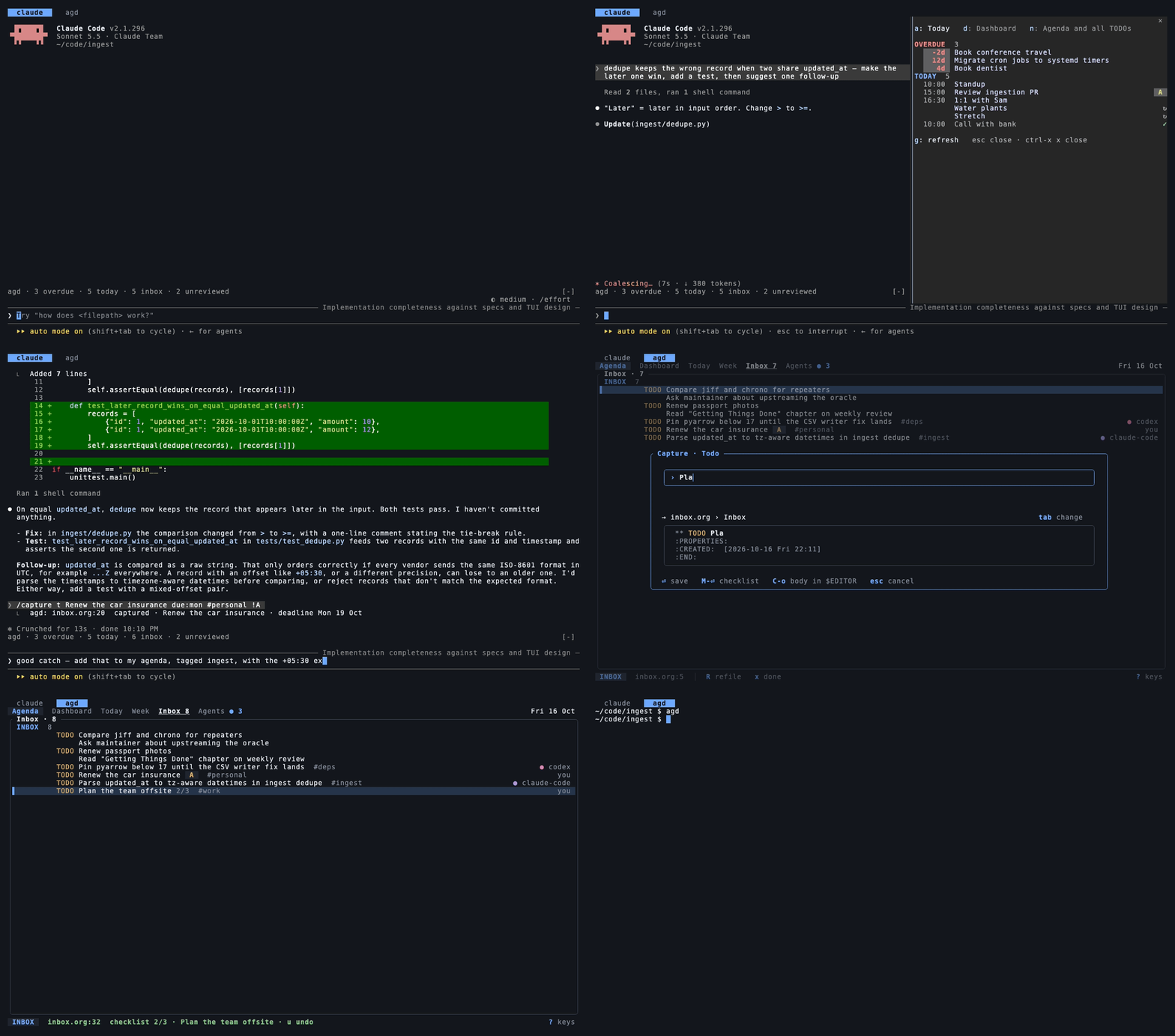
In Claude Code, install agd as a plugin:
It brings the MCP server, the agenda skill and a mod (Claude Code 2.1.296
or later): /agd opens a pane beside the transcript with your start view
and saved views, /capture t text files a task without a Claude turn, and a
line above the prompt shows the day's counts. For Codex and OpenCode,
install the MCP server and skill in a project (--dry-run shows the diff):
agd mcp is a stdio MCP server with seven tools: agenda, query,
describe, capture, edit, plan and set_state. It never opens a
network port, and your agenda reaches a model only when it calls one of
them.
- Every agent write is journaled under the agent's name and project, and waits on the Agents tab until you accept or undo it.
- Agents add
REPO,BRANCHand aSOURCElink to what they capture, so a task says where it came from. agent_inbox = "t"sends agent captures through templatetwithout dates: agents can add work, but not plan your day.
Panes and status bars
# ~/.tmux.conf
herdr panes take agd --pane the same way. The pane
and the TUI watch your files, so changes from Emacs, Neovim or an agent show
up as they happen.
Command line
agd                    the TUI
agd --pane             the narrow pane
agd agenda             the agenda as org-agenda prints it, or --json, --csv, --status
agd capture            one line through a template, or the popup with -i
agd undo               undo your latest command-line change
agd mcp                the stdio MCP server for coding agents
agd setup import       your Emacs or Neovim org settings into config.toml
agd setup install      the MCP server and skill for Codex or OpenCode
agd setup check        parse drift, invalid UTF-8, duplicate IDs, interrupted writes
agd completions SHELL  shell completions
Piped, agd agenda prints exactly Org's text. JSON items carry a stable
ref, and errors with --json are agd.error/v1 objects with a code such
as ref_conflict or invalid_date.
Configuration
One flat file, ~/.config/agd/config.toml (or $XDG_CONFIG_HOME/agd) on
Linux and macOS alike. Missing keys take their defaults and unknown keys are
errors. Values reuse Org's names:
= ["~/org"] # the only directories agd reads or writes
= ["**/*.org"] # files, directories or globs under the roots
= ["TODO(t) NEXT(n) WAIT(w@/!) | DONE(d!) CANCELLED(c@)"] # #+TODO: lines
= { = "yellow", = "dim-red" }
= "week" # day, week, month or a number of days
= "time" # off, time or note; also log_repeat, log_reschedule
= true
= ["emacsclient", "-n", "+{line}:{col}", "{file}"]
= "agd" # #tag and !A; "org" for :tag: and #A
= "w" # open on this view instead of Today
= "t" # agents capture through this template, without dates
[[]]
= "t"
= "Todo"
= "inbox.org"
= "Inbox"
= "* TODO %?\n:PROPERTIES:\n:CREATED: %U\n:END:"
[[]] # an org-agenda custom command
= "w"
= "Work"
= [
{ = "agenda", = "day" },
{ = "tags-todo", = "work/NEXT|WAIT", = "Next and waiting" },
{ = "alltodo", = "Backlog", = [ # org-super-agenda groups
{ = "Overdue", = 'DEADLINE<"<today>"' },
{ = "Quick", = "0:15" },
{ = "category" },
] },
]
Compatibility and safety
Agenda rows and their order, the text and CSV agendas, and every write are compared byte for byte with a pinned Emacs 30.2 and Org 9.7. Repeaters and habits, sorting strategies, tag inheritance, custom agenda command blocks and logging match; regexp matches, diary sexps, skip functions and clocking are reported and never evaluated.
- agd reads and writes only under
roots, and never writes through a symlink. - A write locks, re-reads the file, refuses a stale or ambiguous target or a file Emacs holds unsaved changes for, patches only its bytes, journals the inverse and renames atomically.
- Undo applies only where those bytes are unchanged; anything else is a conflict, never an overwrite.
- No network access at runtime.
More
- Getting started, KEYS.md, IMPORTING.md, COMPATIBILITY.md, SAFETY.md
- DESIGN.md: the words, formats, keys and look every surface follows
- ARCHITECTURE.md, CONTRIBUTING.md, SECURITY.md
just check runs fmt, clippy, the tests, the plugin checks and
nix flake check; just oracles compares agd with the pinned Emacs and
Neovim in Docker.
agd started as a fork of szaffarano/org-mcp-server.
The combined work is GPL-3.0-or-later; upstream-derived code remains
available under its MIT license in
LICENSE-MIT.