
aetna-winit-wgpu
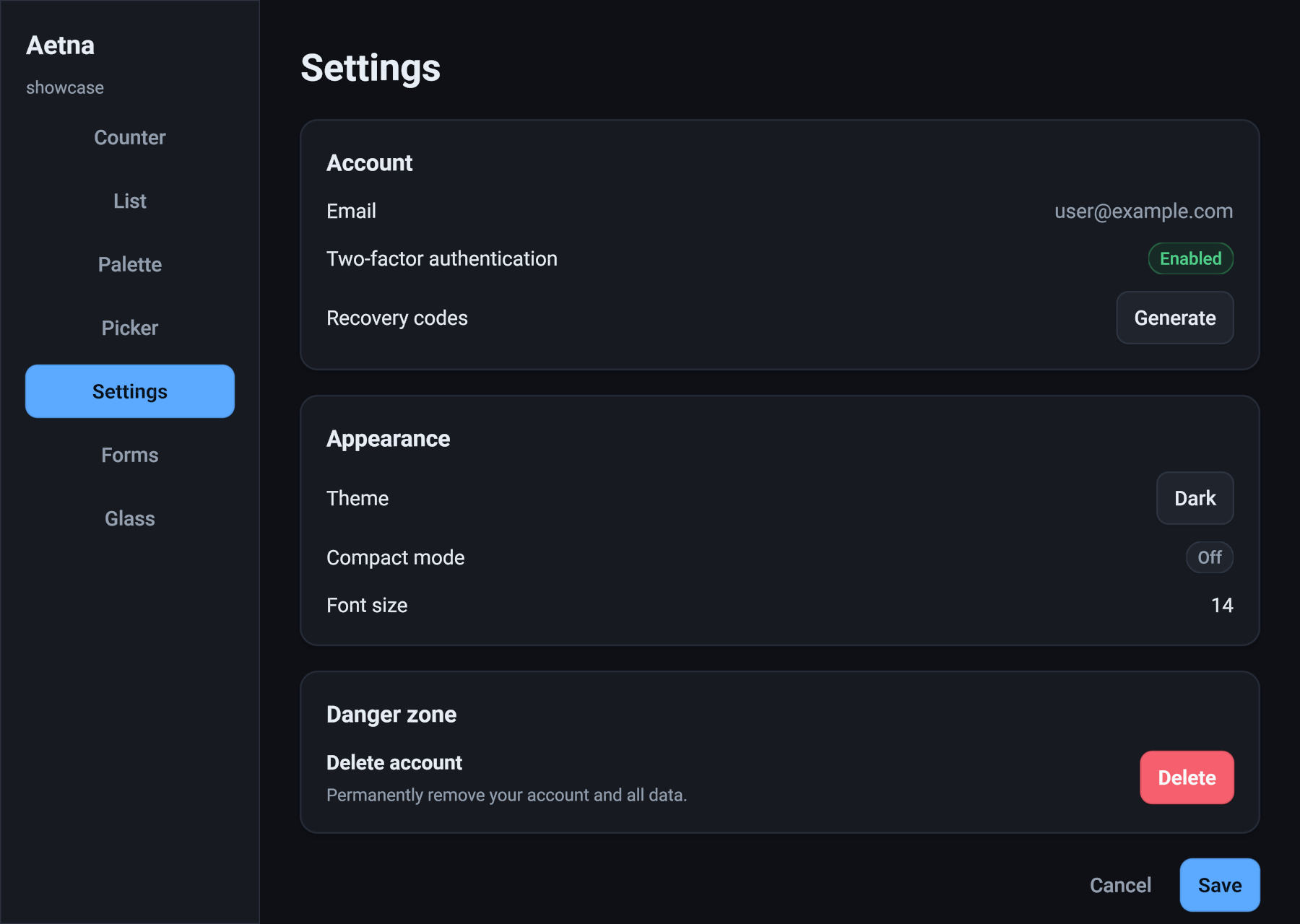
Optional native desktop host for Aetna apps using winit and wgpu.
Use this crate when you want the host to own the window, surface, swapchain, input mapping, IME forwarding, animation redraws, and MSAA target management:
use *;
For apps with external live state, put per-frame refresh in
App::before_build, then use run_with_config and
HostConfig::with_redraw_interval to choose a host cadence. For custom
render-loop integration, bypass this crate and call aetna-wgpu::Runner
directly.
Live data: meter-class vs event-class
External live state divides cleanly into two patterns, and apps that get the choice wrong burn either CPU or responsiveness.
Meter-class — high-frequency, value-changes-every-tick: audio
peak meters, FPS counters, network throughput graphs. The right
shape is fixed-cadence polling at the display refresh rate (33 ms ≈
30 fps is plenty for a peak meter; faster wastes work). Use
HostConfig::with_redraw_interval(Duration) and snapshot the latest
value in App::before_build. aetna-volume's PipeWire peak meter
is the worked example.
Event-class — sparse, value-changes-on-discrete-event: a chat message arrived, a download finished, a USB device was plugged in, a config file changed on disk. The right shape is push-driven — the backend thread wakes the UI loop as the event happens, with no polling. Polling event-class data either burns CPU at a useless cadence or shows the change up to one polling interval late.
The push-wake hook isn't wired through HostConfig yet; bypass
this crate's run/run_with_config and use winit's
EventLoopProxy::send_event directly when you need it (a worked
recipe lives at aetna-wgpu::Runner — drive a custom event loop
that calls Runner::prepare / Runner::render and wakes on
UserEvent). If your app needs both — fixed-cadence meters and
push-driven events — combine with_redraw_interval for the meter
clock with a proxy-driven request_redraw for the event channel;
the two don't conflict.
A future minor release will fold this into HostConfig (likely
with_external_wakeup(Fn(Wakeup))) once a non-meter use case
inside the workspace pressure-tests the shape. The trade-off
itself is the load-bearing piece — recognize which axis your data
falls on before reaching for the host config.