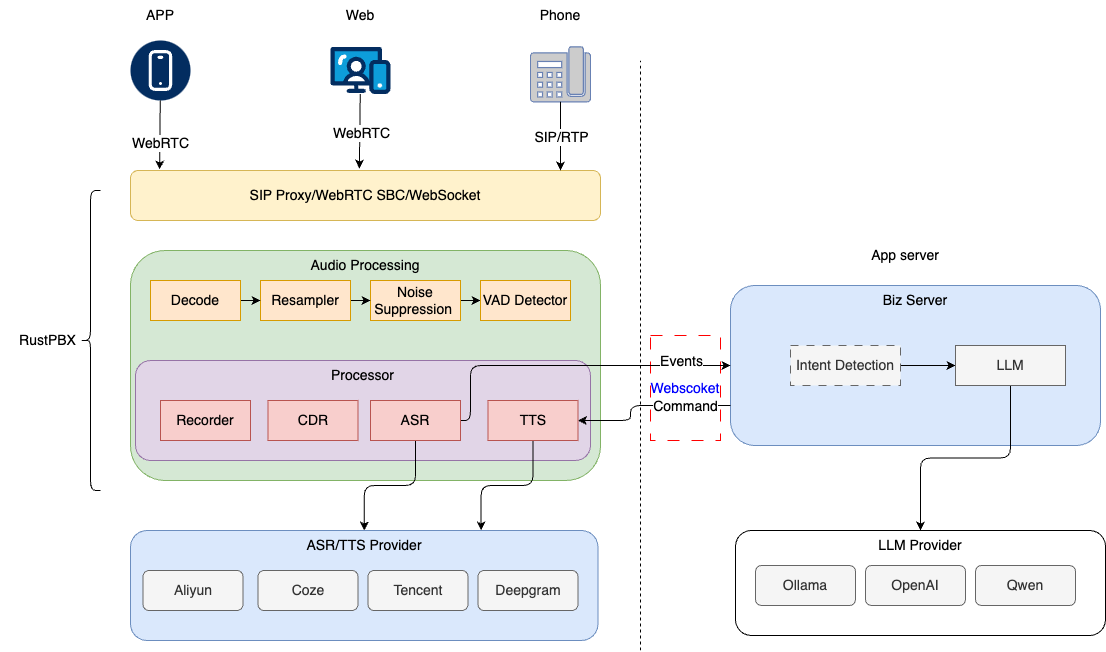
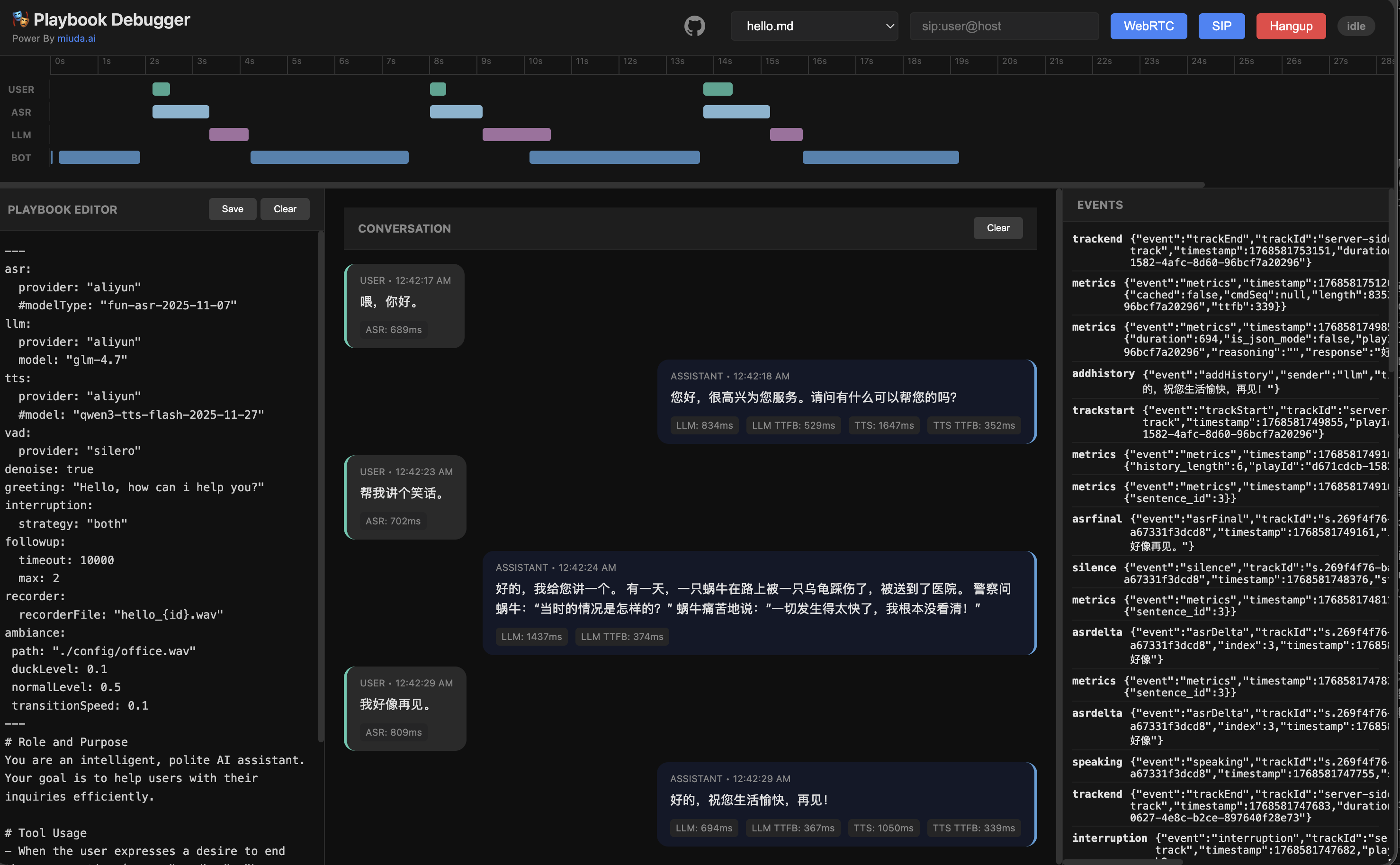
# Active Call API Documentation
This document describes the WebSocket and REST API endpoints provided by Active Call.
## Base URL
All API endpoints are relative to the server base URL.
## Authentication
Most endpoints require WebSocket upgrade for real-time communication.
## WebSocket Call Endpoints
The following three endpoints establish WebSocket connections for different voice communication protocols:
### 1. WebSocket Call Handler
**Endpoint:** `GET /call`
**Description:** Establishes a WebSocket connection for voice call handling with audio stream transmitted via WebSocket.
**Parameters:**
- `id` (optional, string): Session ID. If not provided, a new UUID will be generated (prefixed with `s.`).
- `dump_events` (optional, boolean): Enable event dumping to file. Default: `true`.
- `ping_interval` (optional, number): Interval in seconds to send Ping events. Default: `20`. Set to `0` to disable.
- `server_side_track` (optional, string): Override server-side track ID.
**Response:** WebSocket connection upgrade
**Usage:**
```javascript
const ws = new WebSocket('ws://localhost:8080/call?id=session123&dump_events=true&ping_interval=20');
```
### 2. WebRTC Call Handler
**Endpoint:** `GET /call/webrtc`
**Description:** Establishes a WebSocket connection for WebRTC call handling with audio stream transmitted via WebRTC RTP.
> **Note**: WebRTC requires a Secure Context. Ensure you are accessing your web client via **HTTPS** or **127.0.0.1**, otherwise the browser will not enable WebRTC functionality.
**Parameters:**
- `id` (optional, string): Session ID. If not provided, a new UUID will be generated (prefixed with `s.`).
- `dump_events` (optional, boolean): Enable event dumping to file. Default: `true`.
- `ping_interval` (optional, number): Interval in seconds to send Ping events. Default: `20`. Set to `0` to disable.
- `server_side_track` (optional, string): Override server-side track ID.
**Response:** WebSocket connection upgrade
**Usage:**
```javascript
const ws = new WebSocket('ws://localhost:8080/call/webrtc?id=session123&dump_events=true');
```
### 3. SIP Call Handler
**Endpoint:** `GET /call/sip`
**Description:** Establishes a WebSocket connection for SIP call handling with audio stream transmitted via SIP/RTP.
**Parameters:**
- `id` (optional, string): Session ID. If not provided, a new UUID will be generated (prefixed with `s.`).
- `dump_events` (optional, boolean): Enable event dumping to file. Default: `true`.
- `ping_interval` (optional, number): Interval in seconds to send Ping events. Default: `20`. Set to `0` to disable.
- `server_side_track` (optional, string): Override server-side track ID.
**Response:** WebSocket connection upgrade
**Usage:**
```javascript
const ws = new WebSocket('ws://localhost:8080/call/sip?id=session123&dump_events=true');
```
## WebSocket Communication Flow
```mermaid
sequenceDiagram
participant Client
participant RustPBX
participant MediaEngine
participant ASR/TTS
Client->>RustPBX: WebSocket Connect
RustPBX->>Client: Connection Established
Client->>RustPBX: Send Command (JSON)
RustPBX->>MediaEngine: Process Command
MediaEngine->>ASR/TTS: Audio Processing
ASR/TTS->>MediaEngine: Processing Results
MediaEngine->>RustPBX: Generate Events
RustPBX->>Client: Send Events (JSON)
Note over Client,RustPBX: Audio Stream Flow
Client->>RustPBX: Audio Data (Binary/WebRTC/SIP)
RustPBX->>MediaEngine: Process Audio
MediaEngine->>Client: Audio Response
```
## WebRTC Call Flow
```mermaid
sequenceDiagram
participant Client
participant RustPBX
participant WebRTC Engine
participant ICE Servers
Client->>RustPBX: WebSocket Connect (/call/webrtc)
RustPBX->>Client: Connection Established
Client->>RustPBX: Send Invite Command with SDP Offer
RustPBX->>WebRTC Engine: Create PeerConnection
RustPBX->>ICE Servers: Get ICE Servers
WebRTC Engine->>RustPBX: Generate SDP Answer
RustPBX->>Client: Send Answer Event with SDP
Client->>RustPBX: Set Remote Description
Note over Client,RustPBX: WebRTC Media Flow
Client->>RustPBX: RTP Audio Packets (PCM/PCMA/PCMU/G722)
RustPBX->>Client: RTP Audio Response
Client->>RustPBX: Send TTS/Play Commands
RustPBX->>Client: Send Audio Events
```
## SIP Call Flow
```mermaid
sequenceDiagram
participant Client
participant RustPBX
participant SIP UA
participant SIP Server
Client->>RustPBX: WebSocket Connect (/call/sip)
RustPBX->>Client: Connection Established
Client->>RustPBX: Send Invite Command with Caller/Callee
RustPBX->>SIP UA: Create SIP Dialog
SIP UA->>SIP Server: Send INVITE Request
SIP Server->>SIP UA: Send 200 OK with SDP Answer
RustPBX->>Client: Send Answer Event with SDP
Client->>RustPBX: Set Remote Description
Note over SIP UA,SIP Server: SIP/RTP Media Flow
SIP UA->>SIP Server: RTP Audio Packets (PCM/PCMA/PCMU/G722)
SIP Server->>SIP UA: RTP Audio Response
Client->>RustPBX: Send TTS/Play Commands
RustPBX->>Client: Send Audio Events
```
## Voice Stream Communication Methods
### 1. WebSocket Audio Stream (`/call`)
- **Audio Format:** PCM, PCMA, PCMU, G722
- **Transport:** WebSocket binary messages
- **Usage:** Direct audio streaming over WebSocket connection
- **Advantages:** Simple, low latency, works through firewalls
### 2. WebRTC Audio Stream (`/call/webrtc`)
- **Audio Format:** PCM, PCMA, PCMU, G722
- **Transport:** WebRTC RTP over UDP
- **Usage:** Browser-compatible, NAT traversal
- **Advantages:** Browser native support, adaptive bitrate
### 3. SIP Audio Stream (`/call/sip`)
- **Audio Format:** PCM, PCMA, PCMU, G722
- **Transport:** SIP/RTP over UDP
- **Usage:** Traditional telephony integration
- **Advantages:** Standard telephony protocol, PBX integration
## MediaPass Feature
MediaPass allows for bidirectional audio streaming between RustPBX and an external WebSocket server. This feature enables another side to receive and send audio streams during a call.
### MediaPass Configuration
The `mediaPass` option in `CallOption` configures the WebSocket connection for audio streaming:
```json
{
"mediaPass": {
"url": "ws://localhost:9090/media",
"inputSampleRate": 16000,
"outputSampleRate": 16000,
"packetSize": 2560
}
}
```
**MediaPass Fields:**
- `url` (string): WebSocket URL to connect to for media streaming
- `inputSampleRate` (number): Sample rate of audio received from the WebSocket server (also the sample rate of the track)
- `outputSampleRate` (number): Sample rate of audio sent to the WebSocket server
- `packetSize` (number, optional): Packet size sent to WebSocket server, default is 2560 bytes
- `ptime` (numer, optional): if ptime is set, server will buffering the input audio, and playing it with `ptime` period
### MediaPass Example Usage
#### Example 1: Basic MediaPass Setup
```json
{
"command": "invite",
"option": {
"caller": "sip:alice@rustpbx.com",
"callee": "sip:bob@rustpbx.com",
"codec": "g722",
"mediaPass": {
"url": "ws://ai-server.rustpbx.com:9090/audio",
"inputSampleRate": 16000,
"outputSampleRate": 16000,
"packetSize": 1280
},
"asr": {
"provider": "tencent",
"language": "zh-CN",
"secretId": "your_secret_id",
"secretKey": "your_secret_key",
"modelType": "16k_zh",
"samplerate": 16000
}
}
}
```
#### Example 2: MediaPass with AI Voice Processing
```json
{
"command": "accept",
"option": {
"caller": "sip:caller@rustpbx.com",
"callee": "sip:agent@rustpbx.com",
"codec": "pcmu",
"denoise": true,
"mediaPass": {
"url": "ws://ai-voice-processor.rustpbx.com:8090/stream",
"inputSampleRate": 8000,
"outputSampleRate": 16000,
"packetSize": 2560
},
"vad": {
"type": "webrtc",
"samplerate": 16000,
"speechPadding": 250,
"silencePadding": 100,
"voiceThreshold": 0.5
},
"recorder": {
"recorderFile": "/recordings/call_with_ai.wav",
"samplerate": 16000,
"ptime": 200
}
}
}
```
### MediaPass WebSocket Protocol
The external WebSocket server should handle binary audio data in PCM format:
1. **Receiving Audio:** RustPBX sends PCM audio data as binary WebSocket messages at the configured `outputSampleRate`
2. **Sending Audio:** The WebSocket server can send PCM audio data back to RustPBX at the configured `inputSampleRate`
3. **Audio Format:** Raw PCM data, signed 16-bit little-endian
4. **Packet Size:** Configurable via `packetSize` parameter (default: 2560 bytes)
### MediaPass Flow Diagram
```mermaid
sequenceDiagram
participant Caller
participant RustPBX
participant AI_Server
participant Callee
Caller->>RustPBX: Audio Stream
RustPBX->>AI_Server: PCM Audio (WebSocket)
AI_Server->>AI_Server: Process Audio (ASR/AI/TTS)
AI_Server->>RustPBX: Processed Audio (WebSocket)
RustPBX->>Callee: Processed Audio Stream
Note over Caller,Callee: Bidirectional AI-enhanced communication
```
## WebSocket Commands
Commands are sent as JSON messages through the WebSocket connection. All timestamps are in milliseconds. Each command follows a common structure with the `command` field indicating the operation type.
### Core Call Management Commands
#### Invite Command
**Purpose:** Initiates a new outbound call.
**Fields:**
- `command` (string): Always "invite"
- `option` (CallOption): Call configuration parameters
```json
{
"command": "invite",
"option": {
"caller": "sip:alice@rustpbx.com",
"callee": "sip:bob@rustpbx.com",
"offer": "v=0\r\no=- 1234567890 2 IN IP4 127.0.0.1\r\n...",
"codec": "g722",
"denoise": true,
"asr": {
"provider": "tencent",
"language": "zh-CN",
"appId": "app_id",
"secretId": "your_secret_id",
"secretKey": "your_secret_key",
"modelType": "16k_zh",
"samplerate": 16000,
"startWhenAnswer": true
},
"tts": {
"provider": "tencent",
"speaker": "xiaoyan",
"volume": 5,
"speed": 1.0,
"emotion": "neutral"
}
}
}
```
#### Accept Command
**Purpose:** Accepts an incoming call.
**Fields:**
- `command` (string): Always "accept"
- `option` (CallOption): Call configuration parameters
```json
{
"command": "accept",
"option": {
"caller": "sip:alice@rustpbx.com",
"callee": "sip:bob@rustpbx.com",
"codec": "g722",
"recorder": {
"recorderFile": "/path/to/recording.wav",
"samplerate": 16000,
"ptime": 200
}
}
}
```
#### Reject Command
**Purpose:** Rejects an incoming call.
**Fields:**
- `command` (string): Always "reject"
- `reason` (string): Reason for rejection
- `code` (number, optional): SIP response code
```json
{
"command": "reject",
"reason": "Busy",
"code": 486
}
```
#### Ringing Command
**Purpose:** Sends ringing response for incoming call.
> **Note:** If a `recorder` is set in the ringing command, the `recorder` option in the subsequent accept command will **not** override the recorder settings from the ringing phase.
>
**Fields:**
- `command` (string): Always "ringing"
- `recorder` (RecorderOption, optional): Call recording configuration
- `recorderFile` (string): Path to the recording file
- `samplerate` (number): Recording sample rate in Hz (default: 16000)
- `ptime` (number): Packet time in milliseconds (default: 200)
- `earlyMedia` (boolean): Enable early media during ringing
- `ringtone` (string, optional): Custom ringtone URL
```json
{
"command": "ringing",
"recorder": {
"recorderFile": "/path/to/recording.wav",
"samplerate": 16000,
"ptime": 200
},
"earlyMedia": true,
"ringtone": "http://rustpbx.com/ringtone.wav"
}
```
### Media Control Commands
#### TTS Command
**Purpose:** Converts text to speech and plays audio.
**Fields:**
- `command` (string): Always "tts"
- `text` (string): Text to synthesize
- `speaker` (string, optional): Speaker voice name
- `playId` (string, optional): **Unique identifier for this TTS session. If the same playId is used, it will not interrupt the previous playback.**
- `autoHangup` (boolean, optional): **If true, the call will be automatically hung up after TTS playback is finished.**
- `streaming` (boolean, optional): **If true, indicates streaming text input (like LLM streaming output).**
- `endOfStream` (boolean, optional): **If true, indicates the input text is finished (used with streaming).**
- `waitInputTimeout` (number, optional): Maximum time to wait for user input in seconds
- `option` (SynthesisOption, optional): TTS provider specific options
- `base64` (bool, optional): If true, text is base64 encoded PCM samples of sample rate 16000 hz, **DO NOT use this feature in Streaming TTS**
```json
{
"command": "tts",
"text": "Hello, this is a test message",
"speaker": "xiaoyan",
"playId": "unique_play_id",
"autoHangup": false,
"streaming": false,
"endOfStream": false,
"waitInputTimeout": 30,
"option": {
"provider": "tencent",
"speaker": "xiaoyan",
"volume": 5,
"speed": 1.0
}
}
```
#### Play Command
**Purpose:** Plays audio from a URL.
**Fields:**
- `command` (string): Always "play"
- `url` (string): **URL of audio file to play (supports HTTP/HTTPS URLs). This URL will be returned as playId in the trackEnd event.**
- `autoHangup` (boolean, optional): **If true, the call will be automatically hung up after playback is finished.**
- `waitInputTimeout` (number, optional): Maximum time to wait for user input in seconds
```json
{
"command": "play",
"url": "http://rustpbx.com/audio.mp3",
"autoHangup": false,
"waitInputTimeout": 30
}
```
#### Interrupt Command
**Purpose:** Interrupts current TTS or audio playback.
**Fields:**
- `command` (string): Always "interrupt"
- `graceful` (boolean, optional): If true, waits for the current TTS command to finish playing before stopping. Default: `false`.
- `fadeOutMs` (number, optional): Fade-out duration in milliseconds before stopping playback.
```json
{
"command": "interrupt",
"graceful": false
}
```
#### Pause Command
**Purpose:** Pauses current playback.
```json
{
"command": "pause"
}
```
#### Resume Command
**Purpose:** Resumes paused playback.
```json
{
"command": "resume"
}
```
### Call Transfer Commands
#### Refer Command
**Purpose:** Transfers the call to another party (SIP REFER).
**Fields:**
- `command` (string): Always "refer"
- `caller` (string): Caller identity for the transfer
- `callee` (string): Address of Record (AOR) of the transfer target (e.g., sip:bob@rustpbx.com)
- `options` (ReferOption, optional): Transfer configuration
- `denoise` (boolean, optional): Enable noise reduction
- `timeout` (number, optional): Transfer timeout in seconds
- `moh` (string, optional): Music on hold URL to play during transfer
- `asr` (TranscriptionOption, optional): Automatic Speech Recognition configuration
- `provider` (string): ASR provider (e.g., "tencent", "aliyun", "openai")
- `secretId` (string): Provider secret ID
- `secretKey` (string): Provider secret key
- `region` (string, optional): Provider region
- `model` (string, optional): ASR model to use
- `autoHangup` (boolean, optional): Automatically hang up after transfer completion
- `sip` (SipOption, optional): SIP configuration
- `username` (string): SIP username
- `password` (string): SIP password
- `realm` (string): SIP realm/domain
- `headers` (object, optional): Additional SIP headers
```json
{
"command": "refer",
"caller": "sip:alice@rustpbx.com",
"callee": "sip:charlie@rustpbx.com",
"options": {
"denoise": true,
"timeout": 30,
"moh": "http://rustpbx.com/hold_music.wav",
"asr": {
"provider": "tencent",
"language": "zh-CN",
"appId": "app_id",
"secretId": "your_secret_id",
"secretKey": "your_secret_key",
"modelType": "16k_zh",
"bufferSize": 4000,
"samplerate": 16000,
"endpoint": "https://api.rustpbx.com",
"extra": {
"custom_param": "value"
},
"startWhenAnswer": true
},
"autoHangup": true,
"sip": {
"username": "transfer_user",
"password": "transfer_password",
"realm": "rustpbx.com",
"headers": {
"X-Transfer-Source": "pbx"
}
}
}
}
```
### Audio Track Control Commands
#### Mute Command
**Purpose:** Mutes a specific audio track.
**Fields:**
- `command` (string): Always "mute"
- `trackId` (string, optional): Track ID to mute (if not specified, mutes all tracks)
```json
{
"command": "mute",
"trackId": "track-123"
}
```
#### Unmute Command
**Purpose:** Unmutes a specific audio track.
**Fields:**
- `command` (string): Always "unmute"
- `trackId` (string, optional): Track ID to unmute (if not specified, unmutes all tracks)
```json
{
"command": "unmute",
"trackId": "track-123"
}
```
### Session Management Commands
#### Hangup Command
**Purpose:** Ends the call.
**Fields:**
- `command` (string): Always "hangup"
- `reason` (string, optional): Reason for hanging up
- `initiator` (string, optional): Who initiated the hangup (user, system, etc.)
- `headers` (object, optional): Additional SIP headers to include in the BYE request (SIP calls only)
```json
{
"command": "hangup",
"reason": "user_requested",
"initiator": "user",
"headers": {
"X-Hangup-Cause": "normal"
}
}
```
#### History Command
**Purpose:** Adds a conversation history entry.
**Fields:**
- `command` (string): Always "history"
- `speaker` (string): Speaker identifier
- `text` (string): Conversation text
```json
{
"command": "history",
"speaker": "user",
"text": "Hello, I need help with my account"
}
```
### CallOption Object Structure
The `CallOption` object is used in `invite` and `accept` commands and contains the following fields:
```json
{
"denoise": true,
"offer": "SDP offer string",
"callee": "sip:callee@rustpbx.com",
"caller": "sip:caller@rustpbx.com",
"recorder": {
"recorderFile": "/path/to/recording.wav",
"samplerate": 16000,
"ptime": 200
},
"asr": {
"provider": "tencent",
"language": "zh-CN",
"appId": "app_id",
"secretId": "your_secret_id",
"secretKey": "your_secret_key",
"modelType": "16k_zh",
"bufferSize": 4000,
"samplerate": 16000,
"endpoint": "https://api.rustpbx.com",
"extra": {
"custom_param": "value"
},
"startWhenAnswer": true
},
"vad": {
"type": "webrtc",
"samplerate": 16000,
"speechPadding": 250,
"silencePadding": 100,
"ratio": 0.5,
"voiceThreshold": 0.5,
"maxBufferDurationSecs": 50,
"silenceTimeout": null,
"endpoint": null,
"secretKey": null,
"secretId": null
},
"tts": {
"samplerate": 16000,
"provider": "tencent",
"speed": 1.0,
"appId": "app_id",
"secretId": "your_secret_id",
"secretKey": "your_secret_key",
"volume": 5,
"speaker": "1345",
"codec": "pcm",
"subtitle": true,
"emotion": "neutral",
"endpoint": "https://api.rustpbx.com",
"extra": {
"custom_param": "value"
},
"cacheKey": "cache_key_example"
},
"mediaPass": {
"url": "ws://localhost:9090/media",
"inputSampleRate": 16000,
"outputSampleRate": 16000,
"packetSize": 2560
},
"handshakeTimeout": 30,
"enableIpv6": false,
"inactivityTimeout": 50,
"sip": {
"username": "user",
"password": "password",
"realm": "rustpbx.com",
"headers": {
"X-Custom-Header": "value"
}
},
"extra": {
"custom_field": "custom_value"
},
"codec": "g722",
"eou": {
"type": "tencent",
"endpoint": "https://api.rustpbx.com",
"secretKey": "your_secret_key",
"secretId": "your_secret_id",
"timeout": 5000
}
}
```
**CallOption Fields:**
- `denoise` (boolean, optional): Enable noise reduction for audio processing
- `offer` (string, optional): SDP offer string for WebRTC/SIP negotiation
- `callee` (string, optional): Callee's SIP URI or phone number (e.g., "sip:bob@rustpbx.com")
- `caller` (string, optional): Caller's SIP URI or phone number (e.g., "sip:alice@rustpbx.com")
- `recorder` (RecorderOption, optional): Call recording configuration
- `recorderFile` (string): Path to the recording file
- `samplerate` (number): Recording sample rate in Hz (default: 16000)
- `ptime` (number): Packet time in milliseconds (default: 200)
- `asr` (TranscriptionOption, optional): Automatic Speech Recognition configuration
- `provider` (string): ASR provider ("tencent", "aliyun", "voiceapi")
- `language` (string, optional): Language code (e.g., "zh-CN", "en-US")
- `appId` (string, optional): Application ID for the ASR service
- `secretId` (string, optional): Secret ID for authentication
- `secretKey` (string, optional): Secret key for authentication
- `modelType` (string, optional): ASR model type (e.g., "16k_zh", "8k_en")
- `bufferSize` (number, optional): Audio buffer size in bytes
- `samplerate` (number, optional): Audio sample rate for ASR processing
- `endpoint` (string, optional): Custom ASR service endpoint URL
- `extra` (object, optional): Additional provider-specific parameters
- `startWhenAnswer` (boolean, optional): Start ASR when call is answered
- `vad` (VADOption, optional): Voice Activity Detection configuration
- `type` (string): VAD algorithm type ("silero")
- `samplerate` (number): Audio sample rate for VAD processing (default: 16000)
- `speechPadding` (number): Padding before speech detection in milliseconds (default: 250)
- `silencePadding` (number): Padding after silence detection in milliseconds (default: 100)
- `ratio` (number): Voice detection ratio threshold (default: 0.5)
- `voiceThreshold` (number): Voice energy threshold (default: 0.5)
- `maxBufferDurationSecs` (number): Maximum buffer duration in seconds (default: 50)
- `silenceTimeout` (number, optional): Timeout for silence detection in milliseconds
- `endpoint` (string, optional): Custom VAD service endpoint
- `secretKey` (string, optional): Secret key for VAD service authentication
- `secretId` (string, optional): Secret ID for VAD service authentication
- `tts` (SynthesisOption, optional): Text-to-Speech configuration
- `samplerate` (number, optional): TTS output sample rate in Hz
- `provider` (string, optional): TTS provider ("tencent", "aliyun", "deepgram", "supertonic"). Default: "aliyun" for Chinese (zh), "supertonic" for English (en).
- `speed` (number, optional): Speech speed multiplier (default: 1.0)
- `appId` (string, optional): Application ID for TTS service
- `secretId` (string, optional): Secret ID for authentication
- `secretKey` (string, optional): Secret key for authentication
- `volume` (number, optional): Speech volume level (1-10)
- `speaker` (string, optional): Voice speaker name (e.g., "xiaoyan", "xiaoyun")
- `codec` (string, optional): Audio codec for TTS output
- `subtitle` (boolean, optional): Enable subtitle generation
- `emotion` (string, optional): Speech emotion ("neutral", "sad", "happy", "angry", "fear", "news", "story", "radio", "poetry", "call", "sajiao", "disgusted", "amaze", "peaceful", "exciting", "aojiao", "jieshuo")
- `endpoint` (string, optional): Custom TTS service endpoint URL
- `extra` (object, optional): Additional provider-specific parameters
- `maxConcurrentTasks` (number,optional): Max Concurrent tasks for non streaming tts cmd
- `mediaPass` (MediaPassOption, optional): Media pass-through configuration for external audio processing
- `url` (string): WebSocket URL for media streaming
- `inputSampleRate` (number): Sample rate of audio received from WebSocket server
- `outputSampleRate` (number): Sample rate of audio sent to WebSocket server
- `packetSize` (number, optional): Packet size sent to WebSocket server in bytes (default: 2560)
- `subscribe` (boolean, optional): Enable real-time audio subscription for non-WebSocket calls (SIP/WebRTC). If true, audio will be pushed via the control WebSocket using binary frames with a 1-byte track header (0x00 for caller, 0x01 for callee).
- `handshakeTimeout` (number, optional): Timeout for connection handshake in seconds (e.g., 30)
- `enableIpv6` (boolean, optional): Enable IPv6 support for networking
- `inactivityTimeout` (number, optional): Timeout for audio inactivity in seconds
- `sip` (SipOption, optional): SIP protocol configuration
- `username` (string): SIP username for authentication
- `password` (string): SIP password for authentication
- `realm` (string): SIP realm/domain
- `headers` (object, optional): Additional SIP headers as key-value pairs
- `extra` (object, optional): Additional custom parameters as key-value pairs
- `codec` (string, optional): Audio codec for WebSocket calls ("pcmu", "pcma", "g722", "pcm")
- `eou` (EouOption, optional): End of Utterance detection configuration
- `type` (string, optional): EOU detection provider
- `endpoint` (string, optional): Custom EOU service endpoint URL
- `secretKey` (string, optional): Secret key for EOU service authentication
- `secretId` (string, optional): Secret ID for EOU service authentication
- `timeout` (number, optional): Maximum timeout for EOU detection in milliseconds
### ReferOption Object Structure
The `ReferOption` object is used in the `refer` command and contains the following fields:
```json
{
"denoise": true,
"timeout": 30,
"moh": "http://rustpbx.com/hold_music.wav",
"asr": {
"provider": "tencent",
"language": "zh-CN",
"appId": "app_id",
"secretId": "your_secret_id",
"secretKey": "your_secret_key",
"modelType": "16k_zh",
"bufferSize": 4000,
"samplerate": 16000,
"endpoint": "https://api.rustpbx.com",
"extra": {
"custom_param": "value"
},
"startWhenAnswer": true
},
"autoHangup": true,
"sip": {
"username": "transfer_user",
"password": "transfer_password",
"realm": "rustpbx.com",
"headers": {
"X-Transfer-Source": "pbx"
}
}
}
```
**Fields:**
- `denoise` (boolean, optional): Enable noise reduction during transfer
- `timeout` (number, optional): Transfer timeout in seconds
- `moh` (string, optional): Music on hold URL to play during transfer
- `asr` (TranscriptionOption, optional): Automatic Speech Recognition configuration
- `autoHangup` (boolean, optional): Automatically hang up after transfer completion
- `sip` (SipOption, optional): SIP configuration for the transfer
## WebSocket Events
Events are received as JSON messages from the server. All timestamps are in milliseconds. Each event contains an `event` field that indicates the event type, and most events include a `trackId` field to identify the associated audio track.
### Call Lifecycle Events
#### Incoming Event
**Triggered when:** An incoming call is received (SIP calls only).
**Fields:**
- `event` (string): Always "incoming"
- `trackId` (string): **Unique identifier for the audio track. Used to identify which track generated this event.**
- `timestamp` (number): Event timestamp in milliseconds since Unix epoch
- `caller` (string): Caller's SIP URI or phone number
- `callee` (string): Callee's SIP URI or phone number
- `sdp` (string): SDP offer from the caller
```json
{
"event": "incoming",
"trackId": "track-abc123",
"timestamp": 1640995200000,
"caller": "sip:alice@rustpbx.com",
"callee": "sip:bob@rustpbx.com",
"sdp": "v=0\r\no=- 1234567890 2 IN IP4 127.0.0.1\r\n..."
}
```
#### Answer Event
**Triggered when:** Call is answered and SDP negotiation is complete.
**Fields:**
- `event` (string): Always "answer"
- `trackId` (string): **Unique identifier for the audio track.**
- `timestamp` (number): Event timestamp in milliseconds since Unix epoch
- `sdp` (string): SDP answer from the server
```json
{
"event": "answer",
"trackId": "track-abc123",
"timestamp": 1640995200000,
"sdp": "v=0\r\no=- 1234567890 2 IN IP4 127.0.0.1\r\n..."
}
```
#### Reject Event
**Triggered when:** Call is rejected.
**Fields:**
- `event` (string): Always "reject"
- `trackId` (string): **Unique identifier for the audio track.**
- `timestamp` (number): Event timestamp in milliseconds since Unix epoch
- `reason` (string): Reason for rejection
- `code` (number, optional): SIP response code
```json
{
"event": "reject",
"trackId": "track-abc123",
"timestamp": 1640995200000,
"reason": "Busy",
"code": 486
}
```
#### Ringing Event
**Triggered when:** Call is ringing (SIP calls only).
**Fields:**
- `event` (string): Always "ringing"
- `trackId` (string): **Unique identifier for the audio track.**
- `timestamp` (number): Event timestamp in milliseconds since Unix epoch
- `earlyMedia` (boolean): Whether early media is available
```json
{
"event": "ringing",
"trackId": "track-abc123",
"timestamp": 1640995200000,
"earlyMedia": false
}
```
#### Hangup Event
**Triggered when:** Call is ended.
**Fields:**
- `event` (string): Always "hangup"
- `timestamp` (number): Event timestamp in milliseconds since Unix epoch
- `reason` (string, optional): Reason for hangup
- `initiator` (string, optional): Who initiated the hangup (user, system, etc.)
- `startTime` (string): ISO 8601 timestamp when call started
- `hangupTime` (string): ISO 8601 timestamp when call ended
- `answerTime` (string, optional): ISO 8601 timestamp when call was answered
- `ringingTime` (string, optional): ISO 8601 timestamp when call started ringing
- `from` (Attendee, optional): Information about the caller
- `to` (Attendee, optional): Information about the callee
- `extra` (object, optional): Additional call metadata
```json
{
"event": "hangup",
"timestamp": 1640995200000,
"reason": "user_requested",
"initiator": "user",
"startTime": "2024-01-01T12:00:00Z",
"hangupTime": "2024-01-01T12:05:30Z",
"answerTime": "2024-01-01T12:00:05Z",
"ringingTime": "2024-01-01T12:00:02Z",
"from": {
"username": "alice",
"realm": "rustpbx.com",
"source": "sip:alice@rustpbx.com"
},
"to": {
"username": "bob",
"realm": "rustpbx.com",
"source": "sip:bob@rustpbx.com"
},
"extra": {
"call_quality": "good",
"network_type": "wifi"
}
}
```
### Voice Activity Detection Events
#### Speaking Event
**Triggered when:** Voice activity detection detects speech start.
**Fields:**
- `event` (string): Always "speaking"
- `trackId` (string): **Unique identifier for the audio track.**
- `timestamp` (number): Event timestamp in milliseconds since Unix epoch
- `startTime` (number): When speech started in milliseconds since Unix epoch
- `isFiller` (boolean, optional): Whether this speech segment is a filler word
- `confidence` (number, optional): Confidence score of the voice detection (0.0–1.0)
```json
{
"event": "speaking",
"trackId": "track-abc123",
"timestamp": 1640995200000,
"startTime": 1640995200000,
"isFiller": false,
"confidence": 0.95
}
```
#### Silence Event
**Triggered when:** Voice activity detection detects silence.
**Fields:**
- `event` (string): Always "silence"
- `trackId` (string): **Unique identifier for the audio track.**
- `timestamp` (number): Event timestamp in milliseconds since Unix epoch
- `startTime` (number): When silence started in milliseconds since Unix epoch
- `duration` (number): Duration of silence in milliseconds
```json
{
"event": "silence",
"trackId": "track-abc123",
"timestamp": 1640995200000,
"startTime": 1640995195000,
"duration": 5000
}
```
### AI and Speech Processing Events
#### Answer Machine Detection Event
**Triggered when:** Answer machine detection algorithm identifies automated response.
**Fields:**
- `event` (string): Always "answerMachineDetection"
- `timestamp` (number): Event timestamp in milliseconds since Unix epoch
- `startTime` (number): Detection window start time in milliseconds since Unix epoch
- `endTime` (number): Detection window end time in milliseconds since Unix epoch
- `text` (string): Detected automated message text
```json
{
"event": "answerMachineDetection",
"timestamp": 1640995200000,
"startTime": 1640995200000,
"endTime": 1640995205000,
"text": "Hello, you have reached ABC Company. Please leave a message..."
}
```
#### EOU (End of Utterance) Event
**Triggered when:** End of utterance detection identifies when user has finished speaking.
**Fields:**
- `event` (string): Always "eou"
- `trackId` (string): **Unique identifier for the audio track.**
- `timestamp` (number): Event timestamp in milliseconds since Unix epoch
- `completed` (boolean): Whether the utterance was completed normally
- `interruptPoint` (string, optional): Position in TTS subtitle text where the interruption occurred
```json
{
"event": "eou",
"trackId": "track-abc123",
"timestamp": 1640995200000,
"completed": true,
"interruptPoint": null
}
```
#### ASR Final Event
**Triggered when:** ASR provides final transcription result.
**Fields:**
- `event` (string): Always "asrFinal"
- `trackId` (string): **Unique identifier for the audio track.**
- `timestamp` (number): Event timestamp in milliseconds since Unix epoch
- `index` (number): ASR result sequence number
- `startTime` (number, optional): Start time of speech in milliseconds since Unix epoch
- `endTime` (number, optional): End time of speech in milliseconds since Unix epoch
- `text` (string): Final transcribed text
- `isFiller` (boolean, optional): Whether this result is a filler word
- `confidence` (number, optional): Confidence score (0.0–1.0)
- `taskId` (string, optional): ASR provider task identifier
```json
{
"event": "asrFinal",
"trackId": "track-abc123",
"timestamp": 1640995200000,
"index": 1,
"startTime": 1640995200000,
"endTime": 1640995205000,
"text": "Hello, how can I help you today?",
"isFiller": false,
"confidence": 0.98,
"taskId": "asr-task-001"
}
```
#### ASR Delta Event
**Triggered when:** ASR provides partial transcription result (streaming mode).
**Fields:**
- `event` (string): Always "asrDelta"
- `trackId` (string): **Unique identifier for the audio track.**
- `index` (number): ASR result sequence number
- `timestamp` (number): Event timestamp in milliseconds since Unix epoch
- `startTime` (number, optional): Start time of speech in milliseconds since Unix epoch
- `endTime` (number, optional): End time of speech in milliseconds since Unix epoch
- `text` (string): Partial transcribed text
- `isFiller` (boolean, optional): Whether this result is a filler word
- `confidence` (number, optional): Confidence score (0.0–1.0)
- `taskId` (string, optional): ASR provider task identifier
```json
{
"event": "asrDelta",
"trackId": "track-abc123",
"index": 1,
"timestamp": 1640995200000,
"startTime": 1640995200000,
"endTime": 1640995203000,
"text": "Hello, how can",
"isFiller": false,
"confidence": 0.85
}
```
### Audio Track Events
#### Track Start Event
**Triggered when:** Audio track starts (TTS, file playback, etc.).
**Fields:**
- `event` (string): Always "trackStart"
- `trackId` (string): **Unique identifier for the audio track.**
- `timestamp` (number): Event timestamp in milliseconds since Unix epoch
- `playId` (string, optional): **For TTS command, this is the playId from the TTS command. For Play command, this is the URL from the Play command.**
```json
{
"event": "trackStart",
"trackId": "track-tts-456",
"timestamp": 1640995200000,
"playId": "llm-001"
}
```
#### Track End Event
**Triggered when:** Audio track ends (TTS finished, file playback finished, etc.).
**Fields:**
- `event` (string): Always "trackEnd"
- `trackId` (string): **Unique identifier for the audio track.**
- `timestamp` (number): Event timestamp in milliseconds since Unix epoch
- `duration` (number): Duration of track in milliseconds
- `ssrc` (number): RTP Synchronization Source identifier
- `playId` (string, optional): **For TTS command, this is the playId from the TTS command. For Play command, this is the URL from the Play command.**
```json
{
"event": "trackEnd",
"trackId": "track-tts-456",
"timestamp": 1640995230000,
"duration": 30000,
"ssrc": 1234567890,
"playId": "llm-001"
}
```
#### Interruption Event
**Triggered when:** Current playback is interrupted by user input or another command.
**Fields:**
- `event` (string): Always "interruption"
- `trackId` (string): **Unique identifier for the audio track.**
- `timestamp` (number): Event timestamp in milliseconds since Unix epoch
- `playId` (string, optional): **For TTS command, this is the playId from the TTS command. For Play command, this is the URL from the Play command.**
- `subtitle` (string, optional): Current TTS text being played when interrupted
- `position` (number, optional): Word index position in the subtitle when interrupted
- `totalDuration` (number): Total duration of the TTS content in milliseconds
- `current` (number): Elapsed time since start of TTS when interrupted in milliseconds
```json
{
"event": "interruption",
"trackId": "track-tts-456",
"timestamp": 1640995215000,
"playId": "llm-001",
"subtitle": "Hello, this is a long message that was interrupted",
"position": 5,
"totalDuration": 30000,
"current": 15000
}
```
### User Input Events
#### DTMF Event
**Triggered when:** DTMF tone is detected.
**Fields:**
- `event` (string): Always "dtmf"
- `trackId` (string): **Unique identifier for the audio track.**
- `timestamp` (number): Event timestamp in milliseconds since Unix epoch
- `digit` (string): DTMF digit (0-9, *, #, A-D)
```json
{
"event": "dtmf",
"trackId": "track-abc123",
"timestamp": 1640995200000,
"digit": "1"
}
```
### System Events
#### Ping Event
**Triggered when:** Server sends a periodic heartbeat to keep the connection alive.
**Fields:**
- `event` (string): Always "ping"
- `timestamp` (number): Event timestamp in milliseconds since Unix epoch
- `payload` (string, optional): ISO 8601 timestamp of the ping
> The client should respond with a WebSocket Pong frame (this is handled automatically by most WebSocket clients). The server sends a Ping every `ping_interval` seconds (default: 20). Set `ping_interval=0` to disable.
```json
{
"event": "ping",
"timestamp": 1640995200000,
"payload": "2024-01-01T12:00:00Z"
}
```
#### Hold Event
**Triggered when:** A call is placed on hold or taken off hold.
**Fields:**
- `event` (string): Always "hold"
- `trackId` (string): **Unique identifier for the audio track.**
- `timestamp` (number): Event timestamp in milliseconds since Unix epoch
- `onHold` (boolean): `true` if call is now on hold, `false` if taken off hold
```json
{
"event": "hold",
"trackId": "track-abc123",
"timestamp": 1640995200000,
"onHold": true
}
```
#### Inactivity Event
**Triggered when:** Audio inactivity timeout expires (no audio activity detected for `inactivityTimeout` seconds).
**Fields:**
- `event` (string): Always "inactivity"
- `trackId` (string): **Unique identifier for the audio track.**
- `timestamp` (number): Event timestamp in milliseconds since Unix epoch
```json
{
"event": "inactivity",
"trackId": "track-abc123",
"timestamp": 1640995200000
}
```
#### FunctionCall Event
**Triggered when:** A function/tool call is made by the AI agent (Playbook mode).
**Fields:**
- `event` (string): Always "functionCall"
- `trackId` (string): **Unique identifier for the audio track.**
- `callId` (string): Unique identifier for this function call
- `name` (string): Name of the function being called
- `arguments` (string): JSON-encoded arguments string for the function
- `timestamp` (number): Event timestamp in milliseconds since Unix epoch
```json
{
"event": "functionCall",
"trackId": "track-abc123",
"callId": "call-uuid-123",
"name": "get_weather",
"arguments": "{\"city\": \"Beijing\"}",
"timestamp": 1640995200000
}
```
#### Metrics Event
**Triggered when:** Performance metrics are available.
**Fields:**
- `event` (string): Always "metrics"
- `timestamp` (number): Event timestamp in milliseconds since Unix epoch
- `key` (string): Metric key (e.g., "ttfb.asr.tencent", "completed.asr.tencent")
- `duration` (number): Duration in milliseconds
- `data` (object): Additional metric data
```json
{
"event": "metrics",
"timestamp": 1640995200000,
"key": "ttfb.asr.tencent",
"duration": 150,
"data": {
"index": 1,
"provider": "tencent",
"model": "16k_zh"
}
}
```
#### Error Event
**Triggered when:** An error occurs during processing.
**Fields:**
- `event` (string): Always "error"
- `trackId` (string): **Unique identifier for the audio track.**
- `timestamp` (number): Event timestamp in milliseconds since Unix epoch
- `sender` (string): Component that generated the error (asr, tts, media, etc.)
- `error` (string): Error message description
- `code` (number, optional): Error code
```json
{
"event": "error",
"trackId": "track-abc123",
"timestamp": 1640995200000,
"sender": "asr",
"error": "Connection timeout to ASR service",
"code": 408
}
```
#### Add History Event
**Triggered when:** A conversation history entry is added.
**Fields:**
- `event` (string): Always "addHistory"
- `sender` (string, optional): Component that added the history entry
- `timestamp` (number): Event timestamp in milliseconds since Unix epoch
- `speaker` (string): Speaker identifier (user, assistant, system, etc.)
- `text` (string): Conversation text
```json
{
"event": "addHistory",
"sender": "system",
"timestamp": 1640995200000,
"speaker": "user",
"text": "Hello, I need help with my account"
}
```
#### Binary Event (Audio Data)
**Triggered when:** Binary audio data is sent (WebSocket calls or calls with `subscribe: true`).
**Fields:**
- `event` (string): Always "binary"
- `trackId` (string): **Unique identifier for the audio track.** For subscribed SIP/WebRTC calls, Caller uses `server-side-trackid`, Callee uses the session ID.
- `timestamp` (number): Event timestamp in milliseconds since Unix epoch
- `data` (array): Binary audio data bytes. In `subscribe` mode, the first byte is the track index (0 for Caller, 1 for Callee) followed by original PCM data.
```json
{
"event": "binary",
"trackId": "track-abc123",
"timestamp": 1640995200000,
"data": [/* binary audio data array */]
}
```
#### Other Event
**Triggered when:** Custom or extension events are generated.
**Fields:**
- `event` (string): Always "other"
- `trackId` (string): **Unique identifier for the audio track.**
- `timestamp` (number): Event timestamp in milliseconds since Unix epoch
- `sender` (string): Component that generated the event
- `extra` (object, optional): Additional event data as key-value pairs
```json
{
"event": "other",
"trackId": "track-abc123",
"timestamp": 1640995200000,
"sender": "custom_plugin",
"extra": {
"custom_field": "custom_value",
"plugin_version": "1.0.0"
}
}
```
### Attendee Object Structure
The `Attendee` object appears in call events and contains participant information:
```json
{
"username": "alice",
"realm": "rustpbx.com",
"source": "sip:alice@rustpbx.com"
}
```
**Fields:**
- `username` (string): Username portion of the SIP URI
- `realm` (string): Domain/realm portion of the SIP URI
- `source` (string): Full SIP URI or phone number
## REST API Endpoints
### 4. List Active Calls
**Endpoint:** `GET /list`
**Description:** Returns a list of all currently active calls.
**Parameters:** None
**Response:**
```json
{
"active_calls": [
{
"id": "s.session-id",
"callType": "webrtc",
"cs.option": { ... },
"ringTime": "2024-01-01T12:00:02Z",
"startTime": "2024-01-01T12:00:05Z"
}
]
}
```
**Usage:**
```bash
curl http://localhost:8080/list
```
### 5. Kill Call
**Endpoint:** `GET /kill/{id}`
**Description:** Terminates a specific active call by its session ID.
**Parameters:**
- `id` (path parameter, string): The session ID of the call to terminate.
**Response:**
```json
{ "status": "killed", "id": "s.session123" }
```
If the session is not found:
```json
{ "status": "not_found", "id": "s.session123" }
```
**Usage:**
```bash
curl http://localhost:8080/kill/s.session123
```
### 6. Send Command
**Endpoint:** `POST /command/{id}`
**Description:** Sends a command to a specific active call by its session ID. Accepts the same command objects as the WebSocket command interface.
**Parameters:**
- `id` (path parameter, string): The session ID of the target call.
**Request Body:** A command object (see [WebSocket Commands](#websocket-commands) for the full list).
```json
{ "command": "tts", "text": "Hello, how can I help you?" }
```
**Response:**
```json
{ "status": "sent", "id": "s.session123" }
```
If the session is not found:
```json
{ "status": "not_found", "id": "s.session123" }
```
**Usage:**
```bash
curl -X POST http://localhost:8080/command/s.session123 \
-H "Content-Type: application/json" \
-d '{"command": "hangup", "reason": "normal", "initiator": "server"}'
```
### 7. Get ICE Servers
**Endpoint:** `GET /iceservers`
**Description:** Returns ICE servers configuration for WebRTC connections.
**Parameters:** None
**Response:**
```json
[
{
"urls": ["stun:stun.l.google.com:19302"],
"username": null,
"credential": null
},
{
"urls": ["turn:restsend.com:3478"],
"username": "username",
"credential": "password"
}
]
```
**Usage:**
```bash
curl http://localhost:8080/iceservers
```
### 8. Stream Events
**Endpoint:** `GET /events/{id}`
**Description:** Opens a Server-Sent Events (SSE) stream for a specific active call, delivering real-time session events and commands as they occur.
**Path Parameters:**
| `id` | string | Active call/track ID |
**Response:** `text/event-stream;charset=utf-8`
The stream emits two SSE event types:
| `event` | JSON-serialized `SessionEvent` (same as WebSocket events) |
| `command` | JSON-serialized command sent to the session |
The stream closes when the call ends (channel closed). Lagged messages are silently skipped.
**Errors:**
| 404 | No active call found for given `id` |
**Usage:**
```bash
curl -N http://localhost:8080/events/{id}
```
**Example output:**
```
event: event
data: {"event":"answer","trackId":"track-abc","timestamp":1700000000}
event: command
data: {"command":"tts","text":"Hello, how can I help you?"}
```
### 9. Playbook API
#### List Playbooks
**Endpoint:** `GET /api/playbooks`
**Description:** Returns a list of all available playbook files in `config/playbook/`.
**Response:**
```json
[
{ "name": "demo.md", "updated": "2024-01-01T12:00:00Z" },
{ "name": "simple-demo-en.md", "updated": "2024-01-02T08:00:00Z" }
]
```
**Usage:**
```bash
curl http://localhost:8080/api/playbooks
```
#### Get Playbook
**Endpoint:** `GET /api/playbooks/{name}`
**Description:** Returns the content of a specific playbook file.
**Parameters:**
- `name` (path parameter, string): Playbook filename (e.g., `demo.md`)
**Response:** Plain text content of the playbook file.
**Usage:**
```bash
curl http://localhost:8080/api/playbooks/demo.md
```
#### Save Playbook
**Endpoint:** `POST /api/playbooks/{name}`
**Description:** Creates or updates a playbook file.
**Parameters:**
- `name` (path parameter, string): Playbook filename (e.g., `my-playbook.md`)
- Body: Plain text playbook content
**Response:** `200 OK` on success.
**Usage:**
```bash
curl -X POST http://localhost:8080/api/playbooks/my-playbook.md \
-H "Content-Type: text/plain" \
--data-binary @my-playbook.md
```
#### Run Playbook
**Endpoint:** `POST /api/playbook/run`
**Description:** Associates a playbook with a future WebSocket session. When the session connects, the playbook will automatically be loaded.
**Request Body (JSON):**
```json
{
"playbook": "demo.md",
"type": "webrtc",
"to": "sip:bob@example.com"
}
```
Or with inline content:
```json
{
"content": "---\nname: inline-demo\n...",
"type": "webrtc"
}
```
**Fields:**
- `playbook` (string): Playbook filename to load from `config/playbook/`
- `content` (string): Inline YAML playbook content (alternative to `playbook`)
- `type` (string, optional): Call type hint
- `to` (string, optional): Callee address
**Response:**
```json
{ "session_id": "s.uuid-here" }
```
Use the returned `session_id` as the `id` parameter when connecting the WebSocket.
**Usage:**
```bash
curl -X POST http://localhost:8080/api/playbook/run \
-H "Content-Type: application/json" \
-d '{"playbook": "demo.md"}'
```
#### List Records
**Endpoint:** `GET /api/records`
**Description:** Returns a list of call event records (`.events.jsonl` files in the recorder directory).
**Response:**
```json
[
{ "id": "s.session-uuid", "date": "2024-01-01T12:00:00Z", "duration": "0s", "status": "completed" }
]
```
**Usage:**
```bash
curl http://localhost:8080/api/records
```
## Error Handling
All endpoints return appropriate HTTP status codes:
- `200 OK`: Success
- `400 Bad Request`: Invalid parameters
- `404 Not Found`: Resource not found
- `500 Internal Server Error`: Server error
WebSocket connections may be closed with specific close codes indicating the reason for disconnection.
## Notes
- All WebSocket endpoints support real-time bidirectional communication
- Call sessions are automatically cleaned up when the WebSocket connection is closed
- Event dumping to file can be disabled by setting `dump_events=false` query parameter
- ICE servers are automatically configured based on server configuration
- Audio codecs are automatically negotiated based on capabilities
- VAD (Voice Activity Detection) events are sent for speech detection
- ASR (Automatic Speech Recognition) provides real-time transcription
- TTS (Text-to-Speech) supports streaming synthesis
- **All timestamps are in milliseconds**
- **trackId is used to identify which audio track generated an event**
- **playId prevents interruption of previous TTS playback when the same ID is used. For TTS commands, playId is the specified identifier; for Play commands, playId is the URL**
- **Session IDs generated by the server are prefixed with `s.` (WebSocket sessions) or `c.` (CLI outbound calls)**
- **The `ping_interval` parameter controls heartbeat frequency (default 20s). Set to 0 to disable**
- **autoHangup automatically ends the call after TTS/playback completion**