# Active Call
`active-call` is a standalone Rust crate designed for building AI Voice Agents. It provides a high-performance infrastructure for bridging AI models with real-word telephony and web communications.
## 📖 Documentation
### English Documentation
- **[Documentation Hub](./docs/README.md)** - Complete documentation index
- **[Configuration Guide](./docs/config_guide.en.md)** - Detailed configuration for all call scenarios
- **[API Documentation](./docs/api.md)** - WebSocket API reference
- **[Playbook Tutorial](./docs/playbook_tutorial.en.md)** - Building stateful voice agents
- **[Advanced Playbook Features](./docs/playbook_advanced_features.md)** - SIP Headers, Variables, HTTP Integration ⭐ **NEW**
- **[Twilio Integration Guide](./docs/twilio_integration.md)** - Connect to Twilio Elastic SIP Trunking
- **[Telnyx Integration Guide](./docs/telnyx_integration.md)** - Connect to Telnyx SIP Trunking
### 中文文档
- **[配置指南](./docs/config_guide.zh.md)** - 完整的中文配置指南
- **[Playbook 高级特性](./docs/playbook_advanced_features.md)** - SIP Headers、变量管理、HTTP 调用等 ⭐ **新增**
- **[Twilio 集成指南](./docs/twilio_integration.md)** - 接入 Twilio Elastic SIP Trunking
- **[Playbook 示例库](./config/playbook/README.md)** - 包含简单到高级的完整示例
- [简单 CRM 客服](./config/playbook/simple_crm.md) - SIP Headers 基础
- [HTTP Webhook 集成](./config/playbook/webhook_example.md) - 外部 API 调用
- [完整智能客服系统](./config/playbook/advanced_example.md) - 生产级示例 🚀
## ✨ New Features (v0.3.37+)
### Advanced Playbook Features
🎯 **SIP Headers Extraction & Variables**
- Extract custom headers from SIP INVITE requests
- Use headers as Jinja2 variables in Playbooks: `{{ X-Customer-ID }}`
- Dynamic variable management with `<set_var key="..." value="..." />`
- Customize SIP BYE headers with rendered templates
🌐 **HTTP API Integration**
- Call external APIs from LLM conversations: `<http url="..." method="POST" body='{}' />`
- Automatic response injection into dialogue history
- Build complex workflows with external systems
📝 **Complete Data Flow**
```
SIP INVITE Headers → Extract → Playbook Context → LLM Variables
↓ ↓
LLM Execution → <set_var> / <http> → Update State
↓
SIP BYE → Attach Headers (rendered from variables)
```
See [Advanced Features Guide](./docs/playbook_advanced_features.md) for details.
## Key Capabilities
### 1. Multi-Protocol Audio Gateway
`active-call` supports a wide range of communication protocols, ensuring compatibility with both legacy and modern systems:
- **SIP (Telephony)**: Supports standard SIP signaling over UDP, TCP, **TLS (SIPS)**, and WebSocket. Can act as a **SIP Client/Extension** to register with PBX systems like **[RustPBX](https://github.com/restsend/rustpbx)**, **FreeSWITCH** or **Asterisk**, or handle direct SIP incoming/outgoing calls. Integrates with PSTN carriers such as **[Twilio Elastic SIP Trunking](./docs/twilio_integration.md)** and **[Telnyx](./docs/telnyx_integration.md)**.
- **WebRTC**: Direct browser-to-agent communication with low-latency SRTP. (Note: WebRTC requires a secure context. You must use **HTTPS** or **127.0.0.1** to access your web client).
- **Voice over WebSocket**: A highly flexible API for custom integrations. Push raw PCM/encoded audio over WebSocket and receive real-time events.
### 2. Dual-Engine Dialogue Support
Choose the pipeline that fits your latency and cost requirements:
- **Traditional Serial Pipeline**: Integrated **VAD → ASR → LLM → TTS** flow. Supports various providers (OpenAI, Aliyun, Azure, Tencent) with optimized buffering and endpoints.
- **Realtime Streaming Pipeline**: Native support for **OpenAI/Azure Realtime API**. True full-duplex conversational AI with ultra-low latency, server-side VAD, and emotional nuance.
### 3. Playbook: The Best Practice for Dialogue
The **Playbook** system is our recommended way to build complex, stateful voice agents:
- **Markdown-Driven**: Define personas, instructions, and flows in readable Markdown files.
- **Stateful Scenes**: Manage conversation stages with easy transitions (`Scene` switching).
- **Tool Integration**: Built-in support for DTMF, SIP Refer (Transfer), and custom Function Calling.
- **Advanced Interaction**: Smart interruptions, filler word filtering, background ambiance, and automated post-call summaries via Webhooks.
### 4. Advanced Context Management (NEW)
Enhance conversational fluidity with intelligent context handling:
- **Context Repair**: Automatically detects and fixes fragmentation caused by pauses (e.g., users finishing sentences after an interruption).
- **Rolling Summary**: Manages long conversations by periodically summarizing history to maintain context without hitting token limits.
### 5. High-Performance Media Core
- **Low-Latency VAD**: Includes **TinySilero** (optimized Rust implementation), significantly faster than standard ONNX models.
- **Flexible Processing Chain**: Easily add noise reduction, echo cancellation, or custom audio processors.
- **Codec Support**: PCM16, G.711 (PCMU/PCMA), G.722, and Opus.
### 6. Offline AI Capabilities (NEW)
**Privacy-First & Cost-Effective**: Run ASR and TTS locally without cloud APIs
- **Offline ASR**: [SenseVoice](https://github.com/FunAudioLLM/SenseVoice) multi-language speech recognition (Chinese, English, Japanese, Korean, Cantonese).
- **Offline TTS**: [Supertonic](https://github.com/supertone-inc/supertonic) high-quality multi-lingual text-to-speech (English, Korean, Spanish, Portuguese, French). Default for English (en).
- **Zero Latency Penalty**: Global singleton ONNX sessions shared across all calls
- **Easy Setup**: One-command model download from HuggingFace
- **No API Keys**: Perfect for on-premise deployments and GDPR compliance
#### Quick Start with Offline Models
We recommend using Docker to run `active-call` with offline models. The easiest way is to download the models first using a temporary container.
⚠️ Docker must have access to the internet to download models from HuggingFace.
⚠️ Docker must run with `--net host` on OS to ensure proper SIP/RTP functionality.
**1. Download Models**
```bash
# Create a local directory for models
mkdir -p $(pwd)/data/models
# Download all models (SenseVoice & Supertonic)
docker run --rm \
-v $(pwd)/data/models:/models \
ghcr.io/miuda-ai/active-call:latest \
--download-models all --models-dir /models \
--exit-after-download
```
> **Note for users in Mainland China**:
> If you experience slow downloads from HuggingFace, you can use the mirror site by setting the `HF_ENDPOINT` environment variable:
>
> ```bash
> docker run --rm \
> -e HF_ENDPOINT=https://hf-mirror.com \
> -v $(pwd)/data/models:/models \
> ghcr.io/miuda-ai/active-call:latest \
> --download-models all --models-dir /models
> ```
**2. Run with Models Mounted**
Once downloaded, mount the models directory when running the service:
```bash
docker run -d \
--net host \
-p 8080:8080 \
-p 13050:13050/udp \
-v $(pwd)/data/models:/app/models \
-v $(pwd)/config:/app/config \
ghcr.io/miuda-ai/active-call:latest
```
#### Configuration
```yaml
# In your playbook .md file
---
asr:
provider: "sensevoice" # Offline ASR
language: "zh" # auto, zh, en, ja, ko, yue
tts:
provider: "supertonic" # Offline TTS
speaker: "M1" # M1, M2, F1, F2
speed: 1.0
language: "en" # en, ko, es, pt, fr
vad:
provider: "silero" # Uses built-in TinySilero
---
```
**Benefits:**
- 🔒 **Privacy**: All audio processing happens locally
- 💰 **Cost**: No per-minute API charges
- 🚀 **Performance**: Single model instance shared across calls
- 🌍 **Offline**: Works without internet connection
- 📦 **Self-Contained**: ~500MB model files, no external dependencies
## Protocol Flexibility
### Voice over WebSocket
For developers who need full control, `active-call` provides a raw audio-over-websocket interface. This is ideal for custom web apps or integration with existing AI pipelines where you want to handle the audio stream manually.
### SIP PBX & Carrier Integration
`active-call` can be integrated into existing corporate telephony and PSTN carrier networks:
- **As an Extension**: Register `active-call` to your [RustPBX](https://github.com/restsend/rustpbx), FreeSWITCH or Asterisk PBX like any other VoIP phone. AI agents can then receive calls from internal extensions or external trunks.
- **As a Trunk**: Handle incoming SIP traffic directly from carriers.
- **Twilio Elastic SIP Trunking**: Standard SIP integration with TLS + SRTP. See [Twilio Integration Guide](./docs/twilio_integration.md).
- **Telnyx SIP Trunking**: Standard SIP integration with optional TLS + SRTP. See [Telnyx Integration Guide](./docs/telnyx_integration.md).
#### TLS and SRTP Support
For carrier integrations that require encrypted signaling and media:
```toml
# SIP over TLS (SIPS) — required by Twilio, recommended for production
tls_port = 5061
tls_cert_file = "./certs/cert.pem"
tls_key_file = "./certs/key.pem"
# SRTP — encrypted media transport
enable_srtp = true
```
SRTP can also be overridden per-call via the API (`sip.enableSrtp`).
### SIP Invitation Handlers
`active-call` provides flexible handling of incoming SIP invitations through configurable handlers:
#### Quick CLI Configuration
For rapid setup without editing config files, use CLI parameters:
```bash
# Webhook handler
./active-call --handler https://example.com/webhook
# Playbook handler (default playbook)
./active-call --handler default.md
# Make an outgoing SIP call using a playbook
./active-call --call sip:1001@127.0.0.1:5060 --handler greeting.md
# Set external IP and supported codecs
./active-call --handler default.md --external-ip 1.2.3.4 --codecs pcmu,pcma,opus
```
The handler type is automatically detected:
- URLs starting with `http://` or `https://` become **Webhook handlers**
- Files ending with `.md` become **Playbook handlers** (set as default)
Additional CLI options:
- `--call <SIP_URI>`: Initiate an outgoing SIP call immediately
- `--external-ip <IP>`: Set external IP address for SIP/RTP
- `--codecs <CODECS>`: Comma-separated list of supported codecs (pcmu,pcma,g722,g729,opus,telephone_event)
#### Webhook Handler
Forward incoming SIP invitations to an HTTP endpoint for custom call routing logic:
```toml
[handler]
type = "webhook"
url = "http://localhost:8090/webhook"
method = "POST"
```
#### Playbook Handler
Automatically route calls to specific playbooks based on caller/callee patterns using regex matching:
```toml
[handler]
type = "playbook"
default = "default.md" # Optional: fallback when no rules match
[[handler.rules]]
caller = "^\\+1\\d{10}$" # Match US numbers
callee = "^sip:support@.*" # Match support line
playbook = "support.md" # Use support playbook
[[handler.rules]]
caller = "^\\+86\\d+" # Match Chinese numbers
playbook = "chinese.md" # Language-specific playbook
[[handler.rules]]
callee = "^sip:sales@.*" # Match sales line
playbook = "sales.md" # Use sales playbook
```
**How it works:**
- Rules are evaluated in order from top to bottom
- Each rule can specify `caller` and/or `callee` regex patterns
- Both patterns must match for the rule to apply (omitted patterns match any value)
- The first matching rule determines which playbook to use
- If no rules match and no default is set, the call is rejected
- Playbook files should be placed in the `config/playbook/` directory
**Use cases:**
- Route calls from different regions to language-specific agents
- Direct calls to different departments based on the dialed number
- Provide specialized handling for VIP customers based on caller ID
- Implement time-based routing with multiple handler configurations
### SIP Call with Playbook Example
Here's a complete example of setting up `active-call` to handle incoming SIP calls with playbooks:
#### 1. Create a Playbook File
Create `config/playbook/greeting.md`:
```markdown
---
asr:
provider: "sensevoice"
language: "${ASR_LANGUAGE}" # All fields support ${VAR} syntax
tts:
provider: "supertonic"
speaker: "F1"
speed: ${TTS_SPEED} # Works with numeric values too
llm:
provider: "openai"
model: "${OPENAI_MODEL}"
apiKey: "${OPENAI_API_KEY}"
baseUrl: "${OPENAI_BASE_URL}"
---
# Scene: greeting
You are a friendly AI assistant. Greet the caller warmly and ask how you can help them today.
```
💡 **Universal Environment Variable Support**: All configuration fields support `${VAR_NAME}` syntax, including strings, numbers, and nested fields. If a variable is not set, the placeholder will be kept as-is.
⚠️ **Note**: `${VAR}` (environment variables) and `{{var}}` (runtime variables) are different:
- **`${VAR}`**: Configuration-time replacement (e.g., API keys, model names) - replaced when playbook loads
- **`{{var}}`**: Runtime replacement (e.g., customer info from SIP headers) - replaced during each call
See [Template Syntax Comparison (EN)](docs/template_syntax_comparison.en.md) or [中文版](docs/template_syntax_comparison.md) for details.
#### 2. Configure the Handler
Option A: Using CLI (Quick Start):
```bash
# Start with playbook handler
./active-call --handler config/playbook/greeting.md --sip 0.0.0.0:5060 --external-ip your-server-ip
```
Option B: Using Configuration File (`config.toml`):
```toml
[handler]
type = "playbook"
default = "greeting.md"
# Optional: Add routing rules
[[handler.rules]]
callee = "^sip:sales@.*"
playbook = "sales.md"
[[handler.rules]]
callee = "^sip:support@.*"
playbook = "support.md"
```
#### 3. Make a SIP Call
Using any SIP client (like linphone, zoiper, or sipbot):
```bash
# Using pjsua (PJSIP command line tool)
pjsua --use-ice --null-audio sip:agent@your-server-ip:5060
# Or using sipbot (for testing)
sipbot -target sip:agent@your-server-ip:5060 -duration 30
```
#### 4. What Happens
1. `active-call` receives the SIP INVITE
2. Playbook handler matches the call (by rules or default)
3. Validates that the playbook file exists
4. Accepts the SIP call and establishes RTP media
5. Loads and runs the playbook
6. AI agent converses with the caller
7. Call ends when either party hangs up
#### 5. Monitoring
Check logs to see the call flow:
```bash
RUST_LOG=info ./active-call --handler greeting.md
# You'll see:
# INFO active_call::useragent::playbook_handler: matched playbook for invite
# INFO active_call::handler::handler: Playbook runner started for greeting.md
# INFO active_call::handler::handler: new call started
```
#### Error Handling
If the playbook file doesn't exist:
- The handler validates the file before accepting the SIP call
- Sends `503 Service Unavailable` response to the caller
- Logs: `Playbook file not found, rejecting SIP call`
This prevents accepting calls that can't be properly handled.
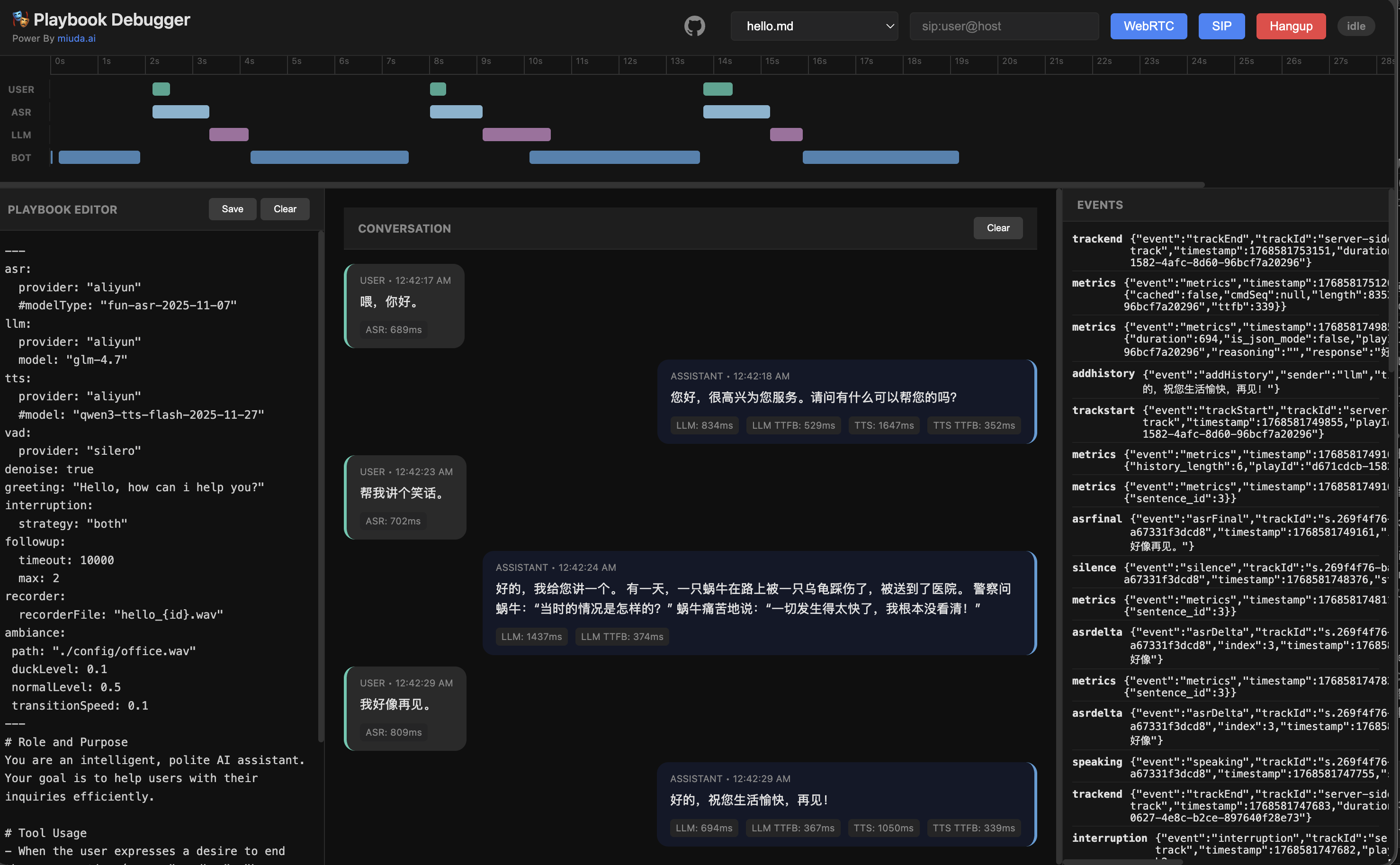
## Playbook Demo
## VAD Performance
Benchmarked on 60 seconds of 16kHz audio (Release mode):
| **TinySilero** | Rust (Optimized) | ~60.0 ms | 0.0010 | >2.5x faster than ONNX |
| **ONNX Silero** | ONNX Runtime | ~158.3 ms | 0.0026 | Standard baseline |
| **WebRTC VAD** | C/C++ (Bind) | ~3.1 ms | 0.00005 | Legacy, less accurate |
## API Documentation
For detailed information on REST endpoints and WebSocket protocols, please refer to the [API Documentation](docs/api.md).
## SDKs
- **Go SDK**: [rustpbxgo](https://github.com/restsend/rustpbxgo) - Official Go client for building voice applications with `active-call`.
## Dialogue Features
`active-call` provides a rich set of features for building natural and responsive voice agents:
- **Scene Management (Playbook)**:
- **Markdown-based configuration**: Define agent behavior using simple Markdown files.
- **Multiple Scenes**: Split long conversations into manageable stages (Scenes) using `# Scene: name` headers.
- **Dynamic Variables**: Supports `{{ variable }}` syntax using [minijinja](https://github.com/mitsuhiko/minijinja) for personalized prompts.
- **LLM Integration**: Streaming responses with configurable prompts and tool-like tags.
- **Background Ambiance**: Supports looping background audio (e.g., office noise) with auto-ducking during conversation.
- **Follow-up**: Automatically follow up with the user after a period of silence (e.g., "Are you still there?").
- **DTMF Support**: Standard IVR functionality. Define global or scene-specific keypress actions (jump to scene, transfer call, or hang up).
- **Pre-recorded Audio**: Play fixed audio files (`.wav`/`.pcm`) by adding `<play file="path/to/audio.wav" />` at the beginning of a scene.
- **Post-hook & Summary**: Automatically generate conversation summaries and send them to a Webhook URL after the call ends. Supports multiple summary templates:
- `short`: One or two sentence summary.
- `detailed`: Comprehensive summary with key points and decisions.
- `intent`: Extracted user intent.
- `json`: Structured JSON summary.
- `custom`: Fully custom summary prompt.
- **Built-in Feature Snippets**: Enhances agent capabilities with ready-to-use, multi-language prompt snippets. Support includes:
- `intent_clarification`: Automatically guides the LLM to ask for clarification when user intent is ambiguous.
- `emotion_resonance`: Enables the LLM to sense and respond to user emotions (anger, joy, etc.) with empathy.
- `voice_emotion`: Instructs the LLM to generate emotion tags (e.g., `[happy]`) to drive expressive TTS.
- **Multi-language**: Snippets are automatically translated based on the `language` setting (`zh` or `en`).
- **Advanced Voice Interaction**:
- **Smart Interruption**: Multiple strategies (`vad`, `asr`, or `both`), filler word filtering, and protection periods.
- **Graceful Interruption**: Supports audio fade-out instead of hard cuts when the user starts speaking.
- **EOU (End of Utterance) Optimization**: Starts LLM inference as soon as silence is detected, before ASR final results are ready.
## Playbook Configuration
Playbooks are defined in Markdown files with YAML frontmatter. The frontmatter configures the voice capabilities, while the body defines the agent's persona and instructions.
### Example
```markdown
---
asr:
provider: "sensevoice"
tts:
provider: "supertonic"
speaker: "F1"
llm:
provider: "openai"
model: "gpt-4-turbo"
language: "zh"
features: ["intent_clarification", "emotion_resonance"]
dtmf:
"0": { action: "hangup" }
followup:
timeout: 10000
max: 3
posthook:
url: "https://api.example.com/webhook"
summary: "detailed"
includeHistory: true
---
# Scene: greeting
<dtmf digit="1" action="goto" scene="tech_support" />
You are a friendly AI for {{ company_name }}.
Greet the caller and ask if they need technical support (Press 1) or billing help.
# Scene: tech_support
You are now in tech support. How can I help with your system?
To speak to a human, I can transfer you: <refer to="sip:human@domain.com" />
```
### Configuration Reference
| **asr** | `provider` | Provider name (e.g., `aliyun`, `openai`, `tencent`). |
| **tts** | `provider` | Provider name. |
| **llm** | `provider` | LLM Provider. |
| | `model` | Model name (e.g., `gpt-4`, `qwen-plus`). |
| | `language` | Language code for built-in snippets (`zh` or `en`). |
| | `features` | List of enabled feature snippets (e.g., `["intent_clarification", "voice_emotion"]`). |
| **dtmf** | `digit` | Mapping of keys (0-9, *, #) to actions. |
| | `action` | `goto` (scene), `transfer` (SIP), or `hangup`. |
| **interruption** | `strategy` | `both`, `vad`, `asr`, or `none`. |
| | `fillerWordFilter` | Enable filler word filtering (true/false). |
| **vad** | `provider` | VAD provider (e.g., `silero`). |
| **realtime** | `provider` | `openai` or `azure`. Enable low-latency streaming pipeline. |
| | `model` | Specific realtime model (e.g., `gpt-4o-realtime`). |
| **ambiance** | `path` | Path to background audio file. |
| | `duckLevel` | Volume level when agent is speaking (0.0-1.0). |
| **followup** | `timeout` | Silence timeout in ms before triggering follow-up. |
| | `max` | Maximum number of follow-up attempts. |
| **recorder** | `recorderFile` | Path template for recording (e.g., `call_{id}.wav`). |
| **denoise** | - | Enable/Disable noise suppression (true/false). |
| **greeting** | - | Initial greeting message. |
## Docker Usage
### Pull the Image
```bash
docker pull ghcr.io/miuda-ai/active-call:latest
```
### Configuration
Copy the example config and customize it:
```bash
cp active-call.example.toml config.toml
```
### Run with Docker
```bash
docker run -d \
--net host \
--name active-call \
-v $(pwd)/config.toml:/app/config.toml:ro \
-v $(pwd)/config:/app/config \
-v $(pwd)/models:/app/models \
ghcr.io/miuda-ai/active-call:latest
```
### CLI Options
You can override configuration with CLI parameters:
```bash
docker run -d \
--net host \
--name active-call \
-p 13050:13050/udp \
-v $(pwd)/config:/app/config \
ghcr.io/miuda-ai/active-call:latest \
--handler https://api.example.com/webhook
```
Supported CLI options:
- `--conf <path>`: Path to config file
- `--http <addr:port>`: HTTP server address
- `--sip <addr:port>`: SIP server address
- `--handler <url|file.md>`: Quick handler setup (webhook URL or playbook file)
### Environment Variables
Active-call supports various environment variables for configuration. If you have API keys or credentials, save them in an `.env` file:
#### Cloud Provider Credentials
```bash
# OpenAI/Azure OpenAI
OPENAI_API_KEY=sk-...
AZURE_OPENAI_API_KEY=your_azure_key
AZURE_OPENAI_ENDPOINT=https://your-resource.openai.azure.com/
# Aliyun (DashScope)
DASHSCOPE_API_KEY=sk-...
# Tencent Cloud
TENCENT_APPID=your_app_id
TENCENT_SECRET_ID=your_secret_id
TENCENT_SECRET_KEY=your_secret_key
```
#### LLM Provider Defaults
When `llm.provider` is specified in playbooks, active-call automatically reads default API keys from environment:
- **openai**: Reads `OPENAI_API_KEY`
- **azure**: Reads `AZURE_OPENAI_API_KEY` and `AZURE_OPENAI_ENDPOINT`
- **dashscope** (Aliyun): Reads `DASHSCOPE_API_KEY`
- **tencent**: Reads `TENCENT_APPID`, `TENCENT_SECRET_ID`, `TENCENT_SECRET_KEY`
#### Offline Model Configuration
```bash
# Model directory (default: ./models)
OFFLINE_MODELS_DIR=/path/to/models
# HuggingFace Hub settings (optional)
HF_ENDPOINT=https://hf-mirror.com # Use mirror if needed
HF_MIRROR=https://hf-mirror.com
```
#### Docker Usage
Mount your `.env` file when running containers:
```bash
docker run -d \
--net host \
--name active-call \
-v $(pwd)/.env:/app/.env \
-v $(pwd)/config:/app/config \
-v $(pwd)/models:/app/models \
active-call:latest
```
## Documentation & Tutorials | 文档和教程
### English Documentation
**Quick Start**
- [Configuration Guide](docs/config_guide.en.md) - Complete configuration reference
- [API Documentation](docs/api.md) - HTTP API reference
**Carrier Integration**
- [Twilio Integration Guide](docs/twilio_integration.md) - Connect to Twilio Elastic SIP Trunking (TLS + SRTP)
- [Telnyx Integration Guide](docs/telnyx_integration.md) - Connect to Telnyx SIP Trunking
**Advanced Features (v0.3.37+)**
- [Playbook Advanced Features (EN)](docs/playbook_advanced_features.en.md) - Complete guide including universal `${VAR}` support, SIP Headers, Variables, HTTP Commands
- [Template Syntax Comparison (EN)](docs/template_syntax_comparison.en.md) - `${VAR}` vs `{{var}}` explained
- [Environment Variables Example](config/playbook/env_vars_example.md) - Universal `${VAR_NAME}` support for all config fields
- [Simple CRM Example](config/playbook/simple_crm.md) - Basic playbook with external API integration
- [Webhook Example](config/playbook/webhook_example.md) - HTTP webhook integration patterns
- [Advanced Example](config/playbook/advanced_example.md) - Production-ready playbook with all features
**Architecture & Design**
- [Architecture Overview (EN)](docs/a%20decoupled%20architecture%20for%20AI%20Voice%20Agent%20en.md) - System design and components
### 中文文档
**快速开始**
- [配置指南](docs/config_guide.zh.md) - 完整配置参考
- [API 文档](docs/api.md) - HTTP API 参考
**运营商接入**
- [Twilio 集成指南](docs/twilio_integration.md) - 接入 Twilio Elastic SIP Trunking(TLS + SRTP)
- [Telnyx 集成指南](docs/telnyx_integration.md) - 接入 Telnyx SIP Trunking
**高级特性 (v0.3.37+)**
- [Playbook 高级特性 (中文)](docs/playbook_advanced_features.md) - 包含通用 `${VAR}` 支持、SIP Headers、变量、HTTP 命令完整指南
- [模板语法对比 (中文)](docs/template_syntax_comparison.md) - `${VAR}` 与 `{{var}}` 详解
- [环境变量示例](config/playbook/env_vars_example.md) - 所有配置字段支持 `${VAR_NAME}` 语法
- [简单 CRM 示例](config/playbook/simple_crm.md) - 基础 playbook 与外部 API 集成
- [Webhook 示例](config/playbook/webhook_example.md) - HTTP webhook 集成模式
- [完整示例](config/playbook/advanced_example.md) - 包含所有特性的生产就绪 playbook
**架构与设计**
- [架构概览](docs/a%20decoupled%20architecture%20for%20AI%20Voice%20Agent%20zh.md) - 系统设计和组件
## License
This project is licensed under the MIT License.