# Abstract Calculus
The [Abstract Calculus](https://medium.com/@maiavictor/the-abstract-calculus-fe8c46bcf39c) is a minimal programming language and model of computation obtained by slightly modifying the Lambda Calculus so that it matches perfectly the abstract part of [Lamping's optimal reduction algorithm](http://citeseerx.ist.psu.edu/viewdoc/download?doi=10.1.1.90.2386&rep=rep1&type=pdf). Characteristics:
1. Like the Lambda Calculus, it can easily express algebraic datatypes and arbitrary recursive algorithms.
2. Like Turing Machines, it can be evaluated through simple, constant-time operations.
3. Unlike the Lambda Calculus (and like Rust), it does not require garbage-collection.
4. Unlike the Lambda Calculus, all intermediate steps of its optimal reduction correspond to terms.
5. Unlike the Lambda Calculus, terms can be reduced not only optimally, but efficiently (i.e., [no oracles](https://dl.acm.org/citation.cfm?id=1131315)).
6. Unlike both, it is intrinsically parallel.
7. It is isomorphic to [interaction combinators](https://pdfs.semanticscholar.org/6cfe/09aa6e5da6ce98077b7a048cb1badd78cc76.pdf), a beautiful model of computation.
## Syntax
The syntax is obtained by simply extending the Lambda Calculus with `pairs` and `let`:
```haskell
term ::=
| λx. term -- abstraction (affine function)
| (term term) -- application
| (term,term) -- superposition (pair)
| let (p,q) = term in term -- definition (let)
| x -- variable
```
Except variables are restricted to occur only once and are freed to occur globally ([why?](https://stackoverflow.com/questions/52048420/can-a-calculus-have-incremental-copying-and-closed-scopes)).
## Reduction rules
There are 4 reduction rules. Two of them are usual: the application of a lambda, and the projection of a pair. The other two deal with the previously unspecified cases: "applying a pair" and "projecting a lambda". The first performs a parallel application, and the second performs an incremental duplication. All of them are constant-time operations.
```haskell
-- Rule 0: lambda-application
((λx.f) a)
----------
f [x / a]
-- Rule 1: pair-projection
let (p,q) = (u,v) in t
----------------------
t [p / u] [q / v]
-- Rule 2: pair-application
((u,v) a)
----------------
let (x0,x1) = a
in ((u x0),(v x1))
-- Rule 3: lambda-projection
let (p,q) = (λx.f) in t
-----------------------
let (p,q) = f in t
[p / λx0.p]
[q / λx1.q]
[x / (x0,x1)]
```
Here, `[a / b]` stands for a global substitution of the occurrence of `a` by `b`, and `x0`, `x1` are fresh variables. I've used additional parenthesis around lambdas to make the reading clearer.
## Examples
### Example 0: lambda-application and pair-projection (nothing new).
```haskell
λu. λv. let (a,b) = (λx.x, λy.y) in (a u, b v)
---------------------------------------------- pair-projection
λu. λv. ((λx.x) u, (λy.y) v)
---------------------------- lambda-application
λu. λv. ((λx.x) u, v)
--------------------- lambda-application
λu. λv. (u, v)
```
### Example 1: using lambda-projection to copy a function.
```haskell
let (a,b) = λx.λy.λz.y in (a,b)
------------------------------- lambda-projection
let (a,b) = λy.λz.y in (λx0.a, λx1.b)
--------------------------------------- lambda-projection
let (a,b) = λz. (y0,y1) in (λx0.λy0.a, λx1.λy1.b)
-------------------------------------------------- lambda-projection
let (a,b) = (y0,y1) in (λx0.λy0.λz0.a, λx1.λy1.λz1.b)
----------------------------------------------------- pair-projection
(λx0.λy0.λz0.y0, λx1.λy1.λz1.y1)
```
### Example 2: demonstrating pair-application.
```haskell
((λx.x, λy.y) λt.t)
------------------- pair-application
let (a0,a1) = λt. t in ((λx.x) a0, (λy.y) a1)
--------------------------------------------- lambda-projection
let (a0,a1) = (t0,t1) in ((λx.x) λt0.a0, (λy.y) λt1.a1)
------------------------------------------------------- pair-projection
((λx.x) λt0.t0, (λy.y) λt1.t1)
------------------------------- lambda-application
((λx.x) λt0.t0, λt1.t1)
----------------------- lambda-application
(λt0.t0, λt1.t1)
```
### Example 3: 2 + 3.
This is equivalent to:
```haskell
add : Nat -> Nat -> Nat
add (S n) m = S (add n m)
add Z m = m
main : Nat
main = add (S (S (S Z))) (S (S Z))
```
[Full reduction.](https://gist.github.com/MaiaVictor/659e047c267a801c7d9cf1970541cb54)
### Example 4: applying not 8 times to True.
[Full reduction.](https://gist.github.com/MaiaVictor/d565bee7d9083e98ae1470067ce12dbb)
---
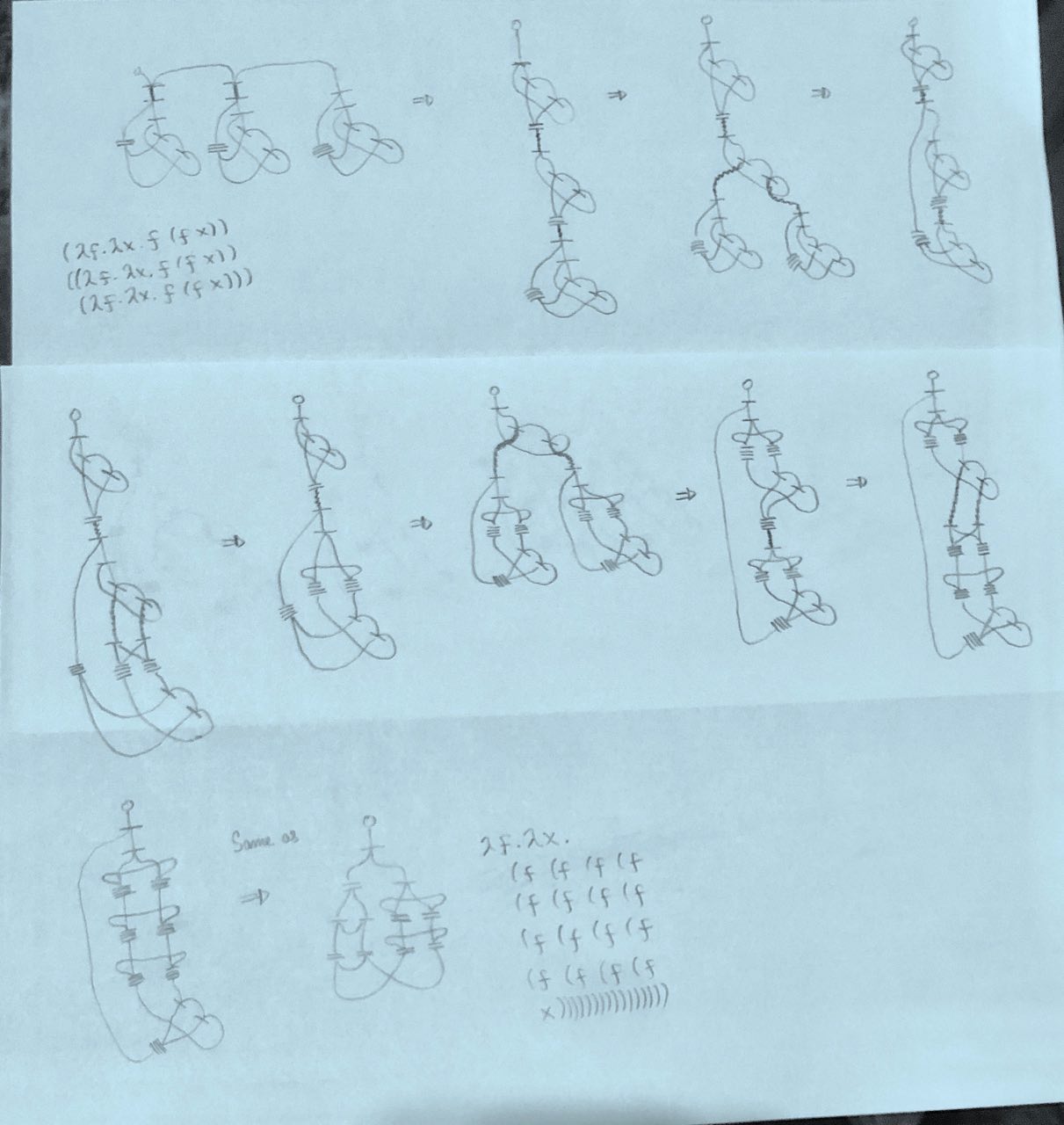
[Here is a handwritten reduction of 2^(2^2).](drawing.jpeg)