Expand description
§bevy_isomesh
⚠️ Vibe Coded. This crate was written by an AI agent working from a research corpus and a ticket queue. Every number below is produced by a test in this repository and every algorithm cites its source, but it has not been through human code review. Read the tests before trusting it with anything that matters.



Bevy 0.20 integration for isomesh: signed distance field in, Mesh asset out. The core crates stay engine-agnostic — this is the one place Bevy types appear.
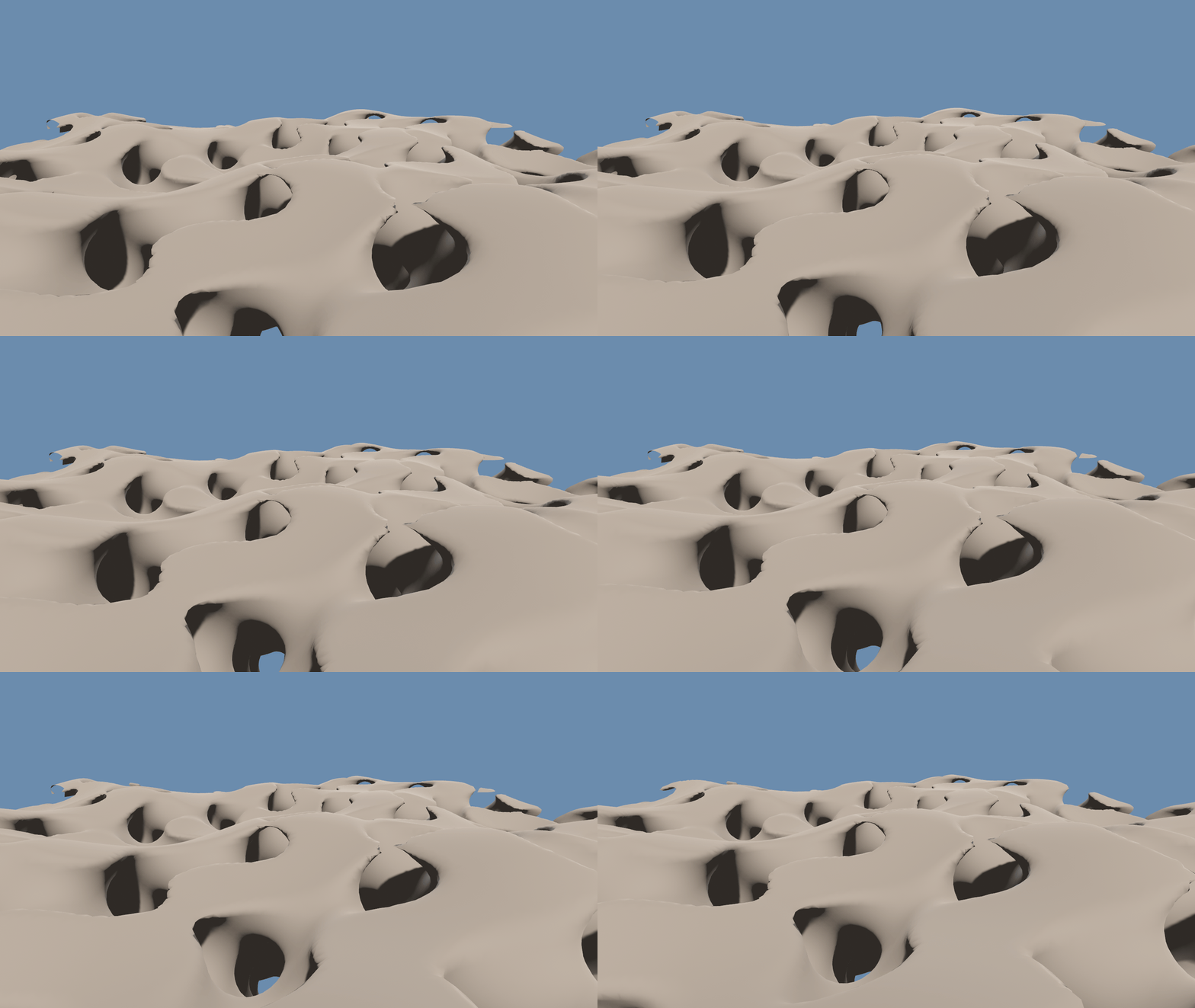
Caves, arches and a roof over your head, from a nine-line field — the whole world is max(heightfield, |gyroid| − thickness), streamed and meshed off the main thread while the camera flies through it. cargo run --example game_showcase --release.
§Compatibility
bevy_isomesh | bevy | wgpu |
|---|---|---|
| main (unreleased) | 0.20 | 30.x |
| 0.0.x | 0.19 | 29.x |
Bevy 0.20 pins wgpu 30.0.1 and glam 0.33 (Bevy 0.19 pinned 29.0.3 and 0.32), and those move together or not at all: Cargo resolves two wgpu majors side by side with no error, and the failure surfaces much later as expected TextureFormat, found a different TextureFormat.
§Quickstart
Spawn a volume, mark its chunks, and attach the render component when the mesh arrives:
use bevy::prelude::*;
use bevy_isomesh::{ChunkMesh, IsomeshPlugin, NeedsRemesh, VoxelChunk, VoxelVolume};
use isomesh::chunk::{ChunkId, ChunkLayout};
use isomesh::fields::Sphere;

fn main() -> Result<(), isomesh::Error> {
    let mut app = App::new();
    // AssetPlugin must come first -- IsomeshPlugin asserts it and names the fix.
    app.add_plugins(DefaultPlugins).add_plugins(IsomeshPlugin);

    // 8 *cells* per chunk axis, 0.25 world units each, origin at zero -- so one
    // chunk spans 2.0. `ChunkLayout::new` takes cells, not samples.
    let layout = ChunkLayout::new(8, 0.25, [0.0; 3])?;
    let volume = app
        .world_mut()
        .spawn(VoxelVolume::new(layout, Sphere::<f32>::canonical()))
        .id();

    for x in -2..2 {
        app.world_mut().spawn((
            VoxelChunk { id: ChunkId::new([x, 0, 0]), volume },
            NeedsRemesh,
        ));
    }

    app.add_systems(Update, attach);
    app.run();
    Ok(())
}

// The plugin stops at a `Handle<Mesh>` on purpose. Attaching `Mesh3d` is the
// application's line to write, and that boundary is what keeps a CPU-only
// consumer from ever compiling the renderer.
fn attach(meshes: Query<(Entity, &ChunkMesh), Without<Mesh3d>>, mut commands: Commands) {
    for (entity, chunk_mesh) in &meshes {
        commands.entity(entity).insert(Mesh3d(chunk_mesh.0.clone()));
    }
}
Extraction runs on the AsyncComputeTaskPool, never in a system; what the frame budget bounds is turning finished extractions into assets. Editing a chunk mid-extraction re-queues it rather than swallowing the edit — the headless behavioral tests state these as claims (spawning_the_work_does_not_do_the_work, an_edit_during_extraction_is_requeued_rather_than_swallowed).
§Editing a field, and ordering against the plugin
VoxelVolume::replace_field swaps in a new field and hands back the old one. mark_changed_chunks compares the two over the volume’s existing chunk entities and inserts NeedsRemesh on exactly the chunks whose surface moved — an edit deep inside solid or empty space marks nothing. The meshing systems sit in the public IsomeshSystems set, so a plugin that edits the field orders itself .before(IsomeshSystems) and the re-mesh is queued the same frame:
use bevy::prelude::*;
use bevy_isomesh::{IsomeshPlugin, IsomeshSystems, VoxelChunk, VoxelVolume, mark_changed_chunks};
use isomesh::fields::Sphere;

fn grow(
    mut commands: Commands,
    mut volumes: Query<(Entity, &mut VoxelVolume)>,
    chunks: Query<(Entity, &VoxelChunk)>,
) {
    for (entity, mut volume) in &mut volumes {
        let before = volume.replace_field(Sphere::<f32> { center: [0.0; 3], radius: 1.5 });
        if let Err(error) = mark_changed_chunks(
            &mut commands, entity, &volume, &chunks, &*before, &*volume.field,
        ) {
            error!("could not mark the edit: {error}");
        }
    }
}

fn main() {
    App::new()
        .add_plugins((DefaultPlugins, IsomeshPlugin))
        .add_systems(Update, grow.before(IsomeshSystems))
        .run();
}
The compared region is the cell bounding box of the volume’s spawned chunks, so the cost is one field evaluation of each field per corner sample of that box; an edit outside every spawned chunk has nothing to mark. A game that knows where its edit is (a brush’s bounds, through ChunkLayout::cell_of, widened by a cell) passes that box to mark_changed_chunks_in and pays for the box instead of the volume.
The rule follows the volume’s extractor, because it is a statement about which points of the field the extractor reads. Extractor::Subgrid { samples } meshes features thinner than a cell that no lattice corner sees, so its volumes are compared at the points the extractor reads (isomesh::chunk::dirty::mark_edit_subgrid): 1 + 7 (samples - 1) evaluations of each field per cell instead of one. A thin wall added to or cut from a Subgrid volume re-meshes its chunk; on a Marching Cubes volume, which cannot mesh it, the same edit marks nothing.
§Two layers — use either
MeshBuilder is a MeshSink whose buffers are exactly the arrays a Bevy Mesh wants, so into_mesh() hands the Vecs over by move — no copy on the way into the asset. This one runs, and does, on every cargo test:
use bevy_isomesh::MeshBuilder;
use isomesh::fields::Sphere;
use isomesh::marching_cubes::MarchingCubes;
use isomesh::RuntimeShape3;

let mut builder = MeshBuilder::new();
let mut mc = MarchingCubes::<f32>::new();
let shape = RuntimeShape3::new([33; 3]).expect("valid shape");
mc.extract(&Sphere::<f32>::canonical(), &shape, [-2.0; 3], 0.125, &mut builder).expect("extraction");

let mesh = builder.into_mesh();
assert!(mesh.count_vertices() > 0);
IsomeshPlugin is the chunked, frame-budgeted layer above it, shown in the quickstart. to_bevy_mesh is the copying alternative for an isomesh::MeshBuffer you are reusing across chunks.
§Going the other way — a Mesh as triangles
from_bevy_mesh turns a Bevy Mesh into the (positions, indices) pair every isomesh entry point takes. Indices::U16 widens to u32, so you never handle both.
use bevy_isomesh::from_bevy_mesh;
use bevy_shape::Cuboid;
use bevy_mesh::Mesh;

let mesh = Mesh::from(Cuboid::new(1.0, 1.0, 1.0));
let (positions, indices) = from_bevy_mesh(&mesh).expect("a cuboid is a triangle list");
assert_eq!(positions.len(), 24);   // four per face, not eight corners
It does not weld, and it does not repair. A cuboid has 24 vertices over 8 distinct corners because each face needs its own normal; collapsing them is a decision only you can make. Nothing is guessed either — a TriangleStrip is refused rather than expanded, because expanding one silently flips every other triangle’s winding, and you get a SoupError naming which property failed rather than a warn! you may not be listening for.
§Welding without flattening your creases
Position-only welding turns a cube into eight corners and loses every crease. weld_keys builds the key that stops it, and isomesh::weld::Welder::weld_split_by honours it:
use bevy_isomesh::{WeldKeyConfig, weld_keys};
use bevy_shape::Cuboid;
use bevy_mesh::Mesh;

let mesh = Mesh::from(Cuboid::new(1.0, 1.0, 1.0));
let keys = weld_keys(&mesh, WeldKeyConfig::default());
// One key per face: the three vertices at each corner differ by normal.
Feed keys to weld_split_by and the cuboid keeps all 24 vertices; weld without it and you get 8.
It takes a quantum, not a smoothing angle, and that is forced rather than preferred. The usual “merge if the normals are within 30°” test is not transitive — so it is not an equivalence relation, and applied to a k-way coincidence it merges some members and refuses others, leaving the leftover a bowtie. This repo measured that exact shape adding up to 791 non-manifold vertices. Quantising to a lattice is transitive; its failure mode is a missed merge at a bucket boundary, which is a visible seam rather than a topology defect. The defaults are conventional, not derived, and they are yours to override.
§What the plugin exposes
The contract, stated rather than implied:
- Components —
VoxelVolume(aChunkLayout+ anArc<dyn VolumeField>+ anExtractor, defaultMarchingCubes),VoxelChunk { id, volume },NeedsRemesh(marker; insert it to request work),ChunkMesh(pub Handle<Mesh>)(the result; yours to render). Every finished chunk gets aChunkMesh, including one the surface does not cross: that mesh has no vertices and isRenderAssetUsages::MAIN_WORLDonly, so it reads (count_vertices()is 0) but is never sent to the renderer, and Bevy’s mesh allocator has nothing to warn about. AMesh3dpointing at it draws nothing. - Resources —
MeshBudget(default: 4 ms of asset-application per frame, at most 2× the task-pool parallelism in flight),MeshStats(spawned / applied / in-flight / waiting counters). - Systems —
(spawn_meshing_tasks, apply_finished_meshes).chain()inUpdate, both private, in the publicIsomeshSystemsset: a system ordered.before(IsomeshSystems)has itsNeedsRemeshpicked up the same frame, one ordered.afterthe next. - Traits —
VolumeField: anyisomesh::Sdf<Scalar = f32> + Send + Sync + 'static, blanket-implemented. - Cargo features — none.
IsomeshPlugin auto-adds bevy_mesh::MeshPlugin if absent, and asserts AssetPlugin was added first with a message that names the fix.
§Choosing an extractor for a chunked world
Extractor::chunk_seams() reports what was measured, per variant: MarchingCubes and Subgrid tile across chunk seams with zero boundary edges; SurfaceNets and DualContouring are Gapped — up to 5 open edges measured on a single seam, a structural property of one-vertex-per-cell placement, not a bug a future release fixes. For a chunked world, use MarchingCubes or Subgrid { samples }; the dual methods are for single-volume extraction where sharp features matter more than tiling.
§Why a separate workspace
This directory is deliberately excluded from the repository’s root workspace. In a shared workspace, Cargo’s feature unification would hand glam the std, serde, bytemuck and encase features Bevy asks for, and cargo test at the root would stop testing what a consumer of isomesh actually gets. The cost is running the two workspaces separately; the benefit is a root lockfile that proves the core crate’s no_std + libm claim on every push.
Dependencies are Bevy’s leaf crates (bevy_asset, bevy_mesh, bevy_app, bevy_ecs, bevy_tasks), never the bevy umbrella, so a CPU-only consumer never compiles the renderer.
Every Bevy example in the project also lives here, and CI builds them all on every commit. That is not tidiness — it is the one thing that stops them rotting. block-mesh‘s examples are pinned to Bevy 0.13 and fast-surface-nets’ to Bevy 0.7, both because they lived somewhere nothing ever built.
§Examples
→ The demo page — all 54 examples, each with an animated capture, what it proves, and the exact command.
34 of them. Start with quickstart — it is the only one that is not a measured experiment, and the only one whose
job is to show you the shape of a working app rather than to prove something about the library. The rest each carry a
claim in the header; a taste, with what each one proves:
| Example | The claim it makes | Evidence |
|---|---|---|
sdf_authoring | building a field rather than meshing one — four primitives, three operators, one asset, and the blend radius on a key | clip |
quickstart | the shortest path from an SDF to a mesh on screen — under 60 lines including the prose, and its exact chunk layout is asserted to mesh all eight chunks | examples/quickstart.rs |
game_showcase | caves and arches a heightfield cannot represent, flown through at 60 fps | clip |
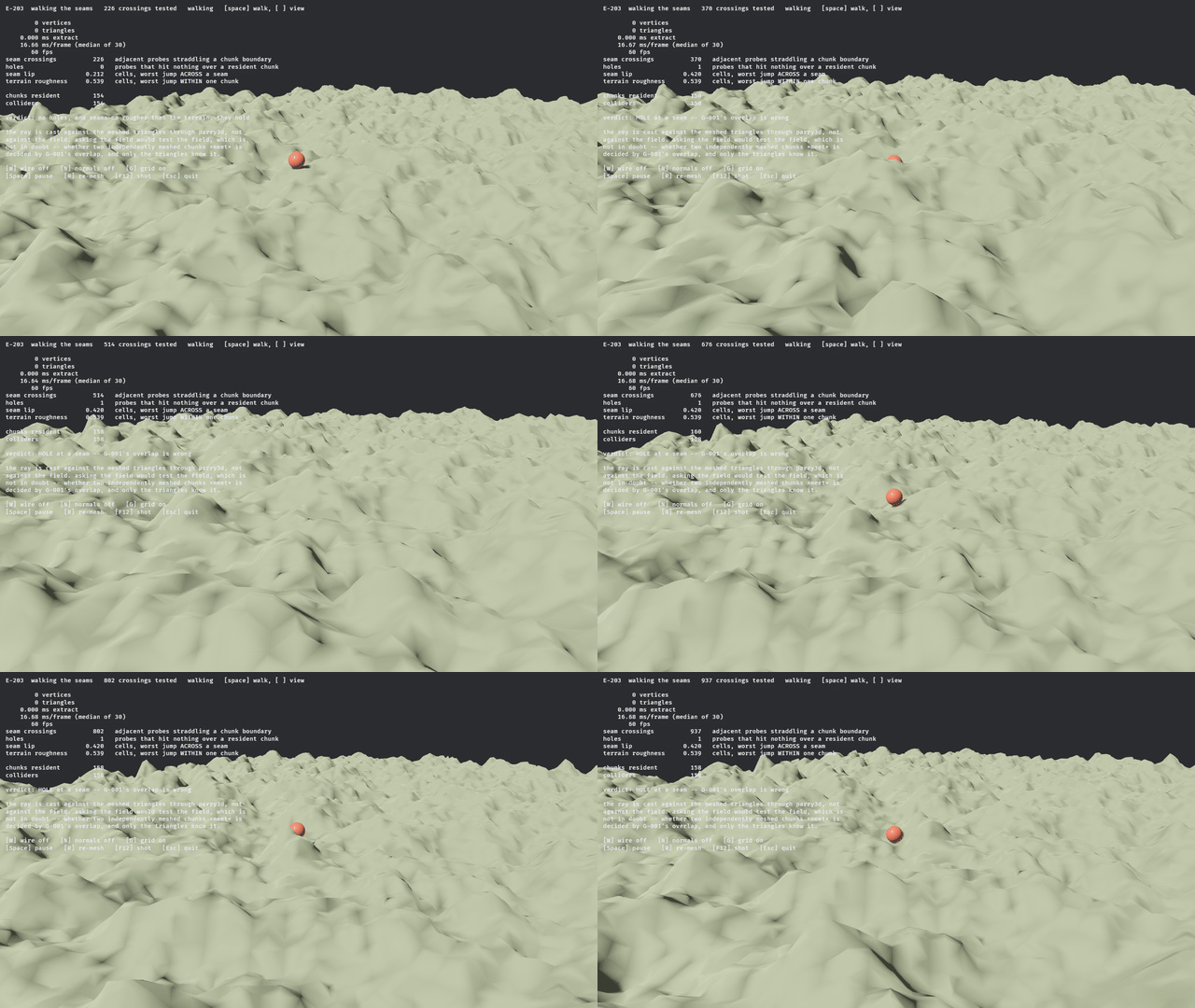
game_walk | 495 chunk-seam crossings walked, 0 holes — the ball stands on the triangles, not the field | clip |
game_dig | carving tunnels re-meshes only the chunks the brush touched | clip |
game_destruction | the debris is the removed geometry — one boolean, two meshes | clip |
game_lod_flyover | an LOD ladder with 0 open seam edges, and 71–111 with transitions off | clip |
game_paint | graffiti survives the wall being blown open, drift exactly zero | clip |
game_budget | every chunk dirtied at once, drained under a frame budget that holds | screenshot |
gpu_compute_mc | GPU Marching Cubes agrees with the CPU vertex-for-vertex, worst case one ULP | screenshot |
marching_cubes_tunnel | the same cell meshed twice — two discs under the face rule, one cylinder under the interior rule; components 2 → 1, χ 2 → 0, boundary edges unchanged | clip |



cd bevy_isomesh
cargo run --example game_showcase --release
Always --release. A debug build meshes 37–62× slower — both ends measured in this repository (FINDINGS M-152) — and will convince you something is wrong with the algorithm.
The full inventory, with a clip of each, is the demo page; the source is bevy_isomesh/examples/ and the measured figures live on the gameplay, algorithms and correctness pages.
§Requirements
Rust 1.97.1 (Bevy 0.20’s own floor), edition 2024.
§License
MIT OR Apache-2.0, at your option.
Re-exports§
pub use mesh::MeshBuilder;pub use mesh::SoupError;pub use mesh::WeldKeyConfig;pub use mesh::from_bevy_mesh;pub use mesh::to_bevy_mesh;pub use mesh::weld_keys;pub use plugin::ChunkMesh;pub use plugin::ChunkSeams;pub use plugin::Extractor;pub use plugin::IsomeshPlugin;pub use plugin::IsomeshSystems;pub use plugin::MeshBudget;pub use plugin::MeshStats;pub use plugin::NeedsRemesh;pub use plugin::VolumeField;pub use plugin::VoxelChunk;pub use plugin::VoxelVolume;pub use plugin::mark_changed_chunks;pub use plugin::mark_changed_chunks_in;