
vibecheck





"I don't always write Rust, but when I do, every function has a doc comment and zero
.unwrap()calls." — The Most Interesting LLM in the World
vibecheck detects AI-generated code and attributes it to a model family. It sniffs out the telltale "vibes" that different AI models leave in code — the suspiciously perfect formatting, the teaching-voice comments, the conspicuous absence of TODO: fix this later.
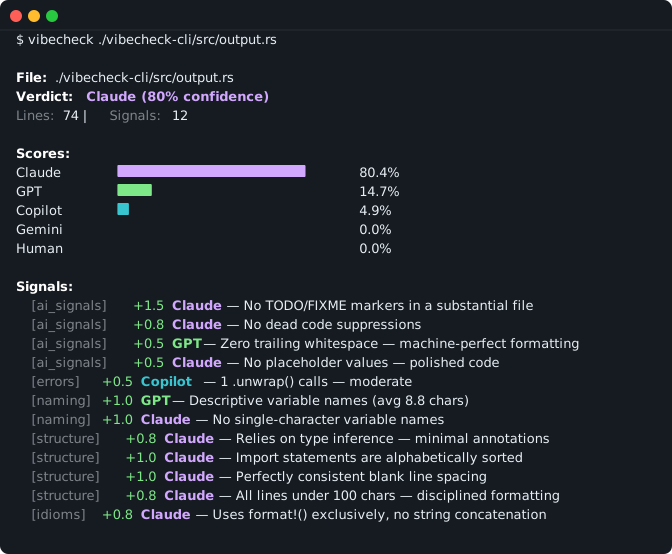
   The 5 stages of vibecheck grief:

   1. Denial     "I wrote this myself"
   2. Anger      "The heuristics are WRONG"
   3. Bargaining "Ok but I modified 2 lines"
   4. Depression  vibecheck src/my_code.rs
                  > Verdict: Claude (94%)
   5. Acceptance "...yeah that's fair"

   ───────────────────────────────────────

   Nobody:
   Absolutely nobody:
   Your AI-generated code:

      /// Processes the input data by applying the configured
      /// transformation pipeline and returning the validated result.
      pub fn process_and_validate_input_data(
          &self,
          input_data: &InputData,
      ) -> Result<ValidatedOutput, ProcessingError> {
How It Works
vibecheck runs your source code through two layers of analysis:
Layer 1 — Text-pattern analyzers (all languages):
| Analyzer | What It Sniffs | Example Signal |
|---|---|---|
| Comment Style | Density, teaching voice, doc comments | "12 comments with teaching/explanatory voice" |
| AI Signals | TODO absence, no dead code, eerie perfection | "Every function has a doc comment — suspiciously thorough" |
| Error Handling | unwrap vs expect vs ?, panic usage | "Zero .unwrap() calls — careful error handling" |
| Naming | Variable length, descriptiveness, single-char names | "Very descriptive variable names (avg 14.2 chars)" |
| Code Structure | Type annotations, import ordering, formatting | "Import statements are alphabetically sorted" |
| Idiom Usage | Iterator chains, builder patterns, Display impls | "8 iterator chain usages — textbook-idiomatic Rust" |
Layer 2 — tree-sitter CST analyzers (language-aware):
| Language | Signals |
|---|---|
| Rust | Cyclomatic complexity, doc comment coverage on pub fns, identifier entropy, nesting depth, import ordering |
| Python | Docstring coverage, type annotation coverage, f-string vs %-format ratio |
| JavaScript | Arrow function ratio, async/await vs .then() chaining, optional chaining density |
| Go | Godoc coverage on exported functions, goroutine count, err != nil check density |
Each signal has a weight (positive = evidence for, negative = evidence against) and points to a model family. The pipeline aggregates all signals into a probability distribution.
Results are stored in a content-addressed cache (redb, keyed by SHA-256 of file contents) so unchanged files are never re-analyzed. A Merkle hash tree extends this to directory level — unchanged subdirectories are skipped entirely, making repeated directory scans near-instant.
Installation
# Install the CLI
# Add the library to your project
Usage
CLI
# No arguments: opens the TUI browser in the current directory
# Analyze a single file (pretty output with colors)
# Analyze a directory (supports .rs, .py, .js, .ts, .go)
# Symbol-level attribution — breaks down each function/method individually
# Plain text output
# JSON output (for piping to other tools)
# Enforce attribution in CI — exit 1 if any file isn't attributed to one of these families
# Assert human authorship specifically
# Skip the cache (always re-analyze, useful for CI reproducibility)
All commands are also available as explicit subcommands: vibecheck analyze, vibecheck tui, vibecheck watch, vibecheck history.
--assert-family accepts a comma-separated list of claude, gpt, copilot, gemini, or human. If any analyzed file's primary attribution is not in the list, vibecheck prints a failure summary to stderr and exits with code 1. This is the flag that makes vibecheck useful in CI.
TUI Codebase Navigator
# Open TUI in the current directory (same as running vibecheck with no args)
# Or point at a specific directory
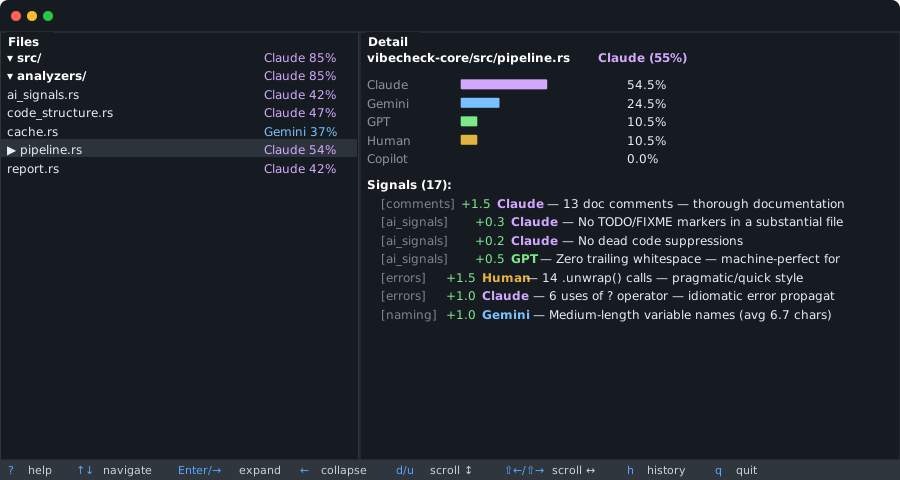
Two-pane browser: file tree with family badges on the left, signal/score/symbol breakdown on the right. Confidence rolls up from symbol → file → directory (weighted by lines of code).
| Key | Action |
|---|---|
j / ↓ |
Move down |
k / ↑ |
Move up |
Enter / → / l |
Expand directory |
← / h |
Collapse directory or go to parent |
d / PageDown |
Scroll detail pane down |
u / PageUp |
Scroll detail pane up |
q / Ctrl+C |
Quit |
Live Watch Mode
# Re-analyze on every file save, print deltas to stdout
Uses OS file-system events (inotify/kqueue/FSEvents) with a 300 ms debounce and a 2 s per-file cooldown to suppress duplicate events from a single save.
Git History
# Replay git history for a file and show how attribution changed over commits
# Limit to the last N commits that touched the file (default: 20)
Reads blobs directly from the git object store (no working-tree checkout). Prints a table: COMMIT | DATE | FAMILY | CONFIDENCE | CHANGE.
Example Output
Not every file is a slam dunk. src/pipeline.rs scores 72% — the two .unwrap() calls bleed a few points toward Copilot:
$ vibecheck src/pipeline.rs

File: src/pipeline.rs
Verdict: Claude (72% confidence)
Lines: 86 | Signals: 12

Scores:
  Claude     █████████████████████ 72.5%
  GPT        ██████ 22.9%
  Copilot    █ 4.6%
  Gemini     0.0%
  Human      0.0%

Signals:
  [ai_signals] +1.5 Claude — No TODO/FIXME markers in a substantial file
  [ai_signals] +0.8 Claude — No dead code suppressions
  [ai_signals] +0.5 GPT — Zero trailing whitespace — machine-perfect formatting
  [errors] +0.5 Copilot — 2 .unwrap() calls — moderate
  [naming] +1.0 Claude — No single-character variable names
  [idioms] +1.5 Claude — 6 iterator chain usages — textbook-idiomatic Rust
  [idioms] +1.0 GPT — 11 method chain continuation lines — builder pattern
  [structure] +1.0 Claude — Import statements are alphabetically sorted
  [structure] +0.8 Claude — All lines under 100 chars — disciplined formatting
  [rust_cst] +2.5 Claude — Low average cyclomatic complexity (1.2) — simple, linear functions
  [rust_cst] +1.5 Claude — Low average nesting depth (2.1) — flat, readable structure
  [rust_cst] +1.0 Claude — use declarations are alphabetically sorted
The Ultimate Test: Self-Detection
vibecheck was written by an AI. Does it know?
$ vibecheck vibecheck-core/src/ --format text

vibecheck-core/src/report.rs          → Claude (96%)   # 👀
vibecheck-core/src/cache.rs           → Claude (96%)
vibecheck-core/src/language.rs        → Claude (93%)
vibecheck-core/src/analyzers/cst/python.rs → Claude (85%)
vibecheck-core/src/pipeline.rs        → Claude (74%)   # two .unwrap()s cost it
Every file in the codebase is correctly attributed to Claude. The confidence ranges from 74% to 96% depending on how "perfect" the individual file is.
$ vibecheck vibecheck-core/src/ --assert-family claude --no-cache

All files passed the vibe check.      # exits 0
  When the AI detector you wrote with AI detects itself as AI:

            ┌────────────────────────┐
            │                        │
            │   ◉_◉                  │
            │                        │
            │   ...well, well, well. │
            │                        │
            │   If it isn't the      │
            │   consequences of my   │
            │   own architecture.    │
            │                        │
            └────────────────────────┘

  "I'm in this photo and I don't like it"
            — this crate's source code, literally
Library API
use Path;
use ModelFamily;
// Analyze a source string directly (no file I/O)
let report = analyze;
println!;
// Analyze a file — content-addressed cache is consulted automatically
// Returns std::io::Result<Report>
let report = analyze_file?;
if report.attribution.primary != Human
// Bypass the cache entirely
let report = analyze_file_no_cache?;
// Symbol-level attribution — Report.symbol_reports is populated
// Returns anyhow::Result<Report>
let report = analyze_file_symbols?;
if let Some = &report.symbol_reports
// Symbol-level, cache bypassed
let report = analyze_file_symbols_no_cache?;
// Directory analysis — Merkle tree skips unchanged subtrees when use_cache=true
// Returns anyhow::Result<Vec<(PathBuf, Report)>>
let results = analyze_directory?;
for in results
GitHub Action / CI Integration
A ready-to-use workflow lives at .github/workflows/vibecheck.yml. It triggers on every pull request and exits 1 if any file's attribution isn't in the allowed list — blocking the PR automatically.
Use case 1: enforce that all code is AI-generated (vibecheck dogfoods this on itself)
- name: Vibecheck source code
  run: cargo run --release -p vibecheck-cli -- vibecheck-core/src/ --format text --assert-family claude,gpt,copilot,gemini --no-cache
Use case 2: enforce that all code is human-written (block AI slop from landing)
- name: No AI slop allowed
  run: vibecheck src/ --assert-family human
When a file fails, stderr shows exactly what was caught and why:
src/new_feature.rs — detected as Claude (89%), expected one of: human
Exit code 1 fails the job and blocks the PR. Both use cases work the same way — --assert-family is just a comma-separated list of families you're willing to accept.
Architecture
Current — Multi-Layer Analysis + Incremental Cache
                    ┌───────────────────────────────────────┐
                    │           vibecheck-core              │
                    │                                       │
  directory ──────► │  Merkle tree walk                     │
  (.rs/.py/etc.)    │    │ unchanged subtree? skip entirely │
                    │    ▼ changed file: SHA-256 lookup     │
                    │  redb cache (3 tables)                │
                    │    file_cache  │  hit → Report        │
                    │    sym_cache   │  hit → SymbolReports │
                    │    dir_cache   │  hit → DirNode hash  │
                    │                ▼ miss: analyze        │
                    │  TextAnalyzers[]   CstAnalyzers[]     │
                    │   (6 pattern)    (tree-sitter)        │
                    │        └──────────┬──────────┘        │
                    │                Signals                │
                    │                   │                   │
                    │          Aggregate + Normalize        │
                    │                   │                   │
                    │     Report ──────────────► cache.put  │
                    │     SymbolReport[] ───────► sym_cache │
                    └───────────────────┼───────────────────┘
                                        │
                               vibecheck-cli
                     ┌─────────────────┼──────────────────┐
                     │                 │                  │
              analyze / --symbols   tui <path>      watch / history
              (file + dir)         (ratatui TUI)    (notify / git2)
Crate split:
| Crate | Contents | Who uses it |
|---|---|---|
vibecheck-core |
Analysis engine, CST analyzers, cache, corpus store | any tool that imports it |
vibecheck-cli |
CLI binary | end users |
vibecheck-core has no CLI dependencies — it is a clean library crate that any tool can import.
Model Family Profiles
How vibecheck tells them apart:
- Claude: Thorough doc comments, teaching voice, zero
unwrap(), textbook iterator chains,format!()over concatenation, sorted imports, suspiciously complete - GPT: Explicit type annotations, builder patterns, method chaining, explanatory (but less pedagogical) comments
- Copilot: Works but cuts corners — moderate
unwrap()usage, less documentation, pragmatic completion style - Gemini: Currently limited signal set (future improvement area)
- Human: TODOs everywhere,
// HACK, commented-out code, single-character variables,panic!()calls, string concatenation, chaotic formatting
Feature Flags
| Crate | Feature | Default | What it enables |
|---|---|---|---|
vibecheck-core |
corpus |
No | SQLite corpus + trend store (rusqlite) |
vibecheck-cli |
— | — | CLI binary; always has clap, walkdir, colored, anyhow |
The corpus feature
The corpus store is separate from the content-addressed redb cache. They serve different purposes:
- redb cache (always on) — performance. If a file's SHA-256 hash hasn't changed, return the cached
Reportinstantly without re-running any analyzers. - corpus store (opt-in) — data collection. Every result is written to SQLite in two tables:
corpus_entries— one deduplicated row per unique file hash, recording its attribution and confidence.trend_entries— a timestamped row on every analysis run (no deduplication). This lets you plot how a file's attribution drifts over time as you edit it or as the heuristics improve.
To enable the corpus store:
TUI Codebase Navigator
Interactive terminal UI — run vibecheck (no args) or vibecheck tui <path> to browse AI likelihood across an entire codebase as a two-pane file tree. Confidence scores roll up from symbol → file → directory (weighted by lines of code). The right pane shows score bars, every signal, and a per-symbol breakdown. The detail pane is scrollable with d/u when there are more signals than fit on screen.
Historical & Live Trend Tracking
# Watch a directory live — re-analyze on save, print deltas
# Walk git history for a file and show attribution changes across commits
history reads blobs directly from the git object store (no checkout needed). watch uses OS filesystem events with a 300 ms debounce and a 2 s per-file cooldown to suppress duplicate events from a single save.
What's Coming
  THE GRAND PLAN (revised)
  ──────────────────────────────────────────────────────
  v0.1 - "It Works On My Machine"          ✓ shipped
  v0.2 - "Infrastructure That Doesn't Lie" ✓ shipped
         (Merkle cache, symbol-level, TUI,
          watch mode, git history)
  v0.3 - "Your Codebase Has a Trend Problem" <- next
         (persistent trend store, sparklines)
  v0.4 - "We Trained a Model On This"
  v1.0 - "Skynet But For Code Review"
  ──────────────────────────────────────────────────────
Roadmap
Phase 1 — Infrastructure ✅
- Crate split —
vibecheck-core(library) +vibecheck-cli(binary) - Content-addressed cache — SHA-256 per file; skip re-analysis of unchanged files (redb)
- tree-sitter CST analysis — Rust (5 signals), Python (3 signals), JavaScript (3 signals), Go (3 signals)
- Corpus store — SQLite-backed labeled dataset + trend log, feature-gated (
--features corpus) - Library API —
vibecheck-coreis a clean library crate with no CLI dependencies - JSON output — pipe results to other tools
- GitHub Action — run vibecheck in CI, fail PRs based on AI attribution (
--assert-family)
Phase 2 — Visible Product ✅
- Historical trend tracking —
vibecheck history <path>replays git log - Live watch mode —
vibecheck watch <path>re-analyzes on file saves - TUI navigator — ratatui-based codebase browser with confidence bars
- Symbol-level attribution —
vibecheck --symbols <file>breaks down each function/method - Merkle hash tree — incremental directory analysis; unchanged subtrees are skipped entirely
Phase 3 — Corpus Growth
- Git repo scraper — acquire labeled corpus from public repos via commit co-author metadata
Phase 4 — Intelligence
- ML classification —
linfa-based model trained on scraped corpus; replaces hand-tuned weights - Version detection — distinguish Claude 3.5 vs Claude 4, GPT-3.5 vs GPT-4o (corpus permitting)
- Plugin system — WASM-based external analyzers
- Benchmark suite — accuracy metrics against known human/AI code datasets
Already Shipped
- 6 text-pattern analyzers — comment style, AI signals, error handling, naming, code structure, idiom usage
- tree-sitter CST analyzers — Rust (5), Python (3), JavaScript (3), Go (3)
- Content-addressed cache — redb backend, SHA-256 keyed, instant on cache hit
- Merkle hash tree — SHA-256 of sorted child hashes; unchanged directory subtrees are skipped entirely
- Symbol-level attribution — per-function/method
SymbolReportwith its ownAttribution+Signallist - TUI navigator — ratatui-based two-pane browser (file tree + detail panel)
- Live watch mode — OS FS events (inotify/kqueue/FSEvents) with 300 ms debounce + 2 s per-file cooldown
- Git history replay — reads blobs from the git object store, no working-tree checkout
- Corpus store — accumulates labeled samples and per-file trend history in SQLite (
--features corpus) - GitHub Action — run vibecheck in CI, fail PRs based on AI attribution (
--assert-family) - JSON output — pipe results to other tools
- Library API —
vibecheck-coreis a clean library crate with no CLI dependencies
Limitations
  ┌─────────────────────────────────────────────────┐
  │                                                 │
  │  DISCLAIMER (legally required vibes disclosure) │
  │                                                 │
  │  vibecheck is a heuristic tool.                 │
  │  It detects VIBES, not PROOF.                   │
  │                                                 │
  │  A meticulous human might code like Claude.     │
  │  A sloppy prompt might produce messy AI.        │
  │                                                 │
  │  Do NOT use this to:                            │
  │    - accuse your coworker in a code review      │
  │    - settle bets on who wrote the bug           │
  │    - submit as evidence in a court of law       │
  │                                                 │
  │  DO use this to:                                │
  │    - win bets on who wrote the bug              │
  │    - roast your team's PR descriptions          │
  │    - feel seen when it detects your AI code     │
  │                                                 │
  │  (Also, this entire crate was written by an AI  │
  │   so we are absolutely not throwing stones.)    │
  │                                                 │
  └─────────────────────────────────────────────────┘
Current limitations:
- Heuristic-based — no ML model; weights are hand-tuned, not learned from a corpus
- Not adversarial-resistant — deliberately obfuscated AI code will fool it
- Model family overlap — GPT and Claude share many patterns; attribution between them is fuzzy
- Symbol-level is file-cached —
--symbolsresults are cached per file hash; mixed authorship within a file is detected but symbol boundaries depend on tree-sitter parse quality - Watch/history are read-only — no persistent trend store yet; trend deltas are printed to stdout only
Contributing
Contributions welcome! Some high-impact areas:
- More signals — if you notice a pattern that screams "AI wrote this", open a PR
- Weight tuning — help calibrate signal weights against real-world code
- More CST signals — extend the existing JS/Go/Rust/Python CST analyzers or add a new language (implement
CstAnalyzerand register indefault_cst_analyzers()) - Test corpus — curate labeled examples of human vs AI code for training and benchmarking
- New text analyzers — implement the
Analyzertrait (analyze(&str) -> Vec<Signal>) and register indefault_analyzers()
License
MIT
  Made with massive vibes by an AI that is fully aware
  of the irony of writing a tool to detect itself.

  ┌──────────────────────────────────────────────────┐
  │  $ vibecheck vibecheck-core                      │
  │                                                  │
  │  Verdict: Claude (81%)                           │
  │                                                  │
  │  Signals:                                        │
  │    [ai_signals] Zero TODOs, alphabetized         │
  │    imports, and every function has a doc         │
  │    comment. This is either a very disciplined    │
  │    human or — and I cannot stress this enough    │
  │    — a chatbot.                                  │
  │                                                  │
  │    Source: I am literally that chatbot.          │
  │                                                  │
  └──────────────────────────────────────────────────┘