Expand description





§undoredo
undoredo is a Rust library that implements the Undo/Redo pattern on
arbitrary data structures by automatically recording sparse deltas (aka.
diffs, patches) of changes, or whole snapshots of past states (Memento
pattern). These edits can then
be stored in linear undo-redo bistack or non-linear history tree provided by
the library. (Alternatively, the sparse deltas can be also sent across a computer
network in packets as a form of delta encoding.)
This approach is much easier than the commonly used Command
pattern, which is the principle
of operation of many other Undo/Redo crates, as having to implement commands
requires maintenance of additional application logic that is often complicated
and can lead to elusive bugs. But if needed, undoredo can also store a command
or other metadata along with every edit, allowing for easy use of the Command
pattern as well.
Delta recording requires creating a separate delta edit type for each
data structure. For ease of use, undoredo has derive macro
#[derive(Delta)]
to automatically generate these types on arbitrary custom structs and enums.
There are also convenience implementations for standard library containers:
HashMap,
HashSet,
BTreeMap,
BTreeSet,
Option,
Box,
Rc,
Arc,
Vec,
VecDeque,
and for some third-party feature-gated types:
bidimap::BiBTreeMap and bidimap::BiHashMap,
indexmap::IndexMap and indexmap::IndexSet,
rstar::RTree,
StableVec,
thunderdome::Arena,
tinyvec::ArrayVec
and tinyvec::TinyVec,
(read more in the Supported containers section).
This crate has no unsafe code and is compatible with serde and no_std,
though alloc is still required. There is
no mandatory third-party dependencies, but there is a first-party dependency on
maplike, a library also developed by
this library’s authors.
§Demo
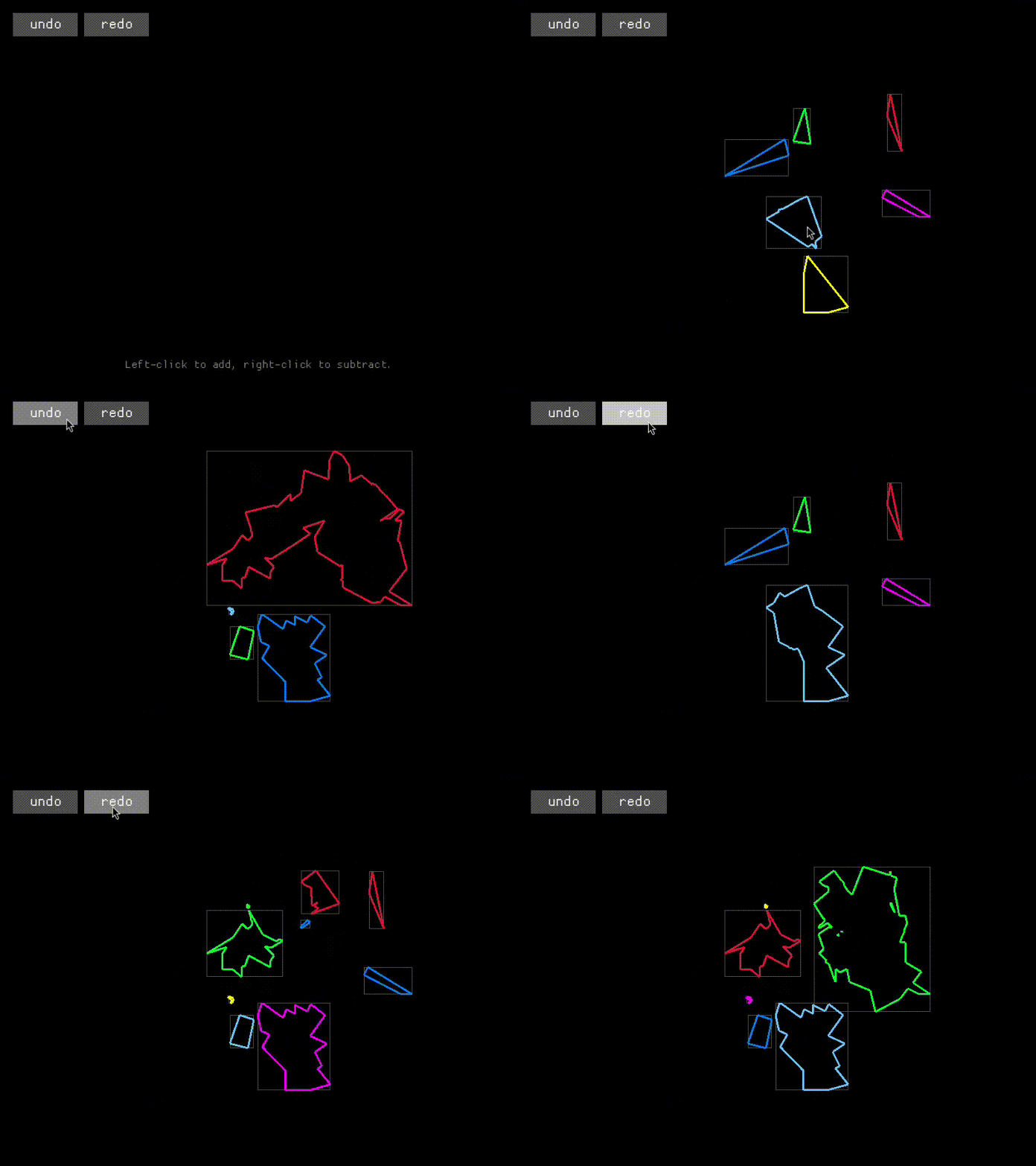
The above demo animation shows Undo/Redo action over dynamically added and subtracted polygons with R-tree spatial indexing. Neither commands nor snapshots are stored, but all edits in history are made of sparse deltas of the polygon container and the associated R-tree.
Source code with instructions for running the above interactive visualization can be found in the repository of the polygon_unionfind crate (see its README for details).
§Usage
§Adding dependency
First, add undoredo as a dependency to your Cargo.toml:
[dependencies]
undoredo = { version = "0.15.1", features = ["derive"] }
The derive feature flag is only required when using deltas on custom struct
or enum types to derive delta edit types. Snapshots and commands work without
any derives.
§Usage examples
§Delta recording on BTreeMap
Following is a basic usage example of delta-recording undo-redo over BTreeMap.
You can find more examples in the
examples/
directory.
use std::collections::BTreeMap;
use undoredo::aliases::BTreeMapDelta;
use undoredo::{Recorder, UndoRedo};

fn main() {
    // The recorder records the ongoing changes to the recorded container.
    let mut recorder: Recorder<BTreeMap<usize, char>> =
        Recorder::new(BTreeMap::new());

    // The undo-redo struct that holds and maintains the undo-redo bistack.
    let mut undoredo: UndoRedo<BTreeMapDelta<usize, char>> = UndoRedo::new();

    // Push elements while recording the changes in a delta.
    recorder.insert(1, 'A');
    recorder.insert(2, 'B');
    recorder.insert(3, 'C');

    // The pushed elements are now present in the container.
    assert!(*recorder.container() == BTreeMap::from([(1, 'A'), (2, 'B'), (3, 'C')]));

    // Flush the recorder and commit the recorded delta of pushing 'A', 'B', 'C'
    // into the undo-redo bistack.
    undoredo.commit(&mut recorder);

    // Now undo the action.
    undoredo.undo(&mut recorder);

    // The container is now empty; the action of pushing elements has been undone.
    assert!(*recorder.container() == BTreeMap::from([]));

    // Now redo the action.
    undoredo.redo(&mut recorder);

    // The elements are back in the container; the action has been redone.
    assert!(*recorder.container() == BTreeMap::from([(1, 'A'), (2, 'B'), (3, 'C')]));

    // Once you are done recording, you can dissolve the recorder to regain
    // ownership and mutability over the recorded container.
    let (btreemap, ..) = recorder.dissolve();
    assert!(btreemap == BTreeMap::from([(1, 'A'), (2, 'B'), (3, 'C')]));
}§Delta-recording on Vec
You can likewise have delta-recording undo-redo on Vec, but with a small
caveat: you need to replace
.remove()
method calls with
.swap_remove().
This is because element removals (both
shift-removals and
swap-removals)
in Vecs invalidate indices, whilst undoredo’s (and maplike’s) interfaces
are modeled after map-like datatypes, in which removal does not cause index
invalidation.
See
examples/vec.rs
for a usage example on Vec where .swap_remove() is used.
§Delta recorder over custom struct or enum
A data structure may not be one of the supported containers, but it may be
a custom struct or enum, made of multiple containers or other members,
possibly with additional generics and fields that should not be subject to
undo-redo. To be able to perform delta recording in such case, you need to
implement a delta structure for it together with two operations,
.apply_delta()
and
.flush_delta().
This can usually be easily done automatically by just applying a provided derive
macro,
#[derive(Delta)]
.
Below is an example of an undoredoable
struct-of-arrays
storage with generic coordinate type T that could be used for a simple
entity-component-system:
use undoredo::{Delta, Recorder};

// No need for `#[derive(Delta)]` for types stored in containers, only the
// containers themselves need this.
#[derive(Clone, Copy, Debug, Eq, Hash, PartialEq)]
pub struct Vector2<T> {
    x: T,
    y: T,
}

// `#[derive(Delta)]` generates the `EntitiesDelta` type, which is needed to
// store deltas as edits in an `UndoRedo` bistack.
#[derive(Delta)]
// You can choose the name for the generated delta edit type through the
// `undoredo` attribute with key `delta`. If you omit this, the default is
// the name of the input type followed by the word `Delta`. The name chosen in
// this example, `EntitiesDelta`, happens to be the same as the default.
#[undoredo(delta = EntitiesDelta)]
// Each delta is made of two collections of elements called "half-deltas".
// `#[derive(Delta)]` generates a type for them as well, named similarly to full
// deltas. If that name does not suit you, you can analogously use the
// `undoredo` attribute with key `half_delta` to rename them.
#[undoredo(half_delta = EntitiesHalfDelta)]
pub struct Entities<T> {
    positions: Recorder<Vec<Vector2<T>>>,
    velocities: Recorder<Vec<Vector2<T>>>,
    healths: Recorder<Vec<i64>>,
    // You can record changes to primitive types too, not just collections.
    turn_counter: Recorder<u64>,
    // You can make fields not be subject to undo-redo by marking them with
    // `#[undoredo(skip)]`.
    // Note that this skipping only works for delta-based undo-redo because
    // snapshots and commands rely on different mechanisms.
    #[undoredo(skip)]
    not_in_delta: String,
}
See examples/entities.rs for the full example.
§Storing command metadata along with edits
It is often desirable to store some metadata along with every recorded edit,
usually some representation of the command that originated it. This can be done
by instead committing the edit using the
.cmd_commit()
method.
The bistack of done and undone committed edits, together with their command
metadatas (“cmd”) if present, can be accessed as slices from the
.done()
and
.undone()
accessor methods.
use std::collections::BTreeMap;
use undoredo::aliases::BTreeMapDelta;
use undoredo::{Recorder, UndoRedo};

// Representation of the command that originated the recorded delta.
#[derive(Debug, Clone, PartialEq)]
enum Command {
    PushChar,
}

fn main() {
    let mut recorder: Recorder<BTreeMap<usize, char>> =
        Recorder::new(BTreeMap::new());
    let mut undoredo: UndoRedo<BTreeMapDelta<usize, char>, Command> = UndoRedo::new();

    recorder.insert(1, 'A');
    recorder.insert(2, 'B');

    // Commit `Command::PushChar` enum variant as command metadata ("cmd") along
    // with the recorded delta.
    undoredo.cmd_commit(Command::PushChar, &mut recorder);

    // `Command::PushChar` is now the top element of the stack of done cmd-deltas.
    assert_eq!(undoredo.done().last().unwrap().cmd, Command::PushChar);

    undoredo.undo(&mut recorder);

    // After undo, `Command::PushChar` is now the top element of the stack of
    // undone cmd-deltas.
    assert_eq!(undoredo.undone().last().unwrap().cmd, Command::PushChar);
}§Command pattern
You can also give up edits altogether and only store commands in the metadata field, thereby implementing the Command pattern. See examples/commands.rs for an example.
§Snapshot-based undo-redo
You can easily perform undo-redo using snapshots (that is, by storing whole past
states instead of only diffs between them) instead of deltas or commands. If you
were using deltas, you need to remove the
Recorder<...>
wrapper over your container and instead use the
Snapshot<...>
wrapper in place of the Delta<...> type.
For instance, if your container is HashMap<usize, char>, it will look like
this:
let mut container: HashMap<usize, char> = HashMap::new();
let mut undoredo: UndoRedo<Snapshot<HashMap<usize, char>>> = UndoRedo::new();
This will work for all container types that implement Clone, without need
for any derive macro invocations or additional trait implementations as is with
deltas.
However, there are two caveats not present with deltas: if you want to be able to restore the container to its initial (often empty) state, you need to commit it first. And if you end up committing your latest changes, to revert them you will need to invoke undo twice, since the first undo just restores the state to the top of the undone stack.
For a full usage example, see examples/snapshots.rs.
§Delta recording on maps with pushing
Some containers with map semantics also provide a special type of insertion
where a value is inserted without specifying a key, which the container instead
automatically generates and returns by itself. In undoredo, this operation is
called pushing.
If a supported type has such a push interface, you can record its changes just
as easily as insertions and removals by calling
.push()
on the recorder, like this:
recorder.push('A');StableVec and thunderdome::Arena are instances of supported pushable maps.
See
examples/stable_vec.rs
and
examples/thunderdome.rs
for complete examples of their usage.
§Delta-recording on sets
Some containers have set semantics: they operate only on values, without
exposing any usable notion of key or index. undoredo can provide delta-based
undo-redo functionality to such a set by treating it as a ()-valued map whose
keys are the set’s values. This is actually also how Rust’s standard library
internally
represents
its two set types, HashSet
and
BTreeSet.
As an example, the following code will construct a recorder and an undo-redo
bistack for a BTreeSet:
let mut recorder: Recorder<BTreeSet<char>> = Recorder::new(BTreeSet::new());
let mut undoredo: UndoRedo<BTreeSetDelta<char>> = UndoRedo::new();
Keeping in mind to pass values as keys, recorder and
undoredo can then be used the same way as with maps above. See
examples/btreeset.rs
for a complete example.
Among the supported third-party types, rstar::RTree is a data structure for
which undoredo has a convenience implementation over set semantics. See
examples/rstar.rs
for an example of its usage.
NOTE: Some set-like data structures are actually multisets: they allow
to insert the same value multiple times without overriding the first one. In
fact, rstar::RTree is a multiset. undoredo will work correctly with such
data structures, seeing them as sets, but only if you never make use of their
multiset property: you must never insert a key again when it is already present
in a multiset.
§Delta-recording on bidirectional maps
Delta-recording can be performed on bidirectional maps (bimaps). undoredo has
a convenience implementation for BiBTreeMap and BiHashMap from the bidimap
crate (bidimap is a maintained fork of the bimap crate).
See examples/bihashmap.rs for an example of undo-redo performed on a bidirectional map.
§History tree
Sometimes, instead of a linear undo-redo made of two stacks
(UndoRedo), it is desirable to store edits in a non-linear history
tree. We provide a data structure for that purpose,
HistoryTree.
See
examples/history_tree.rs
for an example of its usage.
§Delta compression over network
In networking applications, the recorded deltas can also be used for delta encoding (delta compression): you can cut needed network bandwidth by sending them across network instead of snapshots. Even better, this is differencing-free: you don’t have to compute one costly difference upon packet transmission; the cost is spread incrementally as recorded deltas are gradually and automatically constructed during each operation on data.
§Supported containers
§When using snapshots
All data structures that implement the
Clone trait are
supported for snapshot-based undo-redo.
§When using commands
For command-based undo-redo, obviously all data structures are supported as long as the library user implements commands for them.
§When using deltas
To be able to use delta-based undo-redo on a data structure, it is necessary
to have a delta structure as well as two operations,
.apply_delta()
and
.flush_delta(),
available as traits. For ease of use, undoredo supplies a number of built-in
convenience implementations of all these for various commonly-used container
types.
For custom data structures, there is a derive macro, #[derive(Delta)], that
will generate all the necessary code.
Though we try our best, this derive macro may not work on some highly-generic data types. And in some cases, it may be desirable to add some additional logic to the operations. In these situations, it is necessary to implement the delta structure and operations on it manually.
For an example of a manual implementation, take a look at mikwielgus/polygon_unionfind/src/unionfind.rs. This is a delta-undoredoable union-find where every field’s type is a generic parameter.
§Standard library
Rust’s standard library maps and sets have built-in convenience implementations of delta-editing:
HashMap, gated by thestdfeature flag (enabled by default);HashSet, gated by thestdfeature flag (enabled by default);BTreeMap, not feature-gated;BTreeSet, not feature-gated;Option, not feature-gated;Box, not feature-gated;Rc, not feature-gated;Arc, gated by thestdfeature flag (enabled by default);Vec, not feature-gated;VecDeque, not feature-gated.
§Third-party types
In addition to the standard library, undoredo also has built-in feature-gated
convenience implementations of delta-editing for data structures from certain
external crates:
bidimap::BiBTreeMapandbidimap::BiHashMap, gated by thebidimapfeature flag (usage example: examples/bihashmap.rs);indexmap::IndexMapandindexmap::IndexSet, gated by theindexmapfeature flag;rstar::RTree, gated by therstarfeature flag (usage example: examples/rstar.rs);stable_vec::StableVec, gated by thestable-vecfeature flag (usage example: examples/stable_vec.rs);thunderdome::Arena, gated by thethunderdomefeature flag (usage example: examples/thunderdome.rs);tinyvec::ArrayVecandtinyvec::TinyVec, gated by thetinyvecfeature flag.
To use these, enable their corresponding feature flags next to your undoredo
dependency in your Cargo.toml. For example, to enable all third-party type
implementations, write
[dependencies]
undoredo = { version = "0.15.1", features = ["bidimap", "indexmap", "rstar", "stable-vec", "thunderdome", "tinyvec"] }§Custom types
To make delta-based undo-redo work with a map-like non-composite
container data structure for which there is no convenience implementation,
you can create one on your own by implementing the traits from the
maplike crate. Refer to that crate’s
documentation for details. These traits are also re-exported by undoredo, so
it is not necessary to add another dependency.
If you believe that other people could benefit from your implementation,
consider contributing it to maplike. We will integrate it in undoredo on our
own afterwards (no need to open more than one pull request).
§Unsupported containers
Some containers cannot be supported for delta-based
undo-redo because they lack an interface on which
maplike’s traits could be implemented. See the Unsupported
containers
section in maplike’s documentation for details.
§Documentation
See the documentation for more information
on undoredo’s usage.
§Packaging
undoredo is published as a crate on the
Crates.io registry.
§Contributing
We welcome issues, pull requests and any other contributions from anyone to our repository on GitHub.
§Licence
§Outbound licence
undoredo is dual-licensed as under either of
at your option.
§Inbound licence
Unless you explicitly state otherwise, any contribution intentionally submitted for inclusion in this work by you will be dual-licensed as described above, without any additional terms or conditions.
§Feature flags
derive— Enables theDeltaderive macro (and also its constituent macros,ApplyDelta,FlushDelta,HalfDelta,MergeDelta).serde— Enablesserdesupport (derivesSerializeandDeserializetraits).std(enabled by default) — Disable forno_stdcompatibility.bidimap— Enables support of delta-recording forbidimap::BiBTreeMapandbidimap::BiHashMap.indexmap— Enables support of delta-recording forindexmap::IndexMapandindexmap::IndexSet.rstar— Enables support of delta-recording forrstar::RTree.stable-vec— Enables support of delta-recording forstable_vec::StableVec.thunderdome— Enables support of delta-recording forthunderdome::Arena.tinyvec— Enables support of delta-recording fortinyvec::ArrayVecandtinyvec::TinyVec.
Re-exports§
pub extern crate alloc;
Re-exports§
pub use maplike;
Modules§
- aliases
- Type aliases for full and half deltas.
Structs§
- CmdEdit
- An edit along with metadata.
- Delta
- A reversible set of changes to a container.
- History
Tree - A history tree for non-linear undo-redo action.
- History
Tree Node - A single history node in
HistoryTree. - History
Tree Node Id - Id of a node in
HistoryTree. - Recorder
- Records deltas applied to a container so that they can be replayed or reverted.
- Shared
History Tree - A history tree for non-linear undo-redo action with multiple possible external cursors.
- Shared
History Tree Cursor - A cursor that points to a node and owns the container subject to editing.
- Shared
History Tree Node - A single history node in
SharedHistoryTree. - Shared
History Tree Node Id - Id of a node in
SharedHistoryTree. - Snapshot
- A snapshot of the whole state of a container.
- Undo
Redo - An history bistack for linear undo-redo action.
Traits§
- Apply
Delta - Apply the changes in a delta to a container.
- Apply
Edit - Apply an edit.
- Extend
Delta - Extend (merge) the recorder’s recorded delta with the delta passed as an argument.
- Extract
Edit - Extract an edit corresponding to the current state.
- Flush
Delta - Flush the recorder, returning the recorded delta and replacing it with a new empty one.
- Merge
Deltas - Merge two deltas into one.
- Reset
Delta - Reset the currently recorded delta by flushing it out of the recorder and then applying its reverse.
- Revert
Edit - Revert an edit and return an edit that reverts the revert.
Derive Macros§
- Apply
Delta derive - Generates an impl of the trait
ApplyDelta. - Delta
derive - Generates an impl of the trait
ApplyDelta. - Extend
Delta derive - Generates an impl of the trait
ExtendDelta. - Flush
Delta derive - Generates an impl of the trait
FlushDelta. - Half
Delta derive - Generates a half-delta type for the given
structorenum. - Merge
Deltas derive - Generates an impl of the trait
MergeDeltasfor the struct’s delta type. - Reset
Delta derive - Generates an impl of the trait
ResetDelta.