Expand description
Low-level representation of CoAP messages.
The most notable item in toad_msg is Message;
a CoAP message very close to the actual byte layout.
§Allocation
CoAP messages have some attributes whose size is dynamic:
- The message payload (in http terms: the request/response body)
- the number of options (in http terms: headers)
- the value of an option (in http terms: header value)
Message does not require an allocator and has no opinions about what kind of collection
it uses internally to store these values.
It solves this problem by being generic over the collections it needs and uses an Array trait
to capture its idea of what makes a collection useful.
This means that you may use a provided implementation (for Vec or tinyvec::ArrayVec)
or provide your own collection (see the custom collections example)
//! Note: both of these type aliases are exported by `toad_msg` for convenience.

use tinyvec::ArrayVec;
use toad_msg::{Message, Opt};

//                        Message Payload byte buffer
//                        |
//                        |        Array of options in the message
//                        vvvvvvv  vvvvvvvvvvvvvvvvv
type VecMessage = Message<Vec<u8>, Vec<Opt<Vec<u8>>>>;

// Used like: `ArrayVecMessage<1024, 256, 16>`; a message that can store a payload up to 1024 bytes, and up to 16 options each with up to a 256 byte value.
type ArrayVecMessage<
       const PAYLOAD_SIZE: usize,
       const OPT_SIZE: usize,
       const NUM_OPTS: usize,
     > = Message<
           ArrayVec<[u8; PAYLOAD_SIZE]>,
           ArrayVec<[Opt<ArrayVec<[u8; OPT_SIZE]>>; NUM_OPTS]>,
         >;
It may look a little ugly, but a core goal of toad is to be platform- and alloc-agnostic.
§Performance
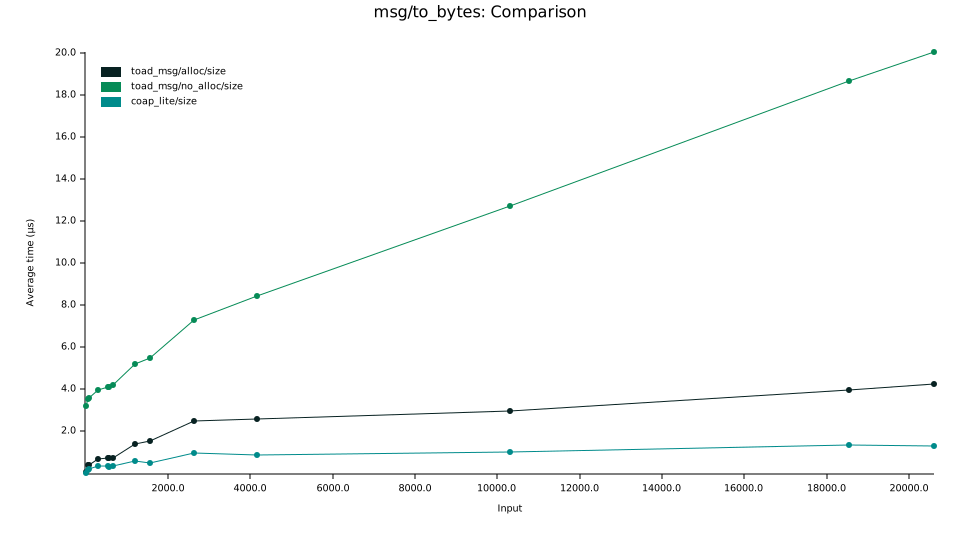
This crate uses criterion to measure performance of the heaped & heapless implementations in this crate as well as coap_lite::Packet.
In general, toad_msg::VecMessage performs identically to coap_lite (+/- 5%), and both are much faster than toad_msg::ArrayVecMessage.
Benchmarks:
§Serializing to bytes
Click to expand chart
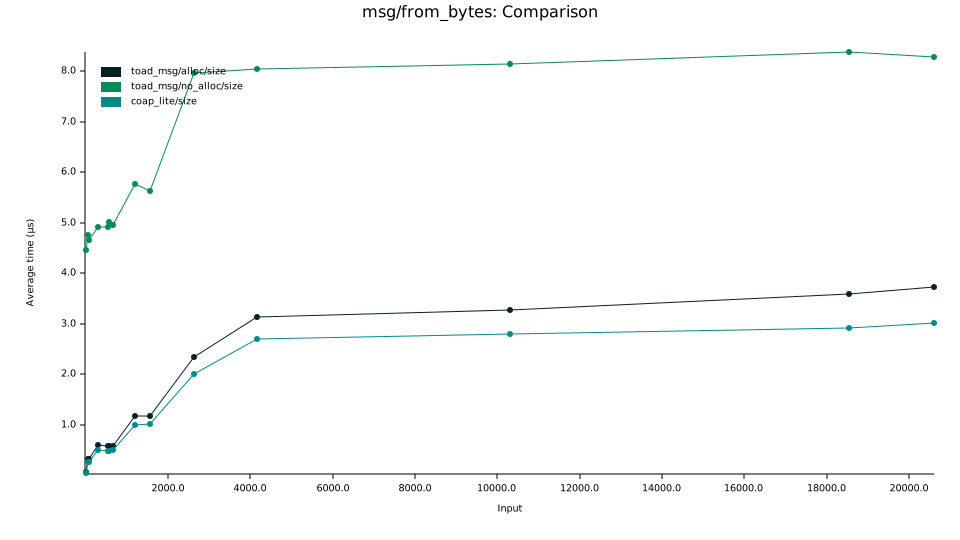
§Deserializing from bytes
Click to expand chart
Re-exports§
pub use code::*;pub use id::*;pub use opt::*;pub use parse_error::*;pub use token::*;pub use ty::*;pub use ver::*;
Modules§
- alloc
alloc - Type aliases for std or alloc platforms
- cache_
key - code
- Message Code
- id
- Message ID
- msg
- Message structs
- opt
- Message Options
- parse_
error - Message parsing errors
- token
- Message Token
- ty
- Message Type
- ver
- Message Version
Structs§
- Default
Cache Key - Default hasher used for
CacheKey - Message
- CoAP Messages
- Payload
- Payloads and Representations
Enums§
- SetOption
Error - An error occurred during a call to
Message::set
Traits§
- Cache
Key - The cache key can be used to compare messages for representing the same action against the same resource; for example requests with different IDs but the same method and cache-key affecting options (ex. path, query parameters) will yield the same cache-key.
- Message
Options - Methods that allow accessing & setting options known to the toad library.
- TryFrom
Bytes - Trait for converting a sequence of bytes into some data structure
- TryInto
Bytes - Trait allowing fallible conversion into bytes