
stikk

stikk is a history browser and workbench for the prikk version control system — a terminal (TUI) front-end over one shared operation layer.
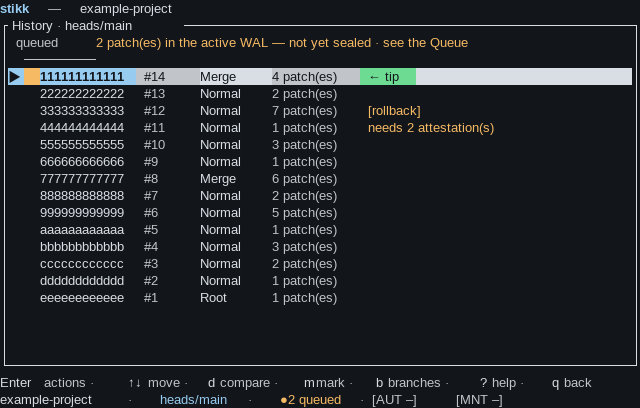
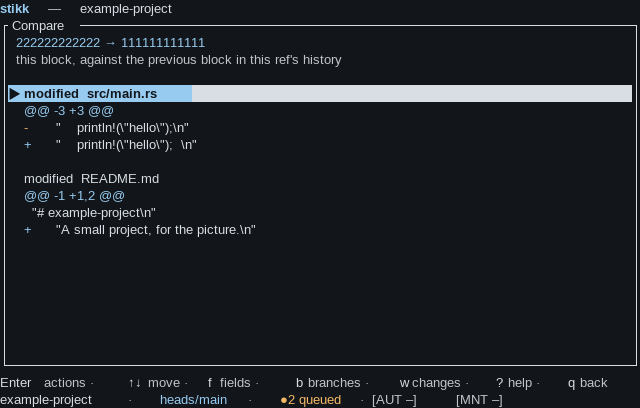
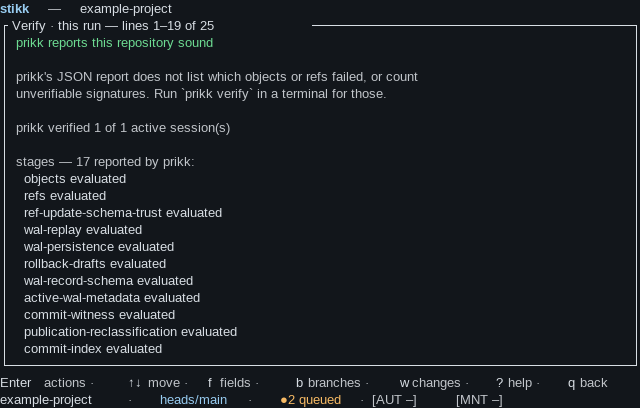
Drawn by stikk's own views from invented data, not photographed — see RFC 042.
Its founding property is that stikk owns no repository authority and no secrets: every repository fact is re-derived from prikk, and prikk — never stikk — reads signing key material. Its stance mirrors prikk's own: where prikk refuses, stikk explains. The name is Norwegian for to set a course, to take a bearing.
This binary crate is the launcher; the layers beneath it are published as
stikk-core,
stikk-tui,
stikk-prikk,
stikk-state, and
stikk-model.
Install
This compiles stikk. If you would rather not compile, or do not have Rust, every release also ships ready-to-run binaries for Linux, macOS and Windows, with checksums — see Install.
stikk drives the external prikk binary at runtime (it is not a Cargo dependency): install a
compatible prikk on your PATH as well. prikk installs itself — on Linux and macOS in one
line (curl -fsSL https://github.com/prikk-vcs/prikk/releases/latest/download/install.sh | sh),
and on Windows in one line too
(irm https://github.com/prikk-vcs/prikk/releases/latest/download/install.ps1 | iex), with
prikk's install guide the authority on all of it.
stikk's own installers install stikk and nothing else; they check for
prikk and print prikk's command when it is missing.
This release requires prikk ≥ 0.28 and is validated
through 0.55.0; a newer prikk still runs, but stikk says its output shapes have not been checked
against it rather than silently assuming they have. If prikk is missing, stikk opens and then
explains that — by design.
Use
Piped or non-TTY invocation prints a one-shot orientation instead of opening the TUI.
Status
v0.18.x lets you choose whose keys this repository trusts, gets an earlier version of your files
back, and installs in two plain steps on every platform — prikk's, then stikk's — against prikk
0.55.0. T lists the adopted maintainer keys with your own marked, a adopts one and x
removes one — each confirmed by typing the key id, and the removal says first that it can make
your own sealed history fail Verify until the key is adopted again. In Block detail, F saves one
file as it was at that block and A saves every file at it into a new folder, always outside the
repository and never over anything already there; a bundle card says which adopted key each
recorded sealer's id names (prikk ≥ 0.54). i opens a bundle and shows prikk's
verification and what importing would change, I imports it as a received branch, and E writes
a branch out to a file outside the repository. Its AUR packages are on the way: the
install page says when they are
published. Each program installs itself: one line installs stikk —
curl … install.sh | sh, or irm … install.ps1 | iex on Windows — checking the download against
the checksum published beside it, installing where you own it, and printing prikk's own install
command when prikk is missing or too old, rather than installing prikk itself; cargo binstall stikk fetches the same prebuilt binary. 64-bit ARM Linux gets a statically-linked build. Verify (V, prikk ≥ 0.39) shows prikk's verdict on
whether the repository is sound, every condition it fails and every stage it ran — and a damaged
repository reads as a verdict, never as a refusal. Compare (prikk ≥ 0.46) shows what changed
between two points in prikk's own diff hunks — two marked blocks or a block and the one
before it, from History and Block detail; any two refs, marked and selected in the ref picker;
the worktree against what commit would author, from Changes. Every line is quoted byte for byte, so a
whitespace or line-ending edit is visible, and stikk computes no difference of its own. Every
string stikk did not write is rendered so that what you read is what prikk reported: a
bidirectional override, a zero-width character or a look-alike space in a path, branch name or
message is written as its escape, and two different names never look alike. Patch detail
(prikk ≥ 0.39) renders one patch's operations from prikk's own report — a text edit's spans, a
created file's content and mode, a deleted file's preimage, a binary replacement's blob ids and
sizes, a permission change's two modes, and a rename with the key that asserted it — opened from
Block detail, which lists every block's patches and the files present at that block, with their
modes (prikk ≥ 0.46), or from the Queue. v shows prikk's own fields instead. Around that it
reads orientation, ref history, worktree changes and the Queue view, with refusal explanations
and a glossary; the ref picker offers the branch you are on before its first seal (prikk ≥
0.47). It performs thirteen mutations: commit (author a worktree capture into the active queue),
seal (freeze that queue into permanent, MAINTAINER-signed history, naming the patches it
freezes), and — from the ref picker — create a branch (n), create a tag (t, or at any
block from History), close a branch (x), switch to a branch (s, previewed as the
exact files it will write and delete) and merge one branch into another (m to mark the
branch to merge from, M for prikk's own plan, Enter to run it), at prikk ≥ 0.42 and ≥ 0.46 for
a switch — plus import a bundle as a received branch (I) and export a branch to a bundle
file (E), at prikk ≥ 0.53, save one file (F) or save a block's files (A) as they
were at a block, and — from the Trust view — adopt a maintainer key (a) or remove one
(x), at prikk ≥ 0.54 — every one of them always preview-first, with tiered confirmation a
compile error can't let you skip, and the last two confirmed by typing the key id.
stikk shares work as a bundle file: i opens one and shows prikk's own verification and what
prikk says importing it would change, an import creates and moves no branch of yours, and an
export writes outside the repository and never over a file that is there.
stikk gets an earlier version of your files back (prikk ≥ 0.54): F and A in Block detail
save one file, or every file at that block, outside the repository and never over an existing
path — both refused in stikk's own words before prikk is asked — and nothing in the repository or
your worktree changes. stikk chooses which keys this repository trusts (prikk ≥ 0.54): T lists
the adopted maintainer keys, with your own marked, and a bundle card says which of them, if any,
each recorded sealer's id names — a name, not a signature, which Verify checks after the import.
a adopts a key and x removes one, each confirmed by typing the key id; a removal says
first that it can make blocks this key sealed fail Verify until the key is adopted again, and an
id already trusted under a different key is shown as the security event it is. Adopting a
received tag, and author keys, are not built yet.
A confirmed commit authors only the worktree its preview showed. stikk notices a commit, seal
or branch switch made in another terminal and refreshes what is on screen. A prikk mv is shown
as the rename prikk says it will author, from prikk's own verdict at prikk ≥ 0.44, and a
declaration prikk would refuse makes commit unavailable. A ref with no published history is named
as one, and reads again on prikk 0.45 and 0.46, where prikk refused it by name. Two refs
compare from the ref picker (b, then m to mark one and d to compare it with the selected
one). stikk reopens each repository where you left it — the focused ref, the top-level view
and the untracked filter, re-checked against prikk before any of it is shown, stored outside
every repository, and STIKK_PRIVATE=1 for a launch that remembers nothing. A merge runs only
where prikk's own plan proves the two sides confluent, never into the branch you are on, and
writes nothing to your worktree. Sync, checkout of a block or a path, adopting a received tag and
author keys are not built yet.
Links
- Source & issues: https://github.com/prikk-vcs/stikk
- Documentation (guide + design set + API): the project's GitHub Pages site
- License: Apache-2.0