Expand description
SeaORM
🐚 An async & dynamic ORM for Rust



§SeaORM
§SeaORM is a relational ORM to help you build web services in Rust with the familiarity of dynamic languages.
 If you like what we do, consider starring, sharing and contributing!
Please help us with maintaining SeaORM by completing the SeaQL Community Survey 2025!

§Getting Started
Integration examples:
- Actix v4 Example
- Axum Example
- GraphQL Example
- jsonrpsee Example
- Loco TODO Example / Loco REST Starter
- Poem Example
- Rocket Example / Rocket OpenAPI Example
- Salvo Example
- Tonic Example
- Seaography Example (Bakery) / Seaography Example (Sakila)
If you want a simple, clean example that fits in a single file that demonstrates the best of SeaORM, you can try:
§Features
-
Async
Relying on SQLx, SeaORM is a new library with async support from day 1.
-
Dynamic
Built upon SeaQuery, SeaORM allows you to build complex dynamic queries.
-
Service Oriented
Quickly build services that join, filter, sort and paginate data in REST, GraphQL and gRPC APIs.
-
Production Ready
SeaORM is feature-rich, well-tested and used in production by companies and startups.
§A quick taste of SeaORM
Let’s have a quick walk through of the unique features of SeaORM.
§Entity
You don’t have to write this by hand! Entity files can be generated from an existing database with sea-orm-cli,
following is generated with --entity-format dense (new in 2.0).
mod cake {
    use sea_orm::entity::prelude::*;

    #[sea_orm::model]
    #[derive(Clone, Debug, PartialEq, DeriveEntityModel, Eq)]
    #[sea_orm(table_name = "cake")]
    pub struct Model {
        #[sea_orm(primary_key)]
        pub id: i32,
        pub name: String,
        #[sea_orm(has_one)]
        pub fruit: HasOne<super::fruit::Entity>,
        #[sea_orm(has_many, via = "cake_filling")] // M-N relation with junction
        pub fillings: HasMany<super::filling::Entity>,
    }
}
mod fruit {
    use sea_orm::entity::prelude::*;

    #[sea_orm::model]
    #[derive(Clone, Debug, PartialEq, DeriveEntityModel, Eq)]
    #[sea_orm(table_name = "fruit")]
    pub struct Model {
        #[sea_orm(primary_key)]
        pub id: i32,
        pub name: String,
        #[sea_orm(unique)]
        pub cake_id: Option<i32>,
        #[sea_orm(belongs_to, from = "cake_id", to = "id")]
        pub cake: HasOne<super::cake::Entity>,
    }
}§Entity Loader
The Entity Loader intelligently uses join for 1-1 and data loader for 1-N relations, eliminating the N+1 problem even when performing nested queries.
// join paths:
// cake -> fruit
// cake -> cake_filling -> filling -> ingredient

let super_cake = cake::Entity::load()
    .filter_by_id(42) // shorthand for .filter(cake::Column::Id.eq(42))
    .with(fruit::Entity) // 1-1 uses join
    .with((filling::Entity, ingredient::Entity)) // 1-N uses data loader
    .one(db)
    .await?
    .unwrap();

// 3 queries are executed under the hood:
// 1. SELECT FROM cake JOIN fruit WHERE id = $
// 2. SELECT FROM filling JOIN cake_filling WHERE cake_id IN (..)
// 3. SELECT FROM ingredient WHERE filling_id IN (..)

super_cake
    == cake::ModelEx {
        id: 42,
        name: "Black Forest".into(),
        fruit: Some(
            fruit::ModelEx {
                name: "Cherry".into(),
            }
            .into(),
        ),
        fillings: vec![filling::ModelEx {
            name: "Chocolate".into(),
            ingredients: vec![ingredient::ModelEx {
                name: "Syrup".into(),
            }],
        }],
};§Select
SeaORM models 1-N and M-N relationships at the Entity level, letting you traverse many-to-many links through a junction table in a single call.
// find all models
let cakes: Vec<cake::Model> = Cake::find().all(db).await?;

// find and filter
let chocolate: Vec<cake::Model> = Cake::find()
    .filter(cake::Column::Name.contains("chocolate"))
    .all(db)
    .await?;

// find one model
let cheese: Option<cake::Model> = Cake::find_by_id(1).one(db).await?;
let cheese: cake::Model = cheese.unwrap();

// find related models (lazy)
let fruit: Option<fruit::Model> = cheese.find_related(Fruit).one(db).await?;

// find related models (eager): for 1-1 relations
let cake_with_fruit: Vec<(cake::Model, Option<fruit::Model>)> =
    Cake::find().find_also_related(Fruit).all(db).await?;

// find related models (eager): works for both 1-N and M-N relations
let cake_with_fillings: Vec<(cake::Model, Vec<filling::Model>)> = Cake::find()
    .find_with_related(Filling) // for M-N relations, two joins are performed
    .all(db) // rows are automatically consolidated by left entity
.await?;§Nested Select
Partial models prevent overfetching by letting you querying only the fields you need; it also makes writing deeply nested relational queries simple.
use sea_orm::DerivePartialModel;

#[derive(DerivePartialModel)]
#[sea_orm(entity = "cake::Entity")]
struct CakeWithFruit {
    id: i32,
    name: String,
    #[sea_orm(nested)]
    fruit: Option<fruit::Model>, // this can be a regular or another partial model
}

let cakes: Vec<CakeWithFruit> = Cake::find()
    .left_join(fruit::Entity) // no need to specify join condition
    .into_partial_model() // only the columns in the partial model will be selected
    .all(db)
.await?;§Insert
SeaORM’s ActiveModel lets you work directly with Rust data structures and persist them through a simple API. It’s easy to insert large batches of rows from different data sources.
let apple = fruit::ActiveModel {
    name: Set("Apple".to_owned()),
    ..Default::default() // no need to set primary key
};

let pear = fruit::ActiveModel {
    name: Set("Pear".to_owned()),
    ..Default::default()
};

// insert one: Active Record style
let apple = apple.insert(db).await?;
apple.id == 1;

// insert one: repository style
let result = Fruit::insert(apple).exec(db).await?;
result.last_insert_id == 1;

// insert many returning last insert id
let result = Fruit::insert_many([apple, pear]).exec(db).await?;
result.last_insert_id == Some(2);§Insert (advanced)
You can take advantage of database specific features to perform upsert and idempotent insert.
// insert many with returning (if supported by database)
let models: Vec<fruit::Model> = Fruit::insert_many([apple, pear])
    .exec_with_returning(db)
    .await?;
models[0]
    == fruit::Model {
        id: 1, // database assigned value
        name: "Apple".to_owned(),
        cake_id: None,
    };

// insert with ON CONFLICT on primary key do nothing, with MySQL specific polyfill
let result = Fruit::insert_many([apple, pear])
    .on_conflict_do_nothing()
    .exec(db)
    .await?;

matches!(result, TryInsertResult::Conflicted);§Update
ActiveModel avoids race conditions by updating only the fields you’ve changed, never overwriting untouched columns. You can also craft complex bulk update queries with a fluent query building API.
use fruit::Column::CakeId;
use sea_orm::sea_query::{Expr, Value};

let pear: Option<fruit::Model> = Fruit::find_by_id(1).one(db).await?;
let mut pear: fruit::ActiveModel = pear.unwrap().into();

pear.name = Set("Sweet pear".to_owned()); // update value of a single field

// update one: only changed columns will be updated
let pear: fruit::Model = pear.update(db).await?;

// update many: UPDATE "fruit" SET "cake_id" = "cake_id" + 2
//               WHERE "fruit"."name" LIKE '%Apple%'
Fruit::update_many()
    .col_expr(CakeId, Expr::col(CakeId).add(Expr::val(2)))
    .filter(fruit::Column::Name.contains("Apple"))
    .exec(db)
.await?;§Save
You can perform “insert or update” operation with ActiveModel, making it easy to compose transactional operations.
let banana = fruit::ActiveModel {
    id: NotSet,
    name: Set("Banana".to_owned()),
    ..Default::default()
};

// create, because primary key `id` is `NotSet`
let mut banana = banana.save(db).await?;

banana.id == Unchanged(2);
banana.name = Set("Banana Mongo".to_owned());

// update, because primary key `id` is present
let banana = banana.save(db).await?;§Delete
The same ActiveModel API consistent with insert and update.
// delete one: Active Record style
let orange: Option<fruit::Model> = Fruit::find_by_id(1).one(db).await?;
let orange: fruit::Model = orange.unwrap();
orange.delete(db).await?;

// delete one: repository style
let orange = fruit::ActiveModel {
    id: Set(2),
    ..Default::default()
};
fruit::Entity::delete(orange).exec(db).await?;

// delete many: DELETE FROM "fruit" WHERE "fruit"."name" LIKE '%Orange%'
fruit::Entity::delete_many()
    .filter(fruit::Column::Name.contains("Orange"))
    .exec(db)
    .await?;
§Ergonomic Raw SQL
Let SeaORM handle 90% of all the transactional queries. When your query is too complex to express, SeaORM still offer convenience in writing raw SQL.
The raw_sql! macro is like the format! macro but without the risk of SQL injection.
It supports nested parameter interpolation, array and tuple expansion, and even repeating group,
offering great flexibility in crafting complex queries.
let item = Item { id: 2 }; // nested parameter access

let cake: Option<cake::Model> = Cake::find()
    .from_raw_sql(raw_sql!(
        Sqlite,
        r#"SELECT "id", "name" FROM "cake" WHERE id = {item.id}"#
    ))
    .one(db)
    .await?;
#[derive(FromQueryResult)]
struct CakeWithBakery {
name: String,
#[sea_orm(nested)]
bakery: Option<Bakery>,
}
#[derive(FromQueryResult)]
struct Bakery {
#[sea_orm(alias = "bakery_name")]
name: String,
}
let cake_ids = [2, 3, 4]; // expanded by the `..` operator
// can use many APIs with raw SQL, including nested select
let cake: Option<CakeWithBakery> = CakeWithBakery::find_by_statement(raw_sql!(
Sqlite,
r#"SELECT "cake"."name", "bakery"."name" AS "bakery_name"
FROM "cake"
LEFT JOIN "bakery" ON "cake"."bakery_id" = "bakery"."id"
WHERE "cake"."id" IN ({..cake_ids})"#
))
.one(db)
.await?;§🧭 Seaography: instant GraphQL API
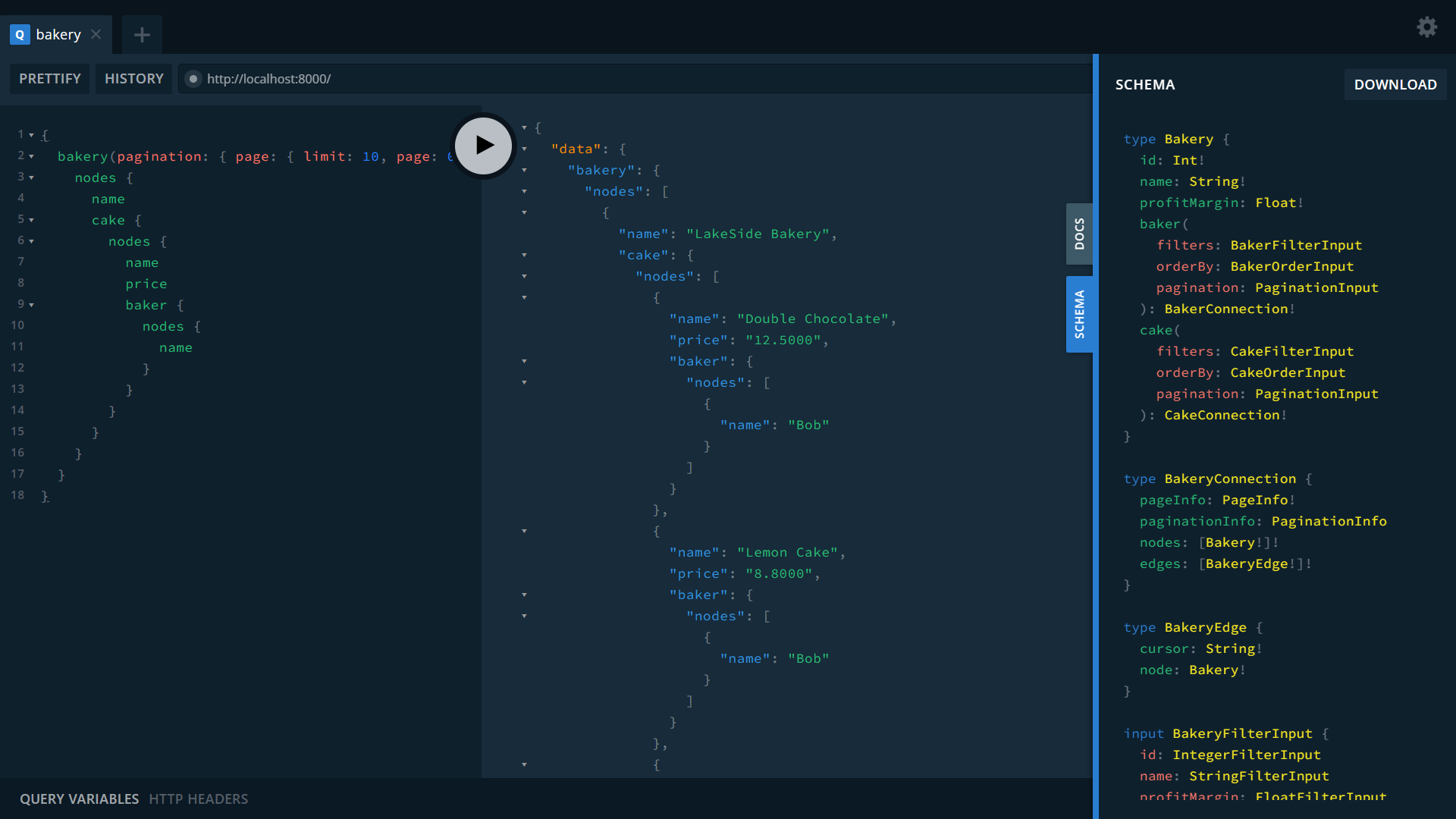
Seaography is a GraphQL framework built for SeaORM. Seaography allows you to build GraphQL resolvers quickly. With just a few commands, you can launch a fullly-featured GraphQL server from SeaORM entities, complete with filter, pagination, relational queries and mutations!
Look at the Seaography Example to learn more.
§🖥️ SeaORM Pro: Professional Admin Panel
SeaORM Pro is an admin panel solution allowing you to quickly and easily launch an admin panel for your application - frontend development skills not required, but certainly nice to have!
SeaORM Pro will be updated to support the latest features in SeaORM 2.0.
Features:
- Full CRUD
- Built on React + GraphQL
- Built-in GraphQL resolver
- Customize the UI with TOML config
- Custom GraphQL endpoints (new in 2.0)
- Role Based Access Control (new in 2.0)
Learn More


§SQL Server Support
SQL Server for SeaORM offers the same SeaORM API for MSSQL. We ported all test cases and examples, complemented by MSSQL specific documentation. If you are building enterprise software, you can request commercial access. It is currently based on SeaORM 1.0, but we will offer free upgrade to existing users when SeaORM 2.0 is finalized.
§Releases
SeaORM 2.0 has reached its release candidate phase. We’d love for you to try it out and help shape the final release by sharing your feedback.
SeaORM 2.0 is shaping up to be our most significant release yet - with a few breaking changes, plenty of enhancements, and a clear focus on developer experience.
If you make extensive use of SeaORM’s underlying query builder, we recommend checking out our blog post on SeaQuery 1.0 release:
It doesn’t mean that SeaORM is ‘done’, we’ve designed an architecture to allow us to deliver new features without major breaking changes.
§License
Licensed under either of
- Apache License, Version 2.0 (LICENSE-APACHE or http://www.apache.org/licenses/LICENSE-2.0)
- MIT license (LICENSE-MIT or http://opensource.org/licenses/MIT)
at your option.
§Contribution
Unless you explicitly state otherwise, any contribution intentionally submitted for inclusion in the work by you, as defined in the Apache-2.0 license, shall be dual licensed as above, without any additional terms or conditions.
We invite you to participate, contribute and together help build Rust’s future.
A big shout out to our contributors!

§Who’s using SeaORM?
SeaORM is trusted by companies and startups for both internal tools and public‑facing applications, thanks to its ergonomics and the familiarity it brings from dynamic languages. Built on async Rust, it combines high performance and a strong type system without sacrificing developer productivity.
Here is a short list of awesome open source software built with SeaORM. Full list here. Feel free to submit yours!
| Project | GitHub | Tagline |
|---|---|---|
| Zed |  | A high-performance, multiplayer code editor |
| OpenObserve |  | Open-source observability platform |
| RisingWave |  | Stream processing and management platform |
| LLDAP |  | A light LDAP server for user management |
| Warpgate |  | Smart SSH bastion that works with any SSH client |
| Svix |  | The enterprise ready webhooks service |
| Ryot |  | The only self hosted tracker you will ever need |
| Lapdev |  | Self-hosted remote development enviroment |
| System Initiative |  | DevOps Automation Platform |
| OctoBase |  | A light-weight, scalable, offline collaborative data backend |
§Sponsorship
SeaQL.org is an independent open-source organization run by passionate developers. If you enjoy using our libraries, please star and share our repositories. If you feel generous, a small donation via GitHub Sponsor will be greatly appreciated, and goes a long way towards sustaining the organization.
§Gold Sponsors

|
QDX pioneers quantum dynamics-powered drug discovery, leveraging AI and supercomputing to accelerate molecular modeling. We’re immensely grateful to QDX for sponsoring the development of SeaORM, the SQL toolkit that powers their data engineering workflows.
§Silver Sponsors
We’re grateful to our silver sponsors: Digital Ocean, for sponsoring our servers. And JetBrains, for sponsoring our IDE.

|

|
§Mascot
A friend of Ferris, Terres the hermit crab is the official mascot of SeaORM. His hobby is collecting shells.

§Rustacean Sticker Pack 🦀
The Rustacean Sticker Pack is the perfect way to express your passion for Rust. Our stickers are made with a premium water-resistant vinyl with a unique matte finish. Stick them on your laptop, notebook, or any gadget to show off your love for Rust!
Sticker Pack Contents:
- Logo of SeaQL projects: SeaQL, SeaORM, SeaQuery, Seaography, FireDBG
- Mascot of SeaQL: Terres the Hermit Crab
- Mascot of Rust: Ferris the Crab
- The Rustacean word
Support SeaQL and get a Sticker Pack! All proceeds contributes directly to the ongoing development of SeaQL projects.
Re-exports§
pub use crate::error::TryGetError;pub use sea_query;pub use strum;pub use sqlx;sqlx-deppub use entity::*;pub use error::*;pub use query::*;pub use schema::*;
Modules§
- dynamic
- The API of this module is not yet stable, and may have breaking changes between minor versions.
- entity
- Module for the Entity type and operations
- error
- Error types for all database operations
- metric
- Types and methods to perform metric collection
- query
- Types and methods to perform queries
- rbac
rbac - schema
- Types that defines the schemas of an Entity
- value
- Helpers for working with Value
Macros§
- debug_
print Non- debug-print - Non-debug version
- debug_
query - Helper to get a raw SQL string from an object that impl
QueryTrait. - debug_
query_ stmt - Helper to get a
Statementfrom an object that implQueryTrait. - raw_sql
macros
Structs§
- Connect
Options - Defines the configuration options of a database
- Cursor
- Cursor pagination
- Database
- Defines a database
- Database
Connection - Handle a database connection depending on the backend enabled by the feature flags. This creates a connection pool internally (for SQLx connections), and so is cheap to clone.
- Database
Transaction - Defines a database transaction, whether it is an open transaction and the type of backend to use. Under the hood, a Transaction is just a wrapper for a connection where START TRANSACTION has been executed.
- Delete
Result - The result of a DELETE operation
- Deleter
- Handles DELETE operations in a ActiveModel using DeleteStatement
- Exec
Result - Defines the result of executing an operation
- Insert
Many Result - The result of an INSERT many operation for a set of ActiveModels
- Insert
Result - The result of an INSERT operation on an ActiveModel
- Inserter
- Defines a structure to perform INSERT operations in an ActiveModel
- Items
AndPages Number - Define a structure containing the numbers of items and pages of a Paginator
- Mock
Database mock - Defines a Mock database suitable for testing
- Mock
Database Connection mock - Defines a connection for the MockDatabase
- Mock
Database Connector mock - Defines a database driver for the MockDatabase
- Mock
Exec Result mock - Defines the results obtained from a MockDatabase
- MockRow
mock - Defines the structure of a test Row for the MockDatabase which is just a BTreeMap<String, Value>
- Open
Transaction mock - Defines a transaction that is has not been committed
- Paginator
- Defined a structure to handle pagination of a result from a query operation on a Model
- Proxy
Database Connection proxy - Defines a connection for the [ProxyDatabase]
- Proxy
Database Connector proxy - Defines a database driver for the [ProxyDatabase]
- Proxy
Exec Result proxy - Defines the results obtained from a [ProxyDatabase]
- Proxy
Row proxy - Defines the structure of a Row for the [ProxyDatabase] which is just a BTreeMap<String, Value>
- Query
Access Audit rbac - Query
Result - Defines the result of a query operation on a Model
- Query
Stream - The self-referencing struct.
- Restricted
Connection rbac - Wrapper of
DatabaseConnectionthat performs authorization on all executed queries for the current user. Note that raw SQLStatementis not allowed currently. - Restricted
Transaction rbac - Wrapper of
DatabaseTransactionthat performs authorization on all executed queries for the current user. Note that raw SQLStatementis not allowed currently. - Select
Five Model - Helper class to handle query result for 5 Models
- Select
Four Model - Helper class to handle query result for 4 Models
- Select
Getable Tuple - Get tuple from query result based on column index
- Select
Getable Value - Get tuple from query result based on a list of column identifiers
- Select
Model - Helper class to handle query result for 1 Model
- Select
SixModel - Helper class to handle query result for 6 Models
- Select
Three Model - Helper class to handle query result for 3 Models
- Select
TwoModel - Helper class to handle query result for 2 Models
- Selector
- Defines a type to do
SELECToperations through a SelectStatement on a Model - Selector
Raw - Performs a raw
SELECToperation on a model - Sqlx
MySql Connector sqlx-mysql - Defines the sqlx::mysql connector
- Sqlx
MySql Pool Connection sqlx-mysql - Defines a sqlx MySQL pool
- Sqlx
Postgres Connector sqlx-postgres - Defines the sqlx::postgres connector
- Sqlx
Postgres Pool Connection sqlx-postgres - Defines a sqlx PostgreSQL pool
- Sqlx
Sqlite Connector sqlx-sqlite - Defines the sqlx::sqlite connector
- Sqlx
Sqlite Pool Connection sqlx-sqlite - Defines a sqlx SQLite pool
- Statement
- Defines an SQL statement
- Transaction
mock - Defines a database transaction as it holds a Vec<Statement>
- Transaction
Stream - The self-referencing struct.
- Update
Result - The result of an update operation on an ActiveModel
- Updater
- Defines an update operation
- Values
Enums§
- Access
Mode - Access mode
- Audit
Error rbac - Database
Backend - The type of database backend for real world databases. This is enabled by feature flags as specified in the crate documentation
- Database
Connection Type - The underlying database connection type.
- Isolation
Level - Isolation level
- Transaction
Error - Defines errors for handling transaction failures
- TryInsert
Result - The types of results for an INSERT operation
- Value
- Value variants
Traits§
- Audit
Trait rbac - ColIdx
- Column Index, used by
TryGetable. Implemented for&strandusize - Connection
Trait - The generic API for a database connection that can perform query or execute statements. It abstracts database connection and transaction
- Cursor
Trait - A trait for any type that can be turn into a cursor
- Iden
- Identifier
- Into
Mock Row mock - A trait to get a MockRow from a type useful for testing in the MockDatabase
- Mock
Database Trait mock - A Trait for any type wanting to perform operations on the MockDatabase
- Paginator
Trait - A Trait for any type that can paginate results
- Proxy
Database Trait proxy - Defines the ProxyDatabaseTrait to save the functions
- Selector
Trait - A Trait for any type that can perform SELECT queries
- Statement
Builder - Any type that can build a Statement
- Stream
Trait - Stream query results
- Transaction
Session - Represents an open transaction
- Transaction
Trait - Spawn database transaction
- TryFrom
U64 - Try to convert a type to a u64
- TryGetable
- An interface to get a value from the query result
- TryGetable
Array - An interface to get an array of values from the query result.
A type can only implement
ActiveEnumorTryGetableFromJson, but not both. A blanket impl is provided forTryGetableFromJson, while the impl forActiveEnumis provided by theDeriveActiveEnummacro. So as an end user you won’t normally touch this trait. - TryGetable
From Json with-json - An interface to get a JSON from the query result
- TryGetable
Many - An interface to get a tuple value from the query result
Functions§
- from_
query_ result_ to_ proxy_ row proxy - Convert QueryResult to ProxyRow
Type Aliases§
- DbBackend
- A shorthand for DatabaseBackend.
- DbConn
- The same as a DatabaseConnection
- PinBox
Stream - Pin a Model so that stream operations can be performed on the model
Attribute Macros§
- compact_
model macros - model
macros
Derive Macros§
- Derive
Active Enum macros - A derive macro to implement
sea_orm::ActiveEnumtrait for enums. - Derive
Active Model macros - The DeriveActiveModel derive macro will implement ActiveModelTrait for ActiveModel which provides setters and getters for all active values in the active model.
- Derive
Active Model Behavior macros - Models that a user can override
- Derive
Column macros - The DeriveColumn derive macro will implement [ColumnTrait] for Columns. It defines the identifier of each column by implementing Iden and IdenStatic. The EnumIter is also derived, allowing iteration over all enum variants.
- Derive
Display macros - Derive
Entity macros - Create an Entity
- Derive
Entity Model macros - This derive macro is the ‘almighty’ macro which automatically generates Entity, Column, and PrimaryKey from a given Model.
- Derive
Iden macros - The DeriveIden derive macro will implement
sea_orm::Idenfor simplify Iden implementation. - Derive
Into Active Model macros - Derive into an active model
- Derive
Migration Name macros - The DeriveMigrationName derive macro will implement
sea_orm_migration::MigrationNamefor a migration. - Derive
Model macros - The DeriveModel derive macro will implement ModelTrait for Model, which provides setters and getters for all attributes in the mod It also implements FromQueryResult to convert a query result into the corresponding Model.
- Derive
Model Ex macros - Derive a complex model with relational fields
- Derive
Partial Model macros - The DerivePartialModel derive macro will implement [
sea_orm::PartialModelTrait] for simplify partial model queries. Since 2.0, this macro cannot be used with theFromQueryResultmacro. - Derive
Primary Key macros - The DerivePrimaryKey derive macro will implement [PrimaryKeyToColumn] for PrimaryKey which defines tedious mappings between primary keys and columns. The EnumIter is also derived, allowing iteration over all enum variants.
- Derive
Related Entity macros - The DeriveRelatedEntity derive macro will implement seaography::RelationBuilder for RelatedEntity enumeration.
- Derive
Relation macros - The DeriveRelation derive macro will implement RelationTrait for Relation.
- Derive
Value Type macros - Implements traits for types that wrap a database value type.
- Enum
Iter - Creates a new type that iterates of the variants of an enum.
- From
Json Query Result macros - From
Query Result macros - Convert a query result into the corresponding Model.
- Iden