1
2
3
4
5
6
7
8
9
10
11
12
13
14
15
16
17
18
19
20
21
22
23
24
25
26
27
28
29
30
31
32
33
34
35
36
37
38
39
40
41
42
43
44
45
46
47
48
49
50
51
52
53
54
55
56
57
58
59
60
61
62
63
64
65
66
67
68
69
70
71
72
73
74
75
76
use crate::Point3;
/// Axis-aligned bounding box is defined by two positions.
///
/// **Note**: The first position is expected to be the minimum bound and the second
/// the maximum bound.
///
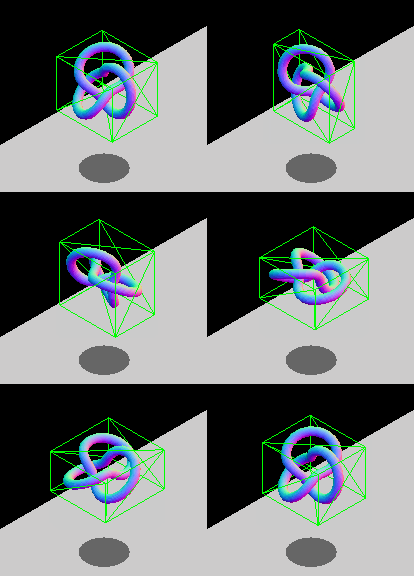
/// The animated GIF below shows a graphic example of an AABB that adapts its
/// size to fit the rotating entity. The box constantly changes dimensions to
/// snugly fit the entity contained inside.
///
/// 
#[derive(Clone, Debug)]
pub struct AABB {
/// Minimum position
pub min: Point3,
/// Maximum position
pub max: Point3,
}
impl Default for AABB {
fn default() -> Self {
Self::empty()
}
}
impl AABB {
/// Create an new AABB from two points.
pub fn new(min: Point3, max: Point3) -> Self {
Self { min, max }
}
/// Create an empty AABB.
pub fn empty() -> Self {
Self::new(
Point3::new(f32::INFINITY, f32::INFINITY, f32::INFINITY),
Point3::new(f32::NEG_INFINITY, f32::NEG_INFINITY, f32::NEG_INFINITY),
)
}
/// Compute AABB volume
pub fn volume(&self) -> f32 {
(self.max.x - self.min.x) * (self.max.y - self.min.y) * (self.max.z - self.min.z)
}
/// Compute AABB surface
pub fn surface(&self) -> f32 {
let dx = self.max.x - self.min.x;
let dy = self.max.y - self.min.y;
let dz = self.max.z - self.min.z;
2.0 * (dx * dy + dx * dz + dy * dz)
}
/// Merge another AABB into this one.
pub fn merge(&mut self, other: &Self) {
self.min = Point3::new(
self.min.x.min(other.min.x),
self.min.y.min(other.min.y),
self.min.z.min(other.min.z),
);
self.max = Point3::new(
self.max.x.max(other.max.x),
self.max.y.max(other.max.y),
self.max.z.max(other.max.z),
);
}
}
/// Your shapes needs to implement `Bounded` trait to build a KD-tree around it.
pub trait Bounded {
/// This function return the **Axis-aligned bounding boxes**
/// (`AABB`) of the object.
///
/// For more information check [AABB](type.AABB.html).
fn bound(&self) -> AABB;
}