Expand description
§FastNN
A robust deep learning library in Rust with CUDA kernels.
FastNN trains neural networks in Rust. It has tensors with automatic
differentiation, the layers and optimizers behind MLPs, CNNs, RNNs and
transformers, data loading, and checkpoints a run can resume from. It runs on
the CPU out of the box and on NVIDIA GPUs with the cuda feature.
The whole stack is in this crate: Rust on the CPU, and with the cuda
feature the kernels in the same repository. It is written to be read, so you
can follow loss.backward() from your training loop down to the kernel.
Every backward rule is tested against finite differences of its own forward,
every CUDA kernel against the CPU path, and unsafe appears only in the
CUDA bindings.
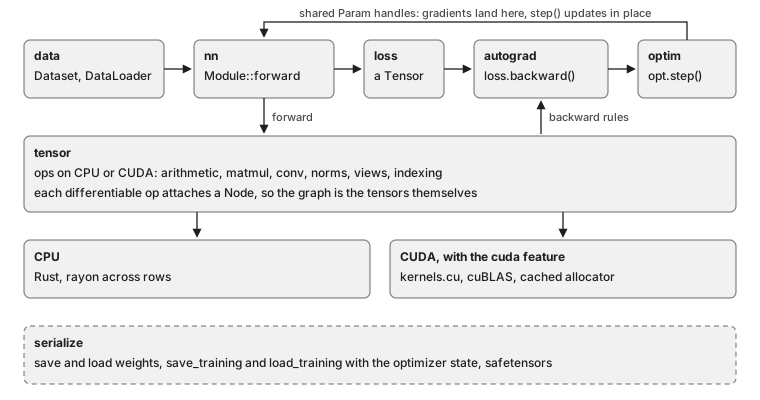
A batch goes through the model, the ops build a graph as they run, and the
loss sits at its end. backward() walks that graph and leaves a gradient in
each Param. The optimizer holds the same Param handles, so
step() reads the gradients and updates the weights in place.
§Quick start
Train a classifier on MNIST:
use fastnn::prelude::*;
use fastnn::data::{Mnist, Split};

let train = Mnist::load(Split::Train)?;
let loader = DataLoader::new(&train, 128).shuffle(true);

let model = Sequential::new()
    .add(Flatten::new())
    .add(Linear::new(784, 128))
    .add(ReLU)
    .add(Linear::new(128, 10));

let mut opt = Adam::new(model.parameters(), 1e-3);

for batch in loader.iter() {
    let loss = cross_entropy(&model.forward(&batch.inputs), &batch.labels());

    opt.zero_grad();
    loss.backward();
    opt.step();
}

save(&model, "mnist.fdl")?;
The examples are complete programs. Run one with
cargo run --release --example <name>:
| Example | What it shows |
|---|---|
simple_mlp | MLP learning XOR, the smallest training loop |
mnist_mlp | Dataset download, batching, evaluation, checkpointing |
mnist_cnn | Convolutions, batch norm, pooling, an LR schedule |
char_lm | Small GPT trained from scratch, resumes after Ctrl-C |
finetune | Pretrain, freeze the backbone, train a new head |
gan | Two networks trained against each other |
vae | Variational autoencoder on 2-D data |
reinforce | Policy gradient on a bandit |
multi_task | Shared trunk, two heads, one combined loss |
Use --release. Debug builds are about 50x slower.
§A Tour of FastNN
A training project meets the crate in a fixed order: build a model, train it,
feed it data, save it, move it to a GPU, maybe generate from it, and debug it
when a run goes bad. This tour follows that order and shows the API for each
step. Everything a script needs is in the prelude, and each module’s own
page goes deeper.
§Models
A model is anything that implements Module, and
Sequential chains layers into one. A layer’s weights are
Param handles, shared with the optimizer, so training never has
to borrow the model.
use fastnn::prelude::*;

let model = Sequential::new()
    .add(Linear::new(16, 32))
    .add(ReLU)
    .add(Dropout::new(0.1))
    .add(Linear::new(32, 4));

let logits = model.forward(&Tensor::randn(&[8, 16]));
assert_eq!(logits.shape(), &[8, 4]);
assert_eq!(model.num_parameters(), 16 * 32 + 32 + 32 * 4 + 4);
Your own layer needs forward, plus named_parameters if it has weights.
Device placement, parameter counting and gradient zeroing follow from those.
use fastnn::nn::module::scoped;
use fastnn::prelude::*;

struct Residual { inner: Linear }

impl Module for Residual {
    fn forward(&self, x: &Tensor) -> Tensor {
        x.add(&self.inner.forward(x).relu())
    }
    fn named_parameters(&self) -> Vec<(String, Param)> {
        scoped("inner", self.inner.named_parameters())
    }
}
nn has the rest: convolutions with dilation and groups, pooling, batch,
layer and RMS normalization, embeddings, LSTM and GRU, multi-head attention,
and transformer encoder and decoder stacks.
§Training
An optimizer takes the model’s parameters and a learning rate. A
LrSchedule maps the step to a rate, and set_lr
applies it. The losses are plain functions in nn.
use fastnn::prelude::*;

let model = Sequential::new().add(Linear::new(4, 3));
let mut opt = AdamW::new(model.parameters(), 1e-3);
let schedule = Warmup::new(CosineAnnealing::new(1e-3, 1000), 100);

let x = Tensor::randn(&[8, 4]);
let targets = [0, 1, 2, 0, 1, 2, 0, 1];

for step in 0..3 {
    opt.set_lr(schedule.lr_at(step));
    let loss = cross_entropy(&model.forward(&x), &targets);

    opt.zero_grad();
    loss.backward();
    clip_grad_norm(opt.parameters(), 1.0);
    opt.step();
}
Dropout and BatchNorm2d behave
differently at inference, so call model.eval() before validation and
model.train() after.
To fine-tune, freeze what should not move. A frozen parameter hands out a detached tensor, so the backward pass stops there and no gradient is computed for it at all. The optimizer skips a parameter with no gradient.
let backbone = Linear::new(16, 16);
backbone.freeze();

let model = Sequential::new().add(backbone).add(ReLU).add(Linear::new(16, 2));
let mut opt = Adam::new(model.parameters(), 1e-3);   // only the head will move
optim has SGD, Adam,
AdamW, RMSprop,
Adagrad, Adadelta,
RAdam and Lion, the
Lookahead and Ema wrappers, and the
Warmup, CosineAnnealing,
OneCycle and StepDecay schedules.
CrossEntropyLoss adds label smoothing, class weights
and an ignore index to the plain function.
§Data
A Dataset is anything indexable that can write one item
into a slice. A DataLoader turns it into shuffled
batches and can place them on a device. Items go into one buffer per batch,
so batching 60,000 images does not allocate 60,000 tensors.
use fastnn::prelude::*;

let inputs = Tensor::randn(&[100, 8]);
let targets = Tensor::from_vec((0..100).map(|i| (i % 3) as f32).collect(), &[100]);
let dataset = TensorDataset::new(&inputs, &targets);

let loader = DataLoader::new(&dataset, 32).shuffle(true);
for batch in loader.iter() {
    let labels = batch.labels();   // targets as class ids
    assert_eq!(batch.inputs.dim(0), labels.len());
}
Mnist::load downloads the digits once and caches them.
The data page shows a dataset written from scratch.
§Checkpoints
save writes the weights, which is all a finished model
needs. A run that has to survive a crash needs more: Adam’s moments and step
count drive its bias correction, and restored without them it restarts at
step 1 with an oversized first update.
save_training writes the weights, the optimizer
state and the step together, and load_training
refuses a plain weights file rather than silently resetting the optimizer.
let mut step = load_training(&model, &mut opt, &path).unwrap_or(0);

while step < total {
    // one training step
    step += 1;
    if step % 500 == 0 {
        save_training(&model, &opt, step, &path)?;
    }
}
save_safetensors and
load_safetensors exchange weights with other
tools. F16 and BF16 files load and are widened to f32.
§GPU
Everything starts on the CPU. Move the model and the loader, and the training loop stays the same. Mixing devices panics instead of copying behind your back.
let device = Device::best();   // the first GPU, else the CPU
model.to_device(device);
let loader = DataLoader::new(&dataset, 128).to_device(device);
Matmul goes through cuBLAS and everything else through the kernels in
cuda/kernels.cu, each checked against the CPU path by the parity tests. The
kernels use fast math, so GPU and CPU results differ in the last few digits.
§Generation
A causal TransformerStack decodes through a
StackCache, so each new token attends to the whole prefix
without recomputing it. Sampler turns logits into a token,
and BeamSearch finds the most probable sequence instead.
use fastnn::prelude::*;

let (vocab, width) = (50, 32);
let tokens = Embedding::new(vocab, width);
let positions = Embedding::new(64, width);
let stack = TransformerStack::causal(width, 4, 64, 2, 0.0);
let head = Linear::new(width, vocab);
let sampler = Sampler::new().temperature(0.8).top_k(10);

let mut ids = vec![1];
let mut cache = stack.new_cache();
no_grad(|| {
    for _ in 0..5 {
        let last = *ids.last().unwrap();
        let x = tokens.lookup(&[last]).add(&positions.lookup(&[cache.len()]));
        let hidden = stack.forward_cached(&x.reshape(&[1, 1, -1]), &mut cache);
        ids.push(sampler.sample(&head.forward(&hidden)));
    }
});
assert_eq!(ids.len(), 6);
Sampling draws from the thread’s random source, so
manual_seed makes a generation reproducible.
§Debugging
One non-finite gradient poisons the weights, and by the time the loss prints
NaN the op at fault is long gone. detect_anomaly
checks every gradient as it is produced and panics at the first bad one,
naming the op:
let w = Param::new(Tensor::from_vec(vec![0.0], &[1]));
detect_anomaly(|| w.tensor().log().sum().backward());
// panics: anomaly: Log produced inf at element 0 of [1] in the gradient for input 0
It reads every gradient, so keep it for debugging. The cheap guard for a
healthy loop is
gradients_are_finite:
if !opt.gradients_are_finite() {
    opt.zero_grad();   // skip this batch instead of stepping into NaN
}
Shape and device mistakes panic with a message naming both shapes, since they
are bugs in the calling code. Where a shape comes from outside your code, a
config file or an upload, the try_ variants return an Error instead:
let a = Tensor::randn(&[2, 3]);
assert!(a.try_matmul(&Tensor::randn(&[4, 4])).is_err());§Tensors
A Tensor is an immutable f32 array on the CPU or a GPU.
Ops return new tensors and broadcast the way NumPy does.
use fastnn::tensor::Tensor;

let a = Tensor::from_vec(vec![1.0, 2.0, 3.0, 4.0, 5.0, 6.0], &[2, 3]);
let bias = Tensor::from_vec(vec![10.0, 20.0, 30.0], &[3]);

let shifted = a.add(&bias);            // [2, 3] + [3] broadcasts over the rows
assert_eq!(shifted.to_vec(), vec![11.0, 22.0, 33.0, 14.0, 25.0, 36.0]);

let gram = a.matmul(&a.transpose());   // [2, 3] x [3, 2]
assert_eq!(gram.shape(), &[2, 2]);

assert_eq!(a.sum_axis(1).to_vec(), vec![6.0, 15.0]);
assert_eq!(a.argmax(1), vec![2, 2]);
assert_eq!(a.narrow(0, 1, 1).to_vec(), vec![4.0, 5.0, 6.0]);
assert_eq!(a.reshape(&[3, -1]).shape(), &[3, 2]);Tensor::zeros, ones,
randn, arange and
eye create tensors, and the Kaiming and Xavier
initialisers are there for weights. to moves a tensor
between devices. The tensor::ops page lists every operation by kind.
§Autograd
A tensor made by a differentiable op carries a node: the rule that made it and
the tensors it consumed. backward() walks those nodes and leaves each
weight’s gradient in its Param. A tensor with no node is plain
data, so there is no requires_grad flag and no tape. Drop the loss and the
graph is freed with it.
use fastnn::prelude::*;

let w = Param::new(Tensor::from_vec(vec![1.0, 2.0], &[2]));
let x = Tensor::from_vec(vec![3.0, 4.0], &[2]);

let loss = w.tensor().mul(&x).sum();   // 1*3 + 2*4
loss.backward();

assert_eq!(w.grad().unwrap().to_vec(), vec![3.0, 4.0]);
Wrap inference in no_grad and no graph is built:
let y = no_grad(|| w.tensor().exp());
assert!(y.grad_fn().is_none());
Every op is two small functions: the forward in tensor/ops/ and its rule in
autograd::ops, in files with the same names. The rule returns gradients in
input order and saves only detached tensors, and tests/gradcheck.rs checks
it against central finite differences of its own forward. Adding an op is
adding those two functions and a test case.
§Feature flags
cudacompilescuda/kernels.cuwithnvccand links the CUDA runtime, cuBLAS and cuRAND. It needs a CUDA toolkit and targets GPUs from Turing to Hopper (sm_75tosm_90). It is off by default. Without it every op runs on the CPU andDevice::cudareturns an error.
These docs are built without cuda, since docs.rs has no CUDA toolkit.
§Platform support
FastNN needs Rust 1.87 or newer.
| Platform | CPU | CUDA |
|---|---|---|
| Linux x86_64 | Tested in CI | Built in CI, parity tested on real hardware |
| Linux ARM64 | Built for releases | Not supported |
| macOS (Intel, Apple Silicon) | Tested in CI | Not available |
| Windows x86_64 | Tested in CI | Should build, not tested |
§Modules
tensoris the array type, its ops and devices.autogradis the graph and the backward rules, one file per op category.nnis layers, losses, sampling and beam search.optimis optimizers, schedules and gradient clipping.datais datasets, batching and MNIST.serializeis checkpoints and safetensors.cudais GPU memory and the kernel bindings.
Re-exports§
Modules§
- autograd
- Reverse-mode autodiff. Each differentiable tensor carries a
Nodewith its backward rule and inputs, so the graph is just the tensors and there is no tape. - cuda
- GPU layer: device setup, memory (
buffer), raw bindings (ffi) and safe wrappers (kernels). - data
- Datasets, batching, and MNIST.
- error
- The error type for I/O, downloads, checkpoints, and CUDA.
- nn
- Layers, losses and decoding helpers. Everything implements
Module, and a layer’s weights are sharedParamhandles so an optimizer can hold them too. - optim
- Optimizers and learning-rate schedules.
- prelude
- The usual imports for a training script.
- rng
- The per-thread random source behind init, dropout, and shuffling.
- serialize
- Checkpoints:
.fdlweights,.fdltraining state, safetensors, and the 16-bit float conversions safetensors needs. - tensor
- Tensors: shape, storage and the link into the autograd graph.