Expand description
This crate provides a correct, clean, flexible, and 🚀 fast software implementation of Posit arithmetic.
§Introduction
Posits are an alternative floating point format proposed by John Gustafson in 2017, with the first standard published in 2022. They have several interesting features that make them an excellent replacement for traditional IEEE754 floats, in domains such as neural networks or HPC.
The following references are useful if you are not yet familiar with posits:
- Posit standard (2022)
- Original extended paper (2017)
- Book (2024)
This crate aims to implement the entire posit standard and beyond, including features such as arbitrary posit and quire sizes, bounded posits, etc. Versions prior to 1.0.0, however, may be incomplete. Correctness is ensured via extensive testing against an oracle.
§Usage
The following is an extended tour over the main functionality of the crate, sort of in the style of “learn X in Y minutes”. For more information, refer to the documentation of specific types and functions.
Use standard posit types, or define your own.
use fast_posit::{p8, p16, p32, p64};  // Standard: n bits, 2 exponent bits
type MyPosit = Posit<24, 3, i32>;  // Non-standard: 24 bits, 3 exponent bits
type MyBoundedPosit = Posit<32, 3, i32, 6>;  // b-posit: 32 bits, 3 exponent bits, 6 max regime
Create posits from ints, IEEE floats, strings, constants, or a raw bit representation.
use fast_posit::{RoundFrom, RoundInto};
let a = p32::round_from(2.71_f64);
let b = p32::round_from(42_i32);
let c = p32::from_bits(0x7f001337);
let d = p32::MIN_POSITIVE;
Perform basic arithmetic and comparisons using the usual operators.
assert!(p16::round_from(2.14) + p16::ONE == p16::round_from(3.14));
assert!(p16::MIN_POSITIVE < 1e-15.round_into());
assert!(p16::round_from(-1.1).floor() == p16::round_from(-2));
Convert posits back to ints, IEEE floats, strings, or a raw bit representation.
assert_eq!(p8::ONE.to_bits(), 0b01000000);
assert_eq!(4_i32, p16::round_from(3.5).round_into());
assert_eq!(-f32::exp2(56.), p16::MIN.round_into());
Use a quire to calculate sums and dot products without loss of precision!
use fast_posit::{q8, q16, q32, q64};
let mut quire = q16::ZERO;
quire += p16::MAX;
quire += p16::round_from(0.1);
quire -= p16::MAX;
let result: p16 = quire.round_into();
// Correct result with the quire, no issues with rounding errors.
assert_eq!(result, p16::round_from(0.1));
// The same sum without the quire would give a wrong result, due to double rounding.
let posit = p16::MAX + p16::round_from(0.1) - p16::MAX;
assert_eq!(posit, p16::ZERO);
Dot products in the quire can give correct results with 32 bits even where IEEE floats fail with 64 bits.
let a = [3.2e7, 1., -1.,  8.0e7];
let b = [4.0e8, 1., -1., -1.6e8];
// Calculating the dot product with 64-bit IEEE floats yields an incorrect result.
let float: f64 = a.iter().zip(b.iter())
  .map(|(x, y)| x * y)
  .sum();
assert_eq!(float, 0.);
// Calculating the dot product with 32-bit posits and a quire yields the correct result.
let posit: p32 = a.iter().zip(b.iter())
  .map(|(x, y)| (p32::round_from(*x), p32::round_from(*y)))
  .fold(q32::ZERO, |mut q, (x, y)| { q.add_prod(x, y); q })
  .round_into();
assert_eq!(posit, 2.round_into());
Use a quire per thread to ensure the result is the same regardless of parallelisation!
let mut quires = [q16::ZERO; 8];
for thread in 0..8 {
  let local_quire = &mut quires[thread];
  *local_quire += p16::round_from(123);
  *local_quire += p16::round_from(456);
  // ...
}
// Assemble the final result by summing the thread-local quires first, then converting to posit.
let [mut first, rest @ ..] = quires;
for i in rest {
  first += &i
}
let result: p16 = first.round_into();
assert_eq!(result, p16::round_from(8 * (123 + 456)));
Use mixed-precision with no hassle; it’s especially cheap when the ES is the same, such as among the standard types.
let terms = [3, 7, 15, 1].map(p8::round_from);  // https://oeis.org/A001203
let pi = {
  let mut partial = p64::ZERO;
  for i in terms[1..].iter().rev() {
    partial = p64::ONE / (i.convert() + partial)  // `i` upcasted p8→p64 essentially for free
  }
  terms[0].convert() + partial
};
assert!((3.141592.round_into() .. 3.141593.round_into()).contains(&pi));
Please refer to the documentation for each specific item for more details. Wherever a function corresponds to a function in the standard, this will be noted.
§Performance
In terms of performance, you can expect as a very rough estimate 70 to 350 Mops/s (corresponding to about a 4–20× slowdown relative to native hw FPU operations) on an 11th gen Intel x86 core at 3.80GHz. This is, as far as we’re aware, faster (or at least as fast) than any freely available software implementation of posit arithmetic.
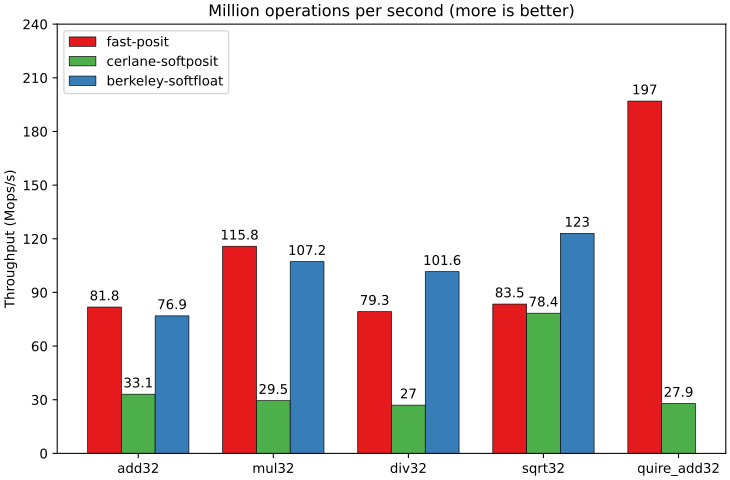
Needless to say, both absolute performance and relative performance vs the FPU will vary depending on your system.
This crate includes benchmarks; run them with cargo bench -F bench.
Structs§
- Posit
- A posit floating point number with
Nbits andESexponent bits, optionally with a maximum regime sizeRS(making it a b-posit). - Quire
- A quire, for a posit type with
Nbits andESexponent bits, which isSIZEbytes long.
Traits§
- Int
- The trait for the underlying machine integer types that can be used to represent a posit
(only satisfied by
i8,i16,i32,i64, andi128). - Round
From - Used to do value-to-value conversions using the rules prescribed for that conversion in the
posit standard, which may round the input (see below). It is the reciprocal of
RoundInto. - Round
Into - Used to do value-to-value conversions using the rules prescribed for that conversion in the
posit standard, which may round the input (see below). It is the reciprocal of
RoundFrom.
Type Aliases§
- p8
- Standard-defined 8-bit posit (with 2-bit exponent and unbounded regime).
- p16
- Standard-defined 16-bit posit (with 2-bit exponent and unbounded regime).
- p32
- Standard-defined 32-bit posit (with 2-bit exponent and unbounded regime).
- p64
- Standard-defined 64-bit posit (with 2-bit exponent and unbounded regime).
- q8
- Standard-defined 128-bit quire for a p8.
- q16
- Standard-defined 256-bit quire for a p16.
- q32
- Standard-defined 512-bit quire for a p32.
- q64
- Standard-defined 1024-bit quire for a p64.