Expand description
§Delta Arrow Reader
Delta Lake in. Arrow batches out. No Spark required.
Delta Arrow Reader is a read-only Rust library that streams Delta Lake data as Arrow batches, with optional SQL through DataFusion.


The Delta Arrow Reader documentation has guided examples and design details.
§When to use it
Delta Arrow Reader is meant for Rust services, command-line tools, and data pipelines that read Delta Lake tables. It is a good fit when:
- You need to read a large table without holding all of it in memory.
- You want to process each batch as soon as it arrives.
- Your application already works with Arrow data.
- You want to run SQL through DataFusion.
§Why not…
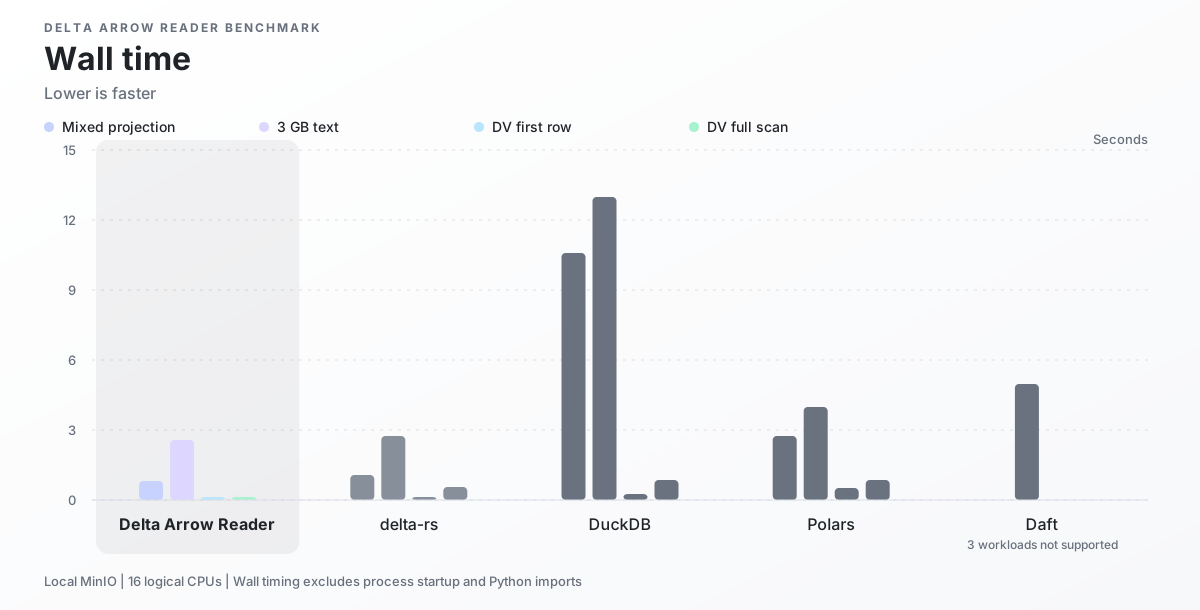
Delta Arrow Reader has one job: read Delta tables and stream Arrow batches. The alternatives below do much more, and their Delta paths carry that extra weight.
§Spark or Trino
Spark is where Delta Lake grew up, and Trino is a proven distributed query engine. If a cluster is already part of your system, either can fit well. If you only need a small, single-node read service, neither does. You would still carry a JVM, a full query runtime, and the operational machinery of a distributed system just to stream Arrow batches.
§The “read everything” engines
DuckDB, Polars, and Daft aim to be one engine for many formats. For Delta reads, the results were poor. DuckDB took 5.8-14.6 times as long as Delta Arrow Reader, and Polars took 1.7-20 times as long. Daft managed only the text projection out of four workloads; it took 2.1 times as long and rejected the deletion-vector tables. All three also used more memory in every comparable run. See the benchmark setup and complete results.
§delta-rs
delta-rs is the closest alternative, but it also covers the full Delta lifecycle, including writes. Delta Arrow Reader narrows that scope to asynchronous reads, bounded memory, Arrow streaming, and efficient deletion vectors. Across the two projection workloads, Delta Arrow Reader ranged from roughly even with delta-rs to finishing 24% sooner. On deletion-vector tables, delta-rs took three times as long to return one live row and seven times as long to scan the full table.
That gap matters because Databricks now recommends deletion vectors for most tables and is rolling out automatic enablement for new tables.
§Installation
Add the reader, Tokio, and the futures utilities used by the example:
cargo add delta-arrow-reader futures-util
cargo add tokio --features macros,rt-multi-thread
For DataFusion, follow the DataFusion installation instructions to add the matching dependencies.
§Read a table
Load a table and consume its batches from asynchronous code:
use delta_arrow_reader::DeltaTableBuilder;
use futures_util::TryStreamExt;

let table = DeltaTableBuilder::new("/tmp/example-delta-table")
    .load_table()
    .await?;
let mut batches = table.scan().build().await?.into_stream();

while let Some(batch) = batches.try_next().await? {
    println!("rows={}", batch.num_rows());
}
Loading a table selects the latest or requested version and reads its schema. By default, the reader evaluates Delta scan metadata, which it uses to choose files, each time it builds a scan. For repeated queries against the same loaded table, eager scan-metadata initialization caches that metadata in memory when the table loads. Later scans can reuse the cache through either the streaming API or DataFusion. Each scan still reads its Parquet data separately when it runs.
The streaming reader quickstart shows how to select columns, filter rows, limit results, and inspect metrics.
§Query with DataFusion
Enable the datafusion feature to query a Delta table through a DataFusion
SessionContext. Registration gives an already loaded table a name in
DataFusion. It does not change when the reader evaluates scan metadata, and
Parquet data is read only when DataFusion executes a query.
The DataFusion quickstart walks through registration and a first SQL query. It also shows how to reuse scan metadata across SQL queries.
§Scope
The reader can load the latest or a selected table snapshot. It supports column selection, row filters, result limits, deletion vectors, bounded read scheduling, and optional DataFusion integration.
It does not write Delta tables, manage transactions, create a Tokio runtime, or provide Delta Funnel orchestration, reporting, or Python APIs.
§Documentation
- Streaming reader quickstart
- DataFusion quickstart
- Architecture
- Execution options
- Scan metrics
- Reader benchmarks
- Rust API reference
§Development
For local checks and documentation setup, see the development guide.
Modules§
- datafusion
- Optional DataFusion table-provider and registration surface.
- guides
- Guides for getting started and understanding how the reader works.
Structs§
- Delta
Batch Stream - Pull-driven stream of finalized logical Arrow batches from one Delta scan.
- Delta
Protocol - Protocol metadata captured from one immutable Delta snapshot.
- Delta
Scan - One immutable, single-use streaming Delta scan plan.
- Delta
Scan Builder - Configures one single-use streaming Delta scan.
- Delta
Scan Execution Options - Bounded execution settings for one Delta scan.
- Delta
Scan Metrics - Shared live metrics for one Delta scan.
- Delta
Scan Metrics Snapshot - Immutable point-in-time copy of one Delta scan’s metrics.
- Delta
Table - One immutable loaded Delta table snapshot.
- Delta
Table Builder - Configures and loads one immutable Delta table snapshot.
- Delta
Table Snapshot - Loaded Delta snapshot metadata awaiting logical Arrow schema conversion.
Enums§
- Delta
Comparison - Comparison operation in a Delta predicate.
- Delta
Predicate - Query-engine-neutral Delta predicate.
- Delta
Reader Error - Redacted failure returned by reader APIs.
- Delta
Reader Phase - Reader operation phase associated with an error.
- Delta
Scalar - Non-null scalar value in a Delta predicate.
- Delta
Snapshot Selection - Delta snapshot selected for a table load.
- Parquet
Reader Backend - Backend used to read Parquet data files.
- Warmup
Mode - Selects how much work table loading performs before returning.
Constants§
- VERSION
- The crate version.
Type Aliases§
- Delta
Storage Options - Storage options forwarded to Delta object-store construction.